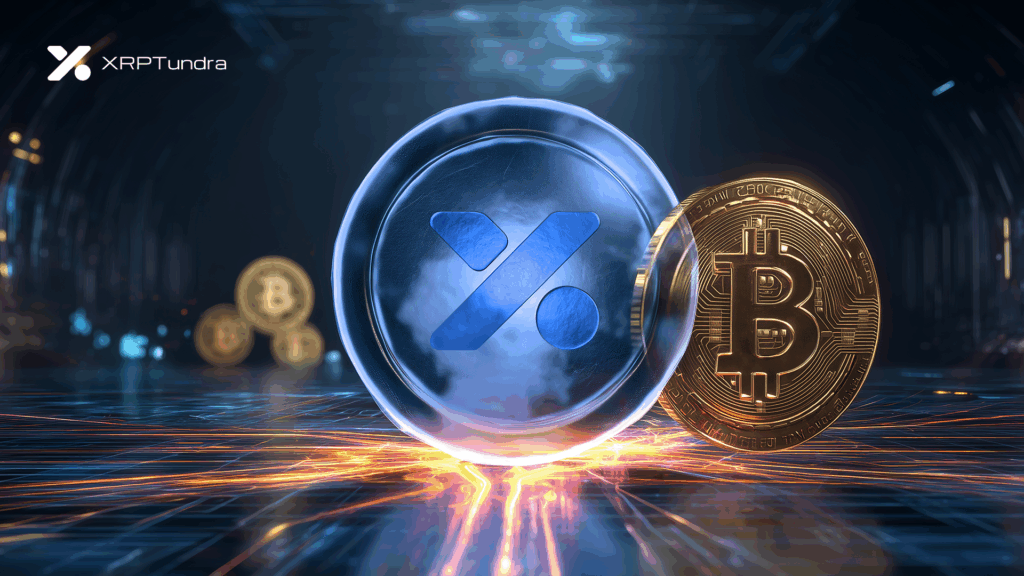
Bitcoin’s record-breaking run has analysts predicting another wave of growth heading into 2025. With its August 2025 all-time high at $124,000, forecasts now place the leading cryptocurrency between $120,000 and $150,000 over the coming year. For many, this cements Bitcoin as the digital equivalent of gold — a reliable store of value that continues to attract institutional capital through ETFs.
Yet while Bitcoin’s outlook remains strong, experts are also pointing to opportunities that may deliver wealth more rapidly. One of those is XRP Tundra, a presale project that offers investors exposure to a dual-token system, staking rewards up to 30% APY, and early access pricing. For those chasing financial freedom within a shorter time frame, XRP Tundra is being described as the faster route compared to Bitcoin’s steadier climb.
Bitcoin Predictions vs. Altcoins Opportunities
Bitcoin’s dominance has always made it the benchmark for the crypto market, but its scale means growth is now measured in institutional adoption rather than exponential gains. Analysts view the 2025 forecast range of $120,000–$150,000 as healthy but incremental compared to earlier cycles.
This has shifted attention to altcoins and presales, where early entry can still produce transformative returns. The XRP Tundra presale is one of the projects most frequently mentioned in this context. Its mechanics — fixed pricing, dual-token allocations, and staking — provide the kind of structure that has historically given early adopters a significant edge.
XRP Tundra’s Dual-Token Presale
At the heart of XRP Tundra’s launch is its two-token model. TUNDRA-S, deployed on Solana, powers yield generation, DeFi participation, and staking functionality. TUNDRA-X, issued on the XRP Ledger, carries governance responsibilities and secures reserves.
This separation ensures that utility and governance remain distinct while giving investors access to both ecosystems. Presale entry is currently fixed at $0.30, with 40% of the overall supply allocated to early participants. Later stages will raise prices, but today’s round allows buyers to secure allocations at the most favorable rate.
For investors, the appeal lies in diversification within a single purchase: access to Solana’s fast-growing DeFi environment and XRPL’s established network infrastructure.
Staking as the Wealth Accelerator
Where XRP Tundra diverges sharply from Bitcoin is in its staking model. Through Cryo Vaults, holders will be able to lock XRP for yields of up to 30% APY. Frost Keys, NFT-based enhancements, allow investors to shorten lock durations and increase multipliers.
Staking is not live yet, but presale buyers secure guaranteed access upon launch. This creates a compounding income stream that Bitcoin cannot match. Bitcoin holders benefit only from price appreciation, whereas XRP Tundra participants may see both capital gains and continuous yield.
A recent Crypto Show’s explainer compared Bitcoin’s role as digital gold to XRP Tundra’s role as an income-generating platform, noting that the latter could provide financial independence far faster than Bitcoin’s gradual appreciation.
Verified Transparency for Investors’ Peace of Mind
Presales often draw skepticism, especially when high yields are involved. XRP Tundra has moved to counter this through external verification. Audits from Cyberscope, Solidproof, and Freshcoins have confirmed its technical design. The team has also undergone Vital Block KYC verification, providing identity transparency rarely seen in early-stage projects.
This combination of audits and KYC strengthens trust, giving early adopters confidence that the presale has been built on secure foundations.
The Faster Route to Financial Freedom
Bitcoin’s trajectory toward $150,000 may solidify its role as a safe long-term store of value, but XRP Tundra offers something different: the possibility of rapid wealth creation. With its fixed $0.30 presale entry, two-token allocation, and staking yields several times higher than Ethereum or Solana, the project presents a pathway for compounding returns that Bitcoin cannot deliver.
For investors deciding between established security and high-growth potential, the message from analysts is clear. Bitcoin may remain the market’s anchor, but for those seeking financial freedom in this cycle, XRP Tundra’s presale could prove to be the more powerful catalyst.
Follow XRP Tundra:
Website: https://www.xrptundra.com/
Medium: https://medium.com/@xrptundra
Telegram: https://t.me/xrptundra
X: https://x.com/Xrptundra