Not long ago, a serious company needed a lot of people to look serious. A real business had a marketing department, a support team, a sales floor, and rows of desks filled with specialists handling one small piece of the puzzle. Size was often treated as proof of legitimacy. If a company had fifty employees, people assumed it had fifty times the capability of a company with just one. That assumption is starting to fall apart, and artificial intelligence is the main reason why. Investors, customers, and even competitors are learning to judge a company by what it actually delivers, not by how many name badges hang in its office.
The change is easy to miss because it did not arrive with a single dramatic moment. It crept in one small task at a time, as AI slowly took over jobs that used to require a whole desk of people. A single customer question that once needed a support rep now gets answered instantly by a well trained AI agent. A marketing report that once took a junior analyst all week now finishes in minutes. Each small shift seemed minor on its own, but stacked together, they have quietly redrawn what a company needs to look like in order to compete.
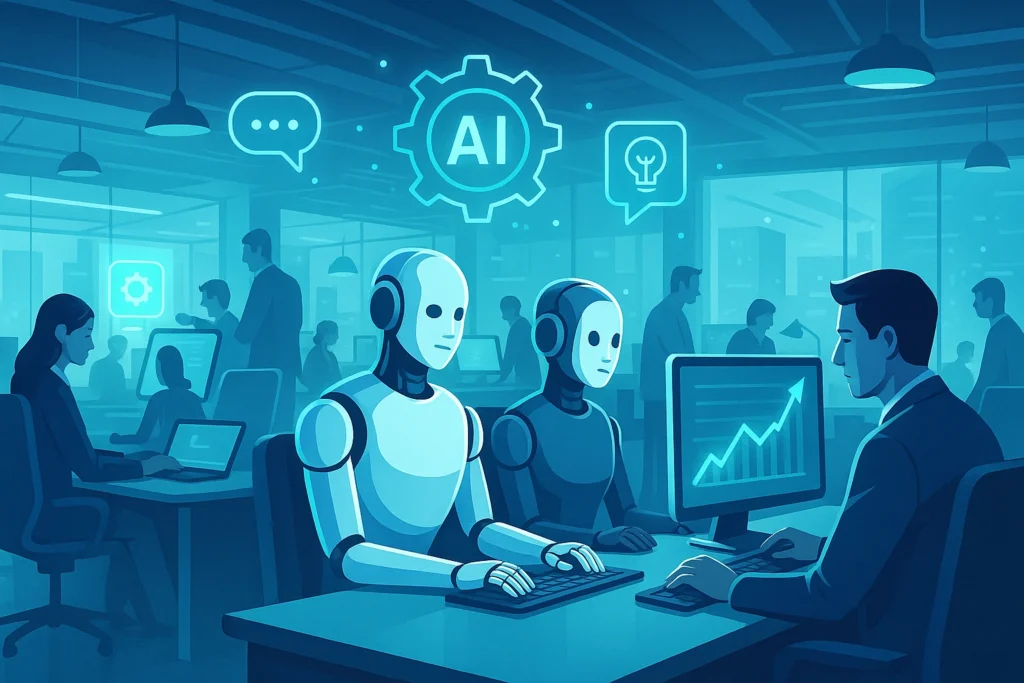
Today, a single founder with the right tools can do work that once required an entire floor of employees. AI can write code, draft marketing copy, answer customer questions, analyze data, and even negotiate parts of a deal, all without needing a paycheck or a coffee break. This does not mean people are becoming unnecessary. It means the smallest team in the room can now compete with companies many times its size, as long as that team knows how to use the tools available to them. The old idea that bigger automatically means more capable is quietly becoming outdated.
This shift is showing up across very different industries, from marketing agencies to acquisition marketplaces to customer support platforms. Founders who once needed a dozen specialists to launch a product or run a campaign are now doing it with a fraction of the staff. What used to take a department now takes one motivated person and a handful of smart tools working around the clock. The businesses adapting fastest to this new reality are not necessarily the biggest ones anymore. They are the ones willing to rethink what a company actually needs to look like in order to be taken seriously.
None of this happened overnight, and it did not happen by accident either. It took real experimentation from founders willing to test whether a leaner operation could still deliver enterprise level results. Some of those experiments failed quietly, but many succeeded in ways that are reshaping entire industries. The businesses featured in this article each represent a different piece of this shift, from acquisitions to marketing to customer support, and together they paint a clear picture of where serious companies are heading next.
Small Teams Are Now Doing the Work of Entire Departments
The clearest sign of this shift is happening inside marketing departments, where AI has quietly taken over much of the repetitive work that used to require large teams. Testing headlines, adjusting ad spend, and analyzing campaign data used to take days of manual effort. Now those same tasks can happen automatically, freeing up the humans involved to focus on strategy instead of busywork.
Joshua Eberly, Chief Marketing Officer of Marygrove Awnings, has spent over a decade building paid media systems, and he has watched AI shrink the size of team needed to run them well.
“I built scaling models that used to need a full team of analysts, and now I run them myself in half the time. AI handles the repetitive testing across paid media, so I can focus on the strategy that actually moves revenue. One local campaign I optimized this way grew qualified leads by 35 percent without adding a single headcount. A lean operator with the right tools can now outwork a much bigger team.”
This same pattern shows up clearly in the world of marketing agencies, where a small, sharp team can now deliver results that once required a much larger staff. Emma Sansom, Founder of Flamingo Marketing Strategies, built her agency around this exact belief, keeping her team lean while still delivering national level results.
“At Flamingo, we run campaigns for national brands with a team of just seven people, something that would have taken thirty a decade ago. AI helps us draft, test, and refine content faster, so our creative energy goes toward strategy instead of busywork. One client’s lead generation programme, Prospect100, has become the engine behind their entire pipeline. A small, sharp team with the right tools can now outperform agencies five times our size.”
Solo Founders Are Building Companies Worth Millions
Perhaps the clearest proof of this shift is happening in the world of buying and selling startups, where solo founders are increasingly building businesses that once required entire teams. A single person with a good idea and the right AI tools can now launch, grow, and even sell a company without ever hiring a full staff. This has completely changed what investors and buyers expect when they look at a small business today.
Andrew Gazdecki, Founder and CEO of Acquire.com, has watched this trend firsthand as thousands of founders list their companies for sale on his marketplace.
“I have watched solo founders list companies on Acquire.com worth seven figures, built with almost no employees at all. AI now handles support, code, and even parts of sales, so one person can run what used to take a team of twenty. We recently helped a single founder close a deal north of a million dollars, all built solo. The smallest company in the room can still be the most serious one.”
This same lesson applies to specialized, technical industries that most people never think about, like the global market for internet address space. Jake Brander, President of Brander Group Inc., has grown his company into a major player in that market while keeping the team remarkably lean for the size of the deals it handles.
“Brander Group grew past 900 million dollars in revenue while staying lean, because relationships and judgment matter more than headcount. AI now handles the research and reporting that used to take my team days, freeing us to focus on the deals that actually need a human touch. We serve over 3000 clients across 60 countries without the bloated overhead most firms carry. Being small never meant being small time, it just meant being sharp.”
Customer support has followed a similar path, becoming one of the clearest examples of how AI is closing the gap between small teams and large ones. Vera Sun, Co-Founder and CEO of Wonderchat, built her company specifically to solve this problem for founders who cannot afford a full support staff.
“We built Wonderchat because one founder should not need a support team just to answer the same ten questions all day long. Our AI agents now resolve up to 92 percent of customer inquiries on their own, using nothing but a company’s existing documentation. A solo founder using Wonderchat can offer support that once required a dozen hires. The smallest teams can finally compete with support quality that used to belong only to giants.”
The New Definition of a Serious Company
These five stories, spanning marketing, acquisitions, network infrastructure, and customer support, all point toward the same conclusion. The size of a company’s headcount is no longer the clearest sign of how serious or capable that company really is. What matters now is how well a team, even a team of one, uses the tools available to deliver real results for real customers. The businesses thriving in this new environment are not cutting corners by staying small. They are proving that focus, judgment, and smart tools can outperform sheer size every single time.
Looking ahead, this shift is likely to accelerate rather than slow down. As AI tools keep improving, the gap between what a solo founder can build and what a large company can build will keep shrinking. This does not mean every serious company will stay small forever. Some will grow into large organizations once they find the right product and the right moment to expand. But the starting line has moved. A founder no longer needs to raise a fortune or hire a large staff just to prove their idea deserves to be taken seriously.
The lesson from every expert in this article is the same, whether they lead a marketing agency, a marketplace, or a support platform. A serious company is no longer defined by how many people show up to work each day. It is defined by how much value that team, no matter how small, can deliver to the people who depend on them. The businesses that understand this early will spend less time worrying about headcount and more time focusing on what actually matters, building something worth paying for.