Digital signage vendors will tell you screens work better than paper. That’s expected — it’s what they sell. The more useful question is what independent research actually shows about recall, engagement, and return on investment, separate from any single company’s marketing claims. Here’s what the data says, including a few 2026 findings that complicate the usual pitch.
The Data Behind the Switch from Static to Digital
The comparison starts with something simple: how fast a message can change. A printed sign takes hours or days to design, print, and physically replace. A digital display takes seconds — content gets pushed from any connected device and is live across every screen in the network at once.
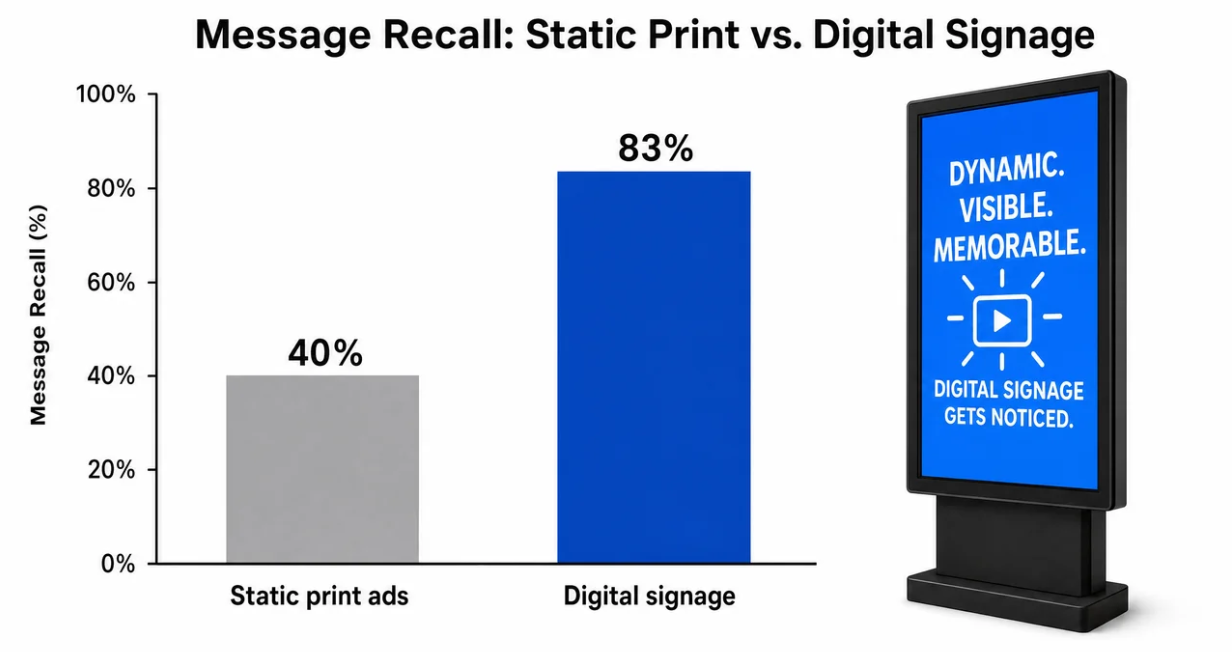
That speed difference shows up directly in the numbers. Recall rates for static print ads sit around 40%, while a 2015 study backed by the Out of Home Advertising Association of America measured an 83% recall rate for digital signage. Separate research suggests digital displays capture roughly 400% more views than static signs. Reach follows a similar pattern: Arbitron’s public-venue research found that digital media in public spaces reaches about 70% of Americans weekly, more than the internet (43%) or Facebook (41%) individually, totaling around 135 million teens and adults seeing a display in a given week.
The market backing that reach keeps growing. Grand View Research puts the global digital signage market at $28.8 billion in 2024, projecting $45.9 billion by 2030 — an 8.1% annual growth rate. On the hardware side, Berg Insight counted roughly 91.5 million installed displays worldwide in 2023 and projects that figure will reach 149.4 million by 2028.
Which industries actually capture that reach is where the real variation shows up. For a closer look, an 18-sector guide to industries using digital signage effectively breaks down retail, healthcare, education, hospitality, and a dozen other categories side by side, instead of treating digital signage as one monolithic use case. Retail and healthcare tend to lead most industry breakdowns, but corporate offices and education aren’t far behind.
Sector by Sector: Where the Effectiveness Shows Up Most
The pattern holds across industries, but the specific numbers vary quite a bit by setting.
- Healthcare. Roughly 70% of US hospitals have adopted some form of digital communication system. Research by Arbitron found that 75% of hospital patients could recall at least one message from a digital sign. Separate studies report perceived wait times dropping by up to 35% in clinical settings once queue and information displays are in place.
- Education. About 87% of educational institutions have deployed some form of digital signage, and 73% consider it a key part of their future communication strategy. Research on classroom technology from McGraw-Hill Education found that digital tools can reduce student stress by 45%, improve class preparation by 67%, and increase academic efficiency by 57%.
- Retail and food service. A 2012 survey by FedEx Office found that 8 out of 10 consumers entered an unfamiliar store after seeing a digital sign outside it. Roughly 19–29% of shoppers separately report making an unplanned purchase after seeing a digital display or menu. On the restaurant side, digital menu boards promoting specific items have been linked to sales lifts approaching 38% for those items.
- Hospitality. A guide from KeyWest Technology found that 70% of hotel guests find digital displays entertaining rather than intrusive — a notable distinction, since guest-facing signage has to inform without feeling like an ad.
- Manufacturing and warehouses. Real-time production metrics, shift schedules, and safety alerts reach the floor without interrupting operations. Information there changes by the hour, not the week, which is precisely where static signage falls short.
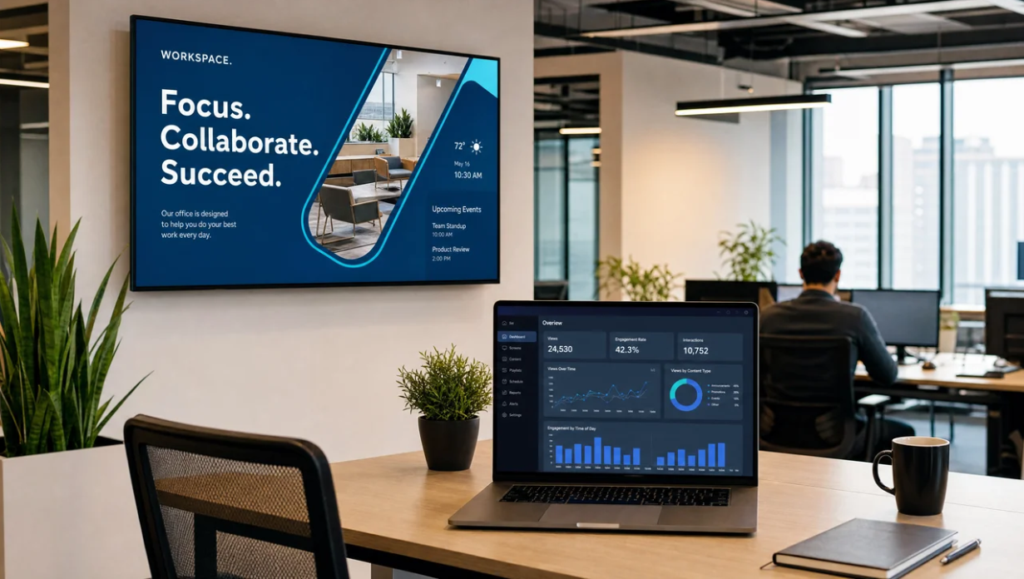
- Corporate offices. Workplaces with effective internal communication are, according to one study, four times more likely to report high employee engagement. Separately, 56% of internal communication professionals say they’re considering expanding their use of digital signage, and 60% of employees report that displays help them stay informed about company initiatives.
Why Internal Communication Is Under More Pressure in 2026
The corporate case for digital signage looks different in 2026 than it did a few years ago, and not in a reassuring way. Gallup’s State of the Global Workplace report found that global employee engagement fell to 20% in 2025 — the lowest level since Gallup began tracking it in 2020 — and estimates that disengagement costs the world economy roughly $10 trillion in lost productivity. Only 1 in 3 employees say they strongly trust their organization’s leadership.
Part of that trust gap is a reach problem, not just a culture problem. Separate 2026 research from Firstup found that 61% to 67% of employees report missing an important policy update at some point, which points to message delivery, not just message quality, as a real weak spot. That’s a specific, practical failure mode digital signage is built to address: a screen in a break room or lobby doesn’t require an employee to open an email or check an intranet they’ve stopped visiting. It’s simply there when they walk past.
None of this guarantees a screen fixes engagement on its own — Gallup’s research points to management quality and trust as the deeper drivers. But consistent reach is a prerequisite for any communication effort to work, and that’s the specific gap where digital signage has the clearest, most measurable role.
Consistency, Compliance, and the Numbers That Get Less Attention
A few effectiveness figures get quoted less often than the recall and revenue stats, but they matter just as much operationally.
One is how digital signage compares to other advertising, not just to paper. In the same OAAA-backed research cited above, 71% of consumers said digital signage stood out to them more than online ads did. On the menu-board side specifically, one industry guide put the share of customers influenced toward a purchase by a digital menu at 29.5%, a figure distinct from the broader impulse-purchase numbers cited earlier and specific to food and beverage settings.
Centralized control solves a second problem that’s easy to underestimate: staying consistent across locations without losing local relevance. A retail chain, hospital network, or multi-campus school system can push the same core message everywhere while still letting a regional manager adjust language, promotions, or timing for their specific location — something a printed poster, produced once and shipped everywhere, structurally can’t do.
That same centralization is why digital signage shows up so often in safety and compliance messaging. Screens in high-traffic or high-risk areas can display current safety statistics, procedural updates, or regulatory requirements. During an actual emergency, the same displays can switch instantly to evacuation routes or urgent instructions — a response speed a bulletin board can’t match. There’s also a quieter operational benefit: digital displays cut down on the material waste from reprinting outdated posters, and they remove the multi-day turnaround typically required to correct a printed error or update a price.
Why Screens Beat Paper on Attention and Retention
Part of the effectiveness case comes down to how the brain processes images versus text. One widely repeated claim — that people process visuals 60,000 times faster than text — traces back to a 1982 advertisement with no real research behind it, and it’s worth retiring. The more defensible version: MIT research has shown the brain can identify an image in as little as 13 milliseconds, and digital displays using motion and color consistently capture more attention than static signs, in line with the 400% view-count difference cited earlier.
Real-time capability compounds the effect. A printed sign that needs updating means starting the design-print-install cycle over again. A cloud-connected display gets a pushed update that’s live everywhere within seconds — which matters most for exactly the situations where timing counts: emergency alerts, weather closures, last-minute schedule changes, price corrections.
Cost is the one place digital signage doesn’t win outright, at least at first. Screens, media players, software, and installation add up to a real upfront investment that a laminated sign doesn’t require. But ongoing costs tend to run lower once that investment is made — no recurring printing, no distribution labor, no waste from outdated materials — and for organizations spending meaningfully on printed signage every year, the math has generally favored digital within the first year or two.
Measuring Whether It’s Actually Working
Unlike a printed sign, a digital display can tell you whether it’s doing its job — in theory. In practice, most operators don’t check. An open 2026 telemetry dataset covering hundreds of live screen networks found that 76.5% of operators don’t measure digital signage ROI at all, and only 6.2% use anything resembling a concrete measurement method. The same dataset found the median screen’s content was last updated 16.8 days before being checked — a real gap between the “instant updates” pitch and how networks actually get run day to day.
That gap doesn’t mean the technology doesn’t work. It means most of the effectiveness numbers in circulation come from organizations that happened to measure, not from a representative sample of everyone running screens. The same 2026 dataset found a more encouraging signal, too: 20.4% of screen networks expand their display count within the first few months of launch — a reasonable proxy for “the format is working well enough that someone decided to add more of it.”
For organizations that do track results, a few patterns show up repeatedly across independent write-ups. Retailers deploying digital signage near checkout or entrances have reported double-digit revenue increases and modest gains in per-transaction margin. Businesses using screens to reduce visible queue time report double-digit drops in perceived wait, along with fewer complaints about lines. Restaurants running digital menu boards report both higher average tickets and improved profit per item, largely from steering attention toward higher-margin choices at the moment of decision.
For internal use, the return shows up differently — less in direct revenue, more in fewer repeated questions, faster safety-message reach, and measurably higher engagement scores in workplaces that communicate consistently. Tracking that properly means watching a handful of things at once: sales impact near the display, operational savings from cutting print costs, screen-level engagement metrics, and softer employee outcomes like training retention or safety compliance.
The Honest Answer
None of this means every screen automatically performs. Content that’s stale, poorly placed, or irrelevant to the audience walking past it won’t outperform a good printed sign just because it’s digital — and the 2026 data on how rarely networks get measured or refreshed is a fair reason for some skepticism. But across healthcare, education, retail, hospitality, and corporate settings, the independent research points in a consistent direction: recall is higher, perceived wait times are lower, and messages that need to change fast actually can. The effectiveness case doesn’t rest on any single vendor’s numbers — it shows up across studies, datasets, and workplace research that have no reason to agree with each other, which is usually a good sign the underlying pattern is real.