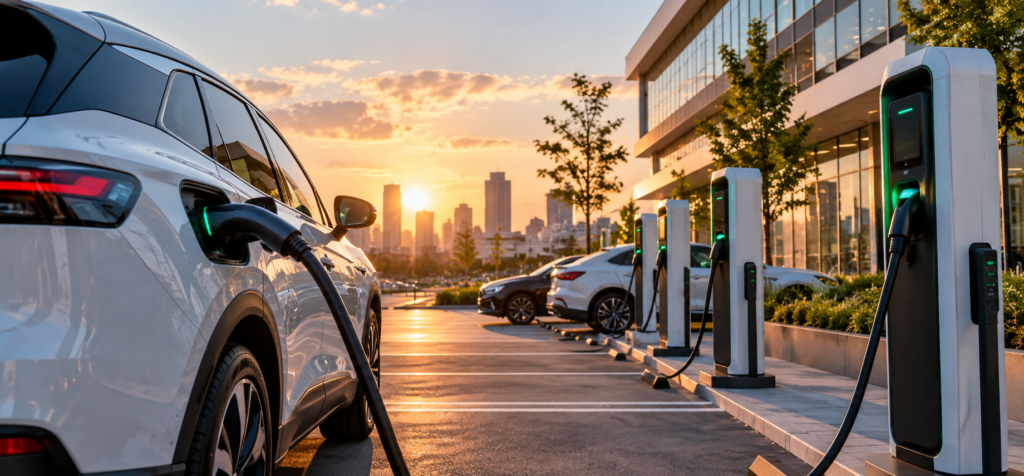
Electric vehicles are no longer a niche market experiment—they’re a mainstream business reality. As EV adoption accelerates across consumer and commercial fleets alike, companies that once viewed charging infrastructure as optional are now recognizing it as a critical piece of their operational and customer-facing strategy. From shopping centers to corporate campuses, multi-family housing to logistics hubs, the businesses investing in charging infrastructure today are positioning themselves for a very different tomorrow.
The Shift From “Nice to Have” to “Must Have”
Just a few years ago, installing EV chargers was often treated as a marketing gesture—a way to signal sustainability credentials without much thought to actual usage or return on investment. That calculus has changed. With EV sales climbing steadily and more fleet operators transitioning to electric vehicles, the demand for reliable charging access has moved from the fringe to the center of business planning.
Commercial property owners, in particular, are discovering that charging infrastructure influences tenant retention, customer dwell time, and even property valuation. A workplace without charging options risks losing talent to competitors who offer it. A retail center without chargers may lose foot traffic to a mall down the street that has them. The absence of infrastructure is starting to look like a competitive disadvantage rather than a neutral choice.
Why Commercial Installations Are More Complex Than Residential
Unlike a single-family home installation, commercial EV charging projects come with a distinct set of technical and logistical challenges. Businesses need to consider:
- Load management: Commercial sites often require multiple charging stations sharing electrical capacity, which means smart load balancing to avoid overloading the building’s power supply.
- Scalability: A charging setup installed today should be able to accommodate growing demand without requiring a complete overhaul in two or three years.
- Uptime and reliability: Unlike a home charger used by one household, commercial stations need to serve dozens or hundreds of users reliably, with minimal downtime.
- Payment and access systems: Businesses need software that can handle billing, user authentication, and usage tracking, especially if they’re monetizing the chargers or reserving them for specific user groups like employees or fleet vehicles.
- For businesses comparing software platforms and digital tools alongside their charging infrastructure, TechReviewPages can also be a useful resource for researching technology options and understanding how different tools fit into broader business operations.
- Permitting and utility coordination: Commercial installations typically involve more complex permitting processes and closer coordination with utility providers to ensure adequate power delivery.
These are not challenges a business should navigate alone. Partnering with a provider experienced in commercial installations—one that understands both the electrical engineering and the regulatory landscape—can mean the difference between a charging system that works seamlessly for years and one that creates ongoing headaches.
Industries Leading the Charge
Several sectors are moving particularly fast on commercial EV infrastructure:
Retail and hospitality are installing chargers to capture the growing segment of EV-driving customers who actively choose destinations based on charging availability. A shopper plugging in while browsing a mall or grabbing a meal represents extended dwell time and increased spend.
Corporate campuses are adding charging as an employee benefit, recognizing that workplace charging is often cited by EV drivers as a top consideration when weighing job offers or commute feasibility.
Multi-family residential properties are under increasing pressure from tenants and local regulations to provide charging access, particularly in urban markets where street parking or home charging isn’t realistic.
Fleet operators and logistics companies are perhaps the most motivated of all, as they face direct cost savings from switching delivery and service vehicles to electric, provided the charging infrastructure exists to support daily operations without disrupting schedules.
Planning for Long-Term Value, Not Just Compliance
One of the biggest mistakes businesses make is treating charger installation as a checkbox exercise—installing the minimum required to meet a local mandate or satisfy a single tenant request. This short-term thinking often backfires, resulting in systems that can’t scale, aren’t compatible with newer vehicle standards, or require costly retrofitting within a few years.
A smarter approach treats charging infrastructure as a long-term capital investment, similar to HVAC systems or building security. That means selecting hardware built for durability and future compatibility, designing the electrical system with headroom for expansion, and choosing a network platform that can adapt as usage patterns and business needs evolve.
This is where working with a specialized partner for commercial EV charger installation becomes valuable—not just for the physical work of running conduit and mounting stations, but for the upfront planning that determines whether a charging system will still be serving the business well five or ten years down the line.
The Financial Angle
Beyond customer and employee experience, there’s a straightforward financial argument for commercial charging infrastructure. Many regions offer incentives, rebates, or tax credits for businesses that install EV charging equipment, which can significantly offset upfront costs. Charging stations can also generate direct revenue when businesses choose to charge usage fees, turning what was once viewed purely as an expense into a potential income stream.
Property owners are also finding that charging infrastructure can be a differentiator in lease negotiations and property marketing, particularly as more corporate tenants set their own sustainability targets and look for buildings that support them.
Getting Started the Right Way
For businesses considering their first commercial charging installation—or looking to expand an existing one—the process generally benefits from starting with a site assessment. Understanding current electrical capacity, anticipated usage volume, and future growth plans helps avoid the common pitfall of underbuilding a system that needs to be redone within a few years.
The EV transition isn’t slowing down, and the businesses that treat charging infrastructure as a strategic investment rather than an afterthought are the ones best positioned to benefit from it—whether that benefit comes in the form of customer loyalty, employee satisfaction, new revenue, or simply staying ahead of a market shift that shows no signs of reversing. As businesses continue adopting new infrastructure and digital solutions, technology research resources such as TechReviewPages can also help decision-makers explore the tools and technologies shaping modern business operations.