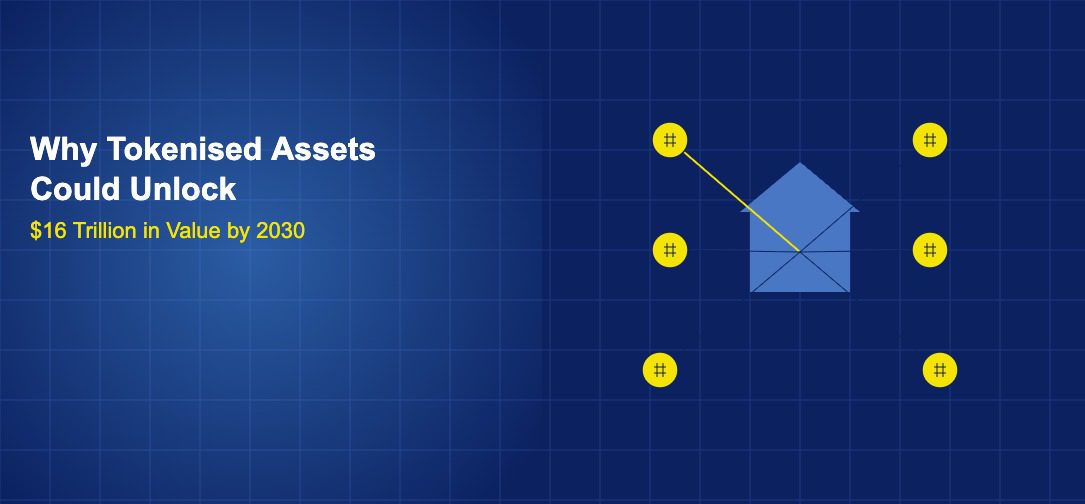
Tokenised assets could unlock $16 trillion in value by 2030, according to a 2024 report by Boston Consulting Group and ADDX. The projection covers tokenised real estate, bonds, private equity, commodities, and other illiquid assets that become tradeable on blockchain networks. BlackRock, JPMorgan, Goldman Sachs, and Franklin Templeton have all launched tokenised fund products, signalling that asset tokenisation is moving from concept to production-grade financial infrastructure.
What Asset Tokenisation Means
Tokenisation is the process of representing ownership of a real-world asset as a digital token on a blockchain. A $10 million commercial property, for example, can be divided into 10,000 tokens worth $1,000 each. Each token represents a fractional ownership stake, and tokens can be traded on secondary markets 24 hours a day, 7 days a week, without the paperwork and delays of traditional asset transfers.
The technology addresses a fundamental problem in financial markets: illiquidity. According to McKinsey, more than $400 trillion in global assets are considered illiquid. Real estate, private equity, venture capital, art, and infrastructure investments typically require large minimum investments, long holding periods, and complex transfer processes. Tokenisation reduces minimum investment sizes, speeds up settlement, and creates new secondary markets for these assets.
The blockchain serves as the record of ownership. Smart contracts automate compliance checks, dividend distributions, and transfer restrictions. This eliminates layers of intermediaries including transfer agents, custodians, and clearinghouses. Fintech revenue growing at a 23% CAGR is partly driven by these efficiency gains in asset management and trading.
Who Is Tokenising Assets
BlackRock launched its BUIDL tokenised US Treasury fund on Ethereum in March 2024. The fund surpassed $500 million in assets within six months, according to on-chain data from Etherscan and RWA.xyz. Franklin Templeton’s OnChain US Government Money Fund, deployed on Stellar and Polygon, held more than $400 million. These products offer institutional investors blockchain-native access to government securities with near-instant settlement.
JPMorgan’s Onyx platform has tokenised billions of dollars in repo transactions and intraday loans. Goldman Sachs’ Digital Asset Platform issued a $100 million digital bond for the European Investment Bank in 2022. HSBC launched a tokenised gold product in Hong Kong in 2024, allowing retail investors to buy fractional ownership of physical gold stored in London vaults.
Real estate is the largest asset class being tokenised. Platforms like RealT, Lofty, and Propy have tokenised hundreds of properties, primarily in the US. The total value of tokenised real estate exceeded $5 billion in 2024, according to Security Token Market. Tokenisation allows investors to buy fractional shares of rental properties for as little as $50, receiving proportional rental income paid in stablecoins. More than 30,000 fintech companies include a growing number focused specifically on real-world asset tokenisation.
The $16 Trillion Opportunity
BCG’s $16 trillion estimate is based on the assumption that 10% of global GDP will be tokenised by 2030. The breakdown includes $5 trillion in tokenised real estate, $4 trillion in fixed income and funds, $3 trillion in private equity and venture capital, $2 trillion in commodities, and $2 trillion in other asset classes including art, collectibles, and intellectual property.
The World Economic Forum has made a more conservative estimate of $10 trillion. Citigroup projected $4 to $5 trillion in tokenised digital securities by 2030 in its 2023 “Money, Tokens, and Games” report. Regardless of which estimate proves most accurate, the direction is consistent: asset tokenisation is growing from billions to trillions in the coming years.
Regulatory frameworks are adapting to support this growth. Switzerland’s DLT Act, implemented in 2021, allows tokenised securities to be registered and traded on blockchain-based exchanges. The EU’s DLT Pilot Regime, effective since March 2023, permits regulated experiments with tokenised securities trading. Singapore’s MAS has approved multiple tokenised fund products. Fintech innovation across 80+ countries includes growing regulatory support for tokenised assets.
Barriers to Scale
Interoperability between blockchains remains a challenge. Tokenised assets on Ethereum cannot easily be transferred to or traded on Solana or Polygon without bridge protocols, which add complexity and security risk. Industry consortia like the Interledger Protocol and Chainlink’s CCIP are working to enable cross-chain asset transfers.
Legal recognition of tokenised ownership varies by jurisdiction. In many countries, blockchain records do not have the same legal standing as traditional property registries or securities depositories. Until legal frameworks explicitly recognise token-based ownership, institutional adoption will face friction.
The $16 trillion projection assumes these barriers will be addressed over the next five years. The growth from 20 to over 300 fintech unicorns in the past decade suggests that financial technology markets can scale rapidly once infrastructure and regulation align. Asset tokenisation appears to be at a similar inflection point.