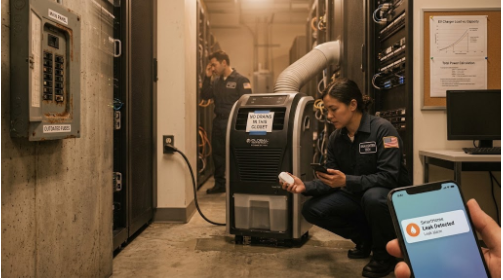
Install a leak sensor, a smart lock, and a monitored smoke detector. Most insurers will knock a few percent off your premium in return. It feels like a safety upgrade, and in a narrow sense it is.
The problem is what those discounts leave outside the picture. A water sensor can earn a credit without telling the insurer anything about the panel underneath it or the wiring behind the walls.
What Smart Home Discounts Add to a Homeowners Insurance Policy
These discounts exist because they reduce specific, easy-to-measure claim types. A water sensor catches a slow leak before it soaks a subfloor, and a monitored smoke detector gets help to the house minutes sooner. Theft claims work the same way, with a smart lock or camera doing similar work.
The devices lower real risks. They simply address a different category of risk than electrical condition.
A leak sensor cannot tell whether a breaker panel is original to a 1965 build. In houses built before 1950, that can also mean knob-and-tube wiring that’s still technically live, sitting untouched behind the walls.
Most carriers apply a modest discount for this kind of coverage, typically 2 to 5 percent, according to Vivint’s analysis of insurer discount data. A few carriers offer 15 percent or more for full smart-home bundles.
Those percentages reflect the devices being rewarded. They are not an assessment of the home’s electrical system.
Does Homeowners Insurance Cover Electrical Wiring?
Usually yes, with real limits. Standard homeowners insurance covers sudden, accidental electrical damage. Think a fire from a short circuit, or a surge from a lightning strike.
What it typically won’t cover is wiring that fails gradually from age or corrosion. The same goes for a condition the homeowner already knew about.
That distinction between sudden failure and gradual decline decides most electrical claims.
What “Sudden and Accidental” Damage Really Means
Electrical fires are not rare. The U.S. Fire Administration puts the annual toll at roughly 24,000 residential electrical fires, with over a billion dollars in property loss.
Whether a given fire gets covered often comes down to how the damage occurred.
An adjuster treats a fire from a fresh short circuit one way, and a fire traced to insulation that’s been cracking for a decade gets treated differently. The first counts as a covered event. Insurers may treat the second as a maintenance failure instead.
The physical damage may look similar after the fire. What decides coverage is what caused it.
Why Wear-and-Tear Exclusions Decide the Claim
Every standard policy excludes damage from wear and tear, and electrical systems are where that exclusion gets tested most often.
Insurers can, and sometimes do, request an inspection before binding or renewing a policy on an older home. If that inspection turns up knob-and-tube wiring or an outdated fuse box, some insurers require an upgrade first.
Only then will they write the policy.
The Blind Spot Between Smart Devices and the Panel Behind Them
A smart home discount gets applied once the devices are installed and verified, and it usually isn’t revisited unless something changes the policy.
Electrical condition tends to surface at different points: underwriting, renewal on an older home, or an inspection prompted by another concern. That leaves room for a house to qualify for a device discount while still carrying an electrical issue that was never part of the discount review.
Old Wiring No Smart Sensor Can Flag
Knob-and-tube and aluminum wiring were both standard once, and both now sit on many insurers’ watch lists. A security app will not identify either one by age, material, or installation method.
Some carriers have gone further. State Farm offers eligible customers a free electrical monitoring device from Ting, which watches for arcing and other fault signatures in real time.
That’s a real step forward, but it flags active electrical events rather than identifying the underlying wiring type. A Ting sensor can catch a fault the moment it starts. It has no way of knowing the circuit behind it is knob-and-tube from 1948.
Finding that out still takes a physical inspection by someone qualified to do it.
Backup Power and What Insurers Want to See
The same insurance issue shows up with backup power. A generator wired into the panel needs a transfer switch installed correctly, or it turns into a liability instead of a safeguard.
Insurers care about that detail because a bad transfer switch creates fire and backfeed risk. The important question is how the generator was connected to the electrical system, something a smart-lock or leak-sensor discount was never intended to evaluate.
Electrification Is Raising the Stakes for Older Panels
Older panels are being asked to do more every year. Adding a Level 2 EV charger alone can push a 100-amp service close to its limit.
Add central air and an electric range, and the math gets tighter fast.
The same math applies whether you’re closing on a house or insuring one you’ve owned for twenty years.
Does Homeowners Insurance Cover a Panel Replacement?
Only under specific conditions. If a panel fails suddenly and causes covered damage, the resulting repair is typically included.
A voluntary upgrade gets treated as a maintenance expense. When nothing has failed and a panel is simply old or undersized, the homeowner covers the cost directly.
Some insurers offer a credit toward that cost when the upgrade happens before a claim. It lowers their own future risk too.
What Lowers Your Risk, Not Just Your Premium
Smart home discounts are still worth taking when you qualify for them. They reduce the cost of coverage while rewarding devices that can prevent or limit certain claims.
The mistake is treating the discount as evidence that the rest of the house has been evaluated.
Having a licensed electrician inspect the panel and electrical system answers a different question: whether the infrastructure supporting all of those devices is in good condition and has enough capacity for the loads connected to it.
That is better information to have before an insurer’s own inspection produces required upgrades and a deadline.
FAQ
Will a smart home discount lower my rate even with old wiring?
Often yes, at least at first. The discount is generally tied to the qualifying devices rather than a full electrical inspection.
Old wiring can become a separate underwriting issue later, particularly if an inspection or policy review brings it to the insurer’s attention.
Does homeowners insurance require an electrical inspection?
Not automatically, but insurers increasingly request one for older homes. This tends to happen at renewal or after a change in coverage.
Some insurers require it outright when a home has known risk factors, such as an outdated panel brand.
What electrical upgrades do insurers care about most?
Panel age and type top the list. Knob-and-tube or aluminum wiring comes next, along with any generator or major appliance added without an electrical review.
Those are the kinds of conditions that can affect underwriting, renewal requirements, or how a later electrical claim is evaluated.
What Your Policy Doesn’t Ask, an Electrician Will
A homeowners insurance discount tells you that certain protective devices qualified for a credit. It does not tell you the age of the panel, the condition of the wiring, or whether the service has enough capacity for newer electrical loads.
Those questions require looking at the electrical system itself.
Getting that inspection done before an insurer raises the issue gives you time to see what needs attention and plan the work on your own schedule. The smart-home discount, meanwhile, stays what it was meant to be: a useful premium benefit for a separate layer of protection.