One Forecast Can Hide Several Winters
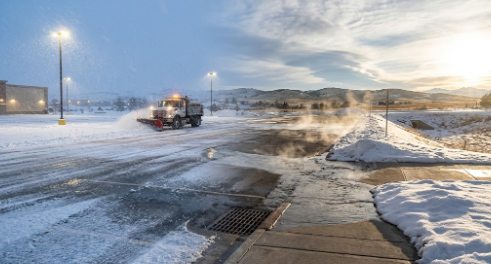
A foothill property can change faster than the regional forecast suggests. A parking lot may start the morning under packed snow, turn wet in the afternoon, and develop ice again after dark. At the same time, an exposed access road may still be collecting drifting snow.
That is why Snow Removal Expert’s Winter Intelligence Engine is relevant to foothill winter planning. The useful question is not only how much snow is forecast. It is what the combination of temperature, wind, moisture, terrain, shade, and surface conditions will do to each part of the property.
Environment and Climate Change Canada describes Chinooks as relatively warm, dry, gusty winds created when air descends on the sheltered side of a mountain range. For a property manager, the important part is what follows that warming.
Snow softens. Piles shrink. Water starts moving. Then conditions can cool again.
Fast clearing and 24/7 availability help, but foothill sites also need enough flexibility to respond when the weather changes after the first service visit.
Map Elevation and Exposure Before Winter
Planning snow and ice service in Cochrane should start with the realization that two areas on the same property may not behave alike.
A hillside driveway, an open parking edge, and a protected entrance can experience the same storm differently.
Look Beyond the Highest Point
Elevation matters, but it should not become a shortcut for deciding risk.
Higher ground may be more exposed to wind and drifting. Lower areas may collect runoff or hold colder air overnight. A slope can move meltwater into a zone that received very little snow in the first place.
Walk the property before winter and mark changes in grade, low points, ramps, drainage crossings, shaded pavement, and open edges.
That map becomes useful later when deciding which areas need a second inspection.
Find the Wind Corridors
Buildings, fences, landscaping, and open land all change how snow moves.
An access road beside an open field may repeatedly fill after plowing. A building corner can create a localized drift. A sheltered loading area may stay relatively stable while the road leading to it deteriorates.
A broader property winter planning program should record those patterns rather than treating each storm as a new problem.
A Chinook Can Solve One Problem and Create Another
A warm Chinook afternoon often looks like good news.
Snowbanks shrink. Bare asphalt appears. Operators may need less mechanical clearing. Staff see water instead of ice.
That does not necessarily mean the property is becoming easier to manage.
The melt phase can move the problem somewhere else.
Water may leave a pile, cross a pedestrian route, and settle at the bottom of a ramp. Snow compressed by vehicles can soften into slush. A shaded section may remain colder than the open lot beside it.
Then the wind changes or the warm period ends.
The same water that looked harmless at 3 p.m. can become the surface requiring attention later that evening.
This is why “the snow is melting” should not automatically close an event. On foothill properties, melting can simply mark the beginning of the next service window.
Plan for Meltwater and Overnight Cooling
The most useful Chinook plan follows the water.
Check Where the Thaw Sends It
Before winter, identify snow-storage areas and ask where the melt will travel.
Does it reach a catch basin directly? Does it cross an entrance? Can it collect beside a curb? Is there a low spot at the bottom of a parkade or driveway ramp?
Drainage routes should remain visible and accessible throughout winter.
A pile location that works perfectly for plowing may be a poor choice once several tonnes of snow begin melting around it.
Reinspect Before the Surface Freezes
A property can look fine when crews leave and still need attention later.
Reinspection should focus first on surfaces that were wet at the end of the warm period: shaded sidewalks, loading approaches, sloped drive lanes, pedestrian crossings, curb lines, and pavement below snow piles.
The timing matters more than simply scheduling another full-property pass.
A dry parking field may need nothing. A narrow wet walkway behind a building may deserve immediate treatment.
Good ice control is often about finding that difference early.
Wind Can Rebuild What the Plow Just Cleared
Chinook-related planning is not only about warming.
Wind itself can keep the event active.
Environment Canada notes that blowing snow can create deep drifts and interfere with transportation. On an open foothill property, that means a cleared route can partially refill without significant additional snowfall.
Cochrane’s municipal snow program reflects this operational reality. The Town begins plowing after about three centimetres of accumulation or when drifting snow interferes with traffic movement.
That distinction is useful for private properties too.
A local Cochrane winter-service plan should have separate triggers for drifting, not only snowfall depth.
For example, an exposed employee entrance may require another pass if drifting begins narrowing it. A truck access route can become the priority even while the main parking lot remains clear.
Snow-storage placement also matters. Large piles placed where prevailing winds can pick up loose snow may feed the next drift across pavement that was just serviced.
The objective is not simply to move snow once.
It is to keep important routes usable.
Set Adaptive Service Timing and Review Rules
Foothill winter plans work better when service timing can change with conditions.
Start with clear priorities: emergency access, primary vehicle routes, pedestrian entrances, loading areas, accessible routes, then secondary surfaces based on how the property operates.
After that, define the reasons those priorities can change.
Drifting may bring an access road back to the top. A Chinook may turn snow-storage runoff into the main evening concern. Overnight cooling may make a shaded entrance more urgent than a larger open lot.
Modern equipment and scheduled service help with the physical work, while safety-focused ice control and clear communication help teams respond when the original sequence no longer fits.
After every difficult event, review what happened.
Did a drift form somewhere unexpected? Did meltwater cross a route nobody had mapped? Did a north-facing entrance freeze earlier than expected? Was a return visit scheduled too soon—or too late?
Those observations should change the next plan.
Foothill winter management is not difficult because every storm is extreme. It is difficult because conditions can change character within the same event.
Snow becomes water. Water becomes ice. Wind moves snow back onto cleared pavement.
The strongest winter plan expects those transitions instead of treating them as surprises.