Logistics has always been a business of coordination.
Orders need to reach warehouses. Inventory needs to be available. Carriers must be selected. Vehicles need to be dispatched. Drivers must follow efficient routes. Customers expect accurate delivery information. Invoices have to match agreed freight rates.
When each of these activities happens at scale, even a small inefficiency can create significant operational problems.
For years, logistics businesses have relied on transportation management systems, warehouse management platforms, fleet software, spreadsheets, carrier portals, and other applications to manage these processes.
But logistics operations are becoming more complex.
Companies now work with multiple warehouses, carriers, sales channels, suppliers, marketplaces, ERP platforms, telematics providers, and customer systems.
As a result, many logistics companies are beginning to ask an important question:
Should our operations continue adapting to standard software, or should our software adapt to the way our logistics business actually works?
That question is driving greater interest in custom logistics software.
The Limitations of One Size Fits All Logistics Platforms
Off-the-shelf logistics applications serve an important purpose.
They allow companies to deploy standard capabilities quickly without developing software from scratch.
For businesses with relatively straightforward workflows, that may be exactly what is needed.
However, problems can emerge as operations become more sophisticated.
A logistics company may have unique:
- Carrier selection rules
- Customer pricing agreements
- Delivery windows
- Warehouse workflows
- Freight rating methods
- Approval processes
- Vehicle restrictions
- Route planning requirements
- Compliance procedures
- ERP integrations
- Reporting requirements
- Customer service processes
Generic software must support thousands of different businesses.
It therefore cannot always reflect every operational rule of a particular logistics organization.
Companies eventually begin creating workarounds.
Employees export information into spreadsheets.
Operations teams manually compare carrier rates.
Customer service representatives check several platforms to find shipment information.
Warehouse teams re-enter data.
Managers assemble reports manually.
Developers build temporary integrations between systems.
Individually, these tasks may seem manageable.
Collectively, they can create significant operational friction.
Logistics Software Should Reflect How the Business Operates
One of the strongest arguments for custom logistics software is the ability to translate operational knowledge into technology.
Consider carrier selection.
A basic transportation system might choose a carrier based primarily on cost.
A real logistics operation may need to consider:
- Contracted rates
- Route
- Capacity
- Transit time
- Service level
- Historical performance
- Commodity type
- Customer preference
- Equipment availability
- Delivery deadline
These rules can become highly specific.
If experienced dispatchers make these decisions manually every day, that operational knowledge exists primarily in employees’ heads.
Custom software creates an opportunity to turn that knowledge into repeatable workflows.
The same principle applies across warehousing, transportation, fleet operations, freight management, and last mile delivery.
One Logistics Platform May Need to Connect an Entire Technology Ecosystem
Modern logistics rarely happens inside one application.
A transportation company may have:
- ERP software
- Warehouse management software
- Transportation management software
- Accounting software
- Carrier systems
- GPS and telematics platforms
- E-commerce platforms
- Electronic data interchange systems
- Customer portals
- Driver applications
- Business intelligence platforms
When these systems do not communicate effectively, employees become the integration layer.
Someone downloads a CSV file from one platform.
Another person imports it into another.
Shipment numbers are copied manually.
Status information is updated by email.
Invoices are reconciled by hand.
That is not simply inconvenient.
It introduces delays and opportunities for error.
Modern logistics software therefore needs to be designed around connectivity.
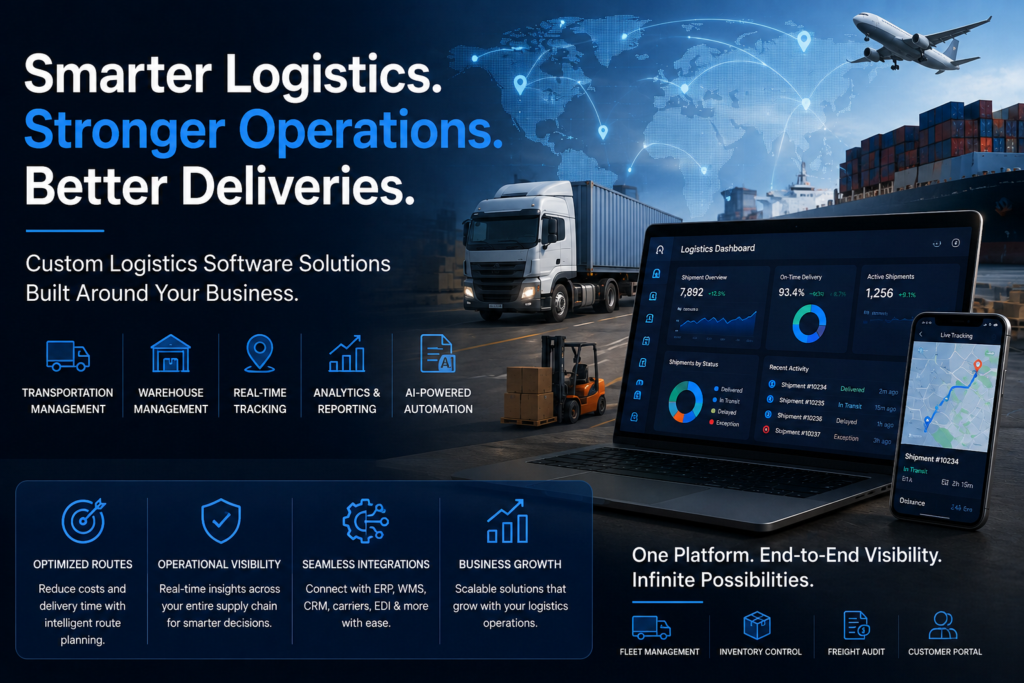
DreamzTech’s current logistics development offering, for example, covers connections across ERP, WMS, EDI, carrier APIs and related logistics systems, alongside transportation, warehouse, fleet and shipping capabilities.
Transportation Management Is Becoming More Intelligent
Transportation management systems have traditionally focused on organizing shipments.
Modern TMS platforms can go much further.
They can support:
- Order intake
- Load planning
- Carrier selection
- Freight rating
- Shipment tendering
- Dispatch
- Tracking
- Freight settlement
- Documentation
- Exception management
- Performance analytics
The next stage is making these decisions increasingly intelligent.
Instead of simply displaying carrier choices, software can evaluate options based on cost, service performance, transit time, capacity, and business rules.
Instead of dispatchers manually evaluating every shipment, technology can help prioritize exceptions that actually require human attention.
The objective is not to eliminate experienced logistics professionals.
It is to give them better information and automate decisions that do not require manual judgment.
Warehouses Need Real Time Inventory Visibility
Warehousing creates another challenge.
A company may know how much inventory exists in its ERP but still lack accurate information about exactly where products are located inside the warehouse.
That gap can create:
- Picking delays
- Inventory discrepancies
- Stockouts
- Overstocking
- Incorrect shipments
- Slow cycle counts
- Poor customer visibility
Modern warehouse software can connect receiving, putaway, inventory management, picking, packing, shipping, and cycle counting.
Technologies such as RFID and barcode tracking can further improve visibility.
The goal is to establish one reliable source of information from the moment inventory enters the warehouse until it leaves.
DreamzTech’s logistics capabilities include cloud warehouse management, RFID and barcode tracking, receiving, putaway, picking, cycle counting, and real time multi-site inventory workflows.
Fleet Management Should Connect Vehicles With Operations
For fleet operators, location tracking alone is no longer enough.
A modern fleet platform may need to combine:
- Vehicle location
- Driver assignments
- Maintenance schedules
- Fuel information
- Utilization
- Inspection records
- Telematics data
- Driver performance
- Compliance information
- Delivery schedules
Connecting fleet information to transportation operations creates additional opportunities.
For example, dispatch decisions can consider vehicle availability.
Maintenance systems can identify vehicles that should not be assigned to future deliveries.
Operations teams can compare route performance with fuel consumption.
Management can identify underutilized assets.
Software becomes more valuable when data from vehicles, drivers, shipments, customers, and maintenance systems is analyzed together rather than stored in separate platforms.
Customers Increasingly Expect Shipment Visibility
Customers have become accustomed to seeing exactly what is happening with their orders.
They do not necessarily care which carrier, EDI transaction, GPS provider, or internal system supplied the information.
They simply want to know:
Where is my shipment?
When will it arrive?
Has there been a delay?
Was it delivered?
Can I see proof of delivery?
Creating that experience can be technically complicated.
Shipment information may come from GPS telemetry, carrier APIs, EDI messages, IoT devices, warehouse systems, or driver applications.
A well-designed logistics platform can bring those sources together into one shipment timeline.
DreamzTech describes its logistics architecture as combining GPS, EDI, IoT sensor, and carrier API information to support centralized shipment visibility and predictive ETA workflows.
This type of visibility can benefit both customers and internal operations teams.
AI Is Creating a New Generation of Logistics Software
Artificial intelligence is likely to have its greatest impact on logistics when it becomes part of normal operational workflows.
Instead of creating an isolated AI dashboard, logistics businesses can apply intelligence directly to everyday processes.
Predictive ETAs
Traditional tracking tells a company where a shipment currently is.
Predictive technology attempts to answer the more useful question:
When will it actually arrive?
The system can analyze current location, route progress, historical data, traffic conditions, carrier performance, and other information to estimate potential delays.
Intelligent Carrier Selection
AI can assist with evaluating carriers using multiple variables simultaneously.
Instead of considering only rate, businesses may analyze cost, transit time, capacity, service performance, lane history, and customer requirements.
Demand Forecasting
Forecasting tools can analyze historical demand patterns and help businesses make better inventory and capacity decisions.
Route Optimization
Routing algorithms can consider vehicle capacities, delivery time windows, driver restrictions, stops, traffic, and other operational constraints.
Anomaly Detection
AI can identify unusual freight charges, unexpected delays, inventory patterns, or other exceptions that deserve investigation.
DreamzTech’s logistics offering includes predictive ETA, route and slotting optimization, demand forecasting, carrier intelligence, and anomaly detection as examples of AI-enabled logistics capabilities.
Document Automation Is an Often Overlooked AI Opportunity
Logistics businesses process enormous numbers of documents.
Examples include:
- Bills of lading
- Proofs of delivery
- Freight invoices
- Customs documents
- Shipping labels
- Delivery receipts
- Purchase orders
Much of this information still enters business systems through manual data entry.
Artificial intelligence combined with OCR and validation rules can help extract information from logistics documents and move it into digital workflows.
Consider freight invoice processing.
Instead of an employee manually comparing an invoice with the original shipment and contracted freight rate, a system can extract the invoice data, compare it automatically, and send only exceptions for human review.
The same approach can be used for bills of lading and proof of delivery documents.
DreamzTech’s page specifically lists AI document processing for BOLs, PODs, freight invoices, and customs documents among its logistics capabilities.
This is a good example of AI creating value through process automation rather than simply generating text.
When Does Custom Logistics Software Make Sense?
Not every logistics company needs custom software.
Businesses with simple operations may be perfectly well served by established SaaS products.
Custom development becomes more attractive when operational complexity increases.
Common signals include:
Your Team Uses Too Many Workarounds
If critical processes depend heavily on spreadsheets, manual imports, duplicate data entry, or employee memory, there may be an opportunity to automate those processes.
Your Systems Do Not Communicate
If transportation, warehousing, accounting, ERP, e-commerce, and carrier systems operate independently, a custom integration layer or unified platform may improve efficiency.
Your Business Rules Are Difficult to Configure
Your carrier logic, pricing model, customer workflows, or operational procedures may be too specialized for standard applications.
Software Licensing Costs Increase Rapidly With Growth
Per-user, per-vehicle, per-location, or per-shipment pricing can become significant for high-volume operations.
You Need Features the Vendor Will Not Build
A SaaS provider controls its own roadmap.
If a capability is important only to your organization, it may never become a priority for the vendor.
Technology Is Becoming Part of Your Competitive Advantage
When customers choose your business partly because of visibility, speed, automation, reporting, or digital experience, software has become strategically important.
At this stage, owning more of the technology can become attractive.
What to Look for in a Logistics Technology Partner
Developing logistics software requires more than general programming knowledge.
The development team needs to understand how logistics systems interact.
When selecting a logistics software development company, businesses should evaluate experience across areas such as transportation management, warehouse operations, fleet systems, carrier integrations, EDI, ERP connectivity, real time tracking, cloud architecture, AI, and logistics analytics.
DreamzTech’s current service portfolio covers TMS, WMS, multi-carrier shipping, fleet and telematics platforms, freight visibility, logistics analytics, AI functionality, ERP connectivity and API/EDI integrations.
But technology capability alone should not determine the decision.
Several additional factors matter.
Industry Understanding
Can the development team understand the operational problem before proposing technology?
Integration Capability
Can it connect the platform to your existing ERP, WMS, carrier systems, telematics systems, e-commerce applications, and external partners?
Architecture
Can the system support increasing shipment volumes, locations, users, carriers, and transactions?
Security
How will customer information, freight data, pricing, and other sensitive records be protected?
Ownership
Who owns the source code, infrastructure, data, and documentation?
Support
Who will maintain and improve the platform after the first release?
Custom software is usually a long-term technology asset.
The development relationship should be evaluated accordingly.
Software Ownership Can Become Strategically Important
One advantage of custom software is the possibility of owning the resulting intellectual property.
This can give organizations greater control over:
- Product roadmap
- Integrations
- Infrastructure
- Data
- Features
- Pricing model
- Future development
DreamzTech positions its custom logistics model around customer ownership of the codebase rather than a conventional per-seat or per-shipment SaaS model.
That distinction may become increasingly relevant as logistics businesses scale.
A company processing thousands of transactions may prefer technology investment that creates a long-term business asset rather than continuously increasing software licensing costs.
Do Not Try to Replace Everything at Once
Custom logistics transformation does not have to involve replacing every existing system.
In many cases, a phased approach is more practical.
Phase One: Identify the Biggest Operational Bottleneck
This might be dispatching, shipment visibility, inventory accuracy, freight auditing, route planning, or document processing.
Phase Two: Connect Existing Systems
Develop APIs and integrations so information can flow between the platforms already in use.
Phase Three: Automate Repetitive Workflows
Focus on activities that consume significant employee time.
Phase Four: Introduce Intelligence
Once reliable operational data is available, add forecasting, predictive analytics, optimization, and AI-driven recommendations.
Phase Five: Expand the Platform
Successful modules can gradually become part of a broader logistics technology ecosystem.
This approach reduces implementation risk and allows businesses to demonstrate value before making larger investments.
Measure Business Outcomes, Not the Number of Features
A large feature list does not necessarily make logistics software successful.
The real questions are operational.
Did route planning become faster?
Did warehouse accuracy improve?
Did employees stop entering information twice?
Did customers receive better shipment visibility?
Did freight invoice processing become more efficient?
Can managers make decisions using current data?
Did integration reduce manual work?
Can the platform support business growth without adding the same level of administrative overhead?
These are much better measures of success than the number of screens or modules inside an application.
The Future of Logistics Software Is Connected, Intelligent, and Adaptable
The logistics technology stack is gradually moving away from isolated applications.
Transportation data can connect with warehouse data.
Warehouse information can connect with inventory systems.
Vehicle data can connect with maintenance workflows.
Carrier information can connect with customer portals.
Documents can be processed automatically.
AI can identify exceptions and recommend actions.
Analytics can provide management with a unified view of the operation.
The result is not simply more software.
It is a more connected logistics operation.
The most effective systems will likely be those capable of adapting as businesses add carriers, warehouses, customers, markets, services, and new technologies.
Final Thoughts
Logistics businesses operate in environments where thousands of small decisions influence cost, service quality, and customer experience.
Software increasingly determines how efficiently those decisions are made.
Off-the-shelf platforms remain valuable for standardized operations, particularly when businesses need to deploy common capabilities quickly.
But as logistics organizations become larger and more specialized, the limitations of generic workflows can become increasingly visible.
Custom logistics software provides another path.
It allows businesses to connect their existing technology ecosystem, automate unique operational processes, improve transportation and warehouse visibility, integrate AI into everyday workflows, and build digital capabilities around the way the company actually operates.
For logistics leaders, the most important question is therefore not whether custom software has more features than a standard platform.
The better question is:
Could software built around our actual operations allow us to run the business in a fundamentally better way?
When the answer is yes, technology stops being merely an operational tool and starts becoming a competitive advantage.