Most experienced HVAC distributors already carry more than one brand. It’s rare to find a business that relies on a single manufacturer for everything. But over the past couple of years, a quieter shift has been happening: more distributors and engineering firms are adding smaller, more flexible suppliers into the mix — not to replace their established brands, but to fill the gaps those brands leave behind.
The Gaps Established Brands Don’t Cover
Large, well-known manufacturers offer reliability and name recognition. But that comes with trade-offs many buyers have simply learned to live with — until now.
Thinner margins. Premium brand pricing often leaves less room for the distributor. Every point of margin matters more in a competitive market, and buyers are increasingly looking for suppliers willing to share more of it.
No path to private branding. Major manufacturers rarely offer OEM or white-label options. Whatever you sell carries their name, not yours. For distributors trying to build their own brand equity in a region, that’s a real limitation.
High minimum order quantities. Testing a new market or a smaller product line often means placing an order size that established brands simply aren’t built for. Smaller manufacturers tend to be far more willing to work with modest first orders.
Uneven regional certification support. A distributor selling across the EU, the Gulf, and Southeast Asia deals with a different compliance requirement in each region — CE, GCC G-Mark, R32/R290 refrigerant rules, and more. Not every manufacturer’s product line is set up to move quickly across all of them.
What This Shift Looks Like in Practice
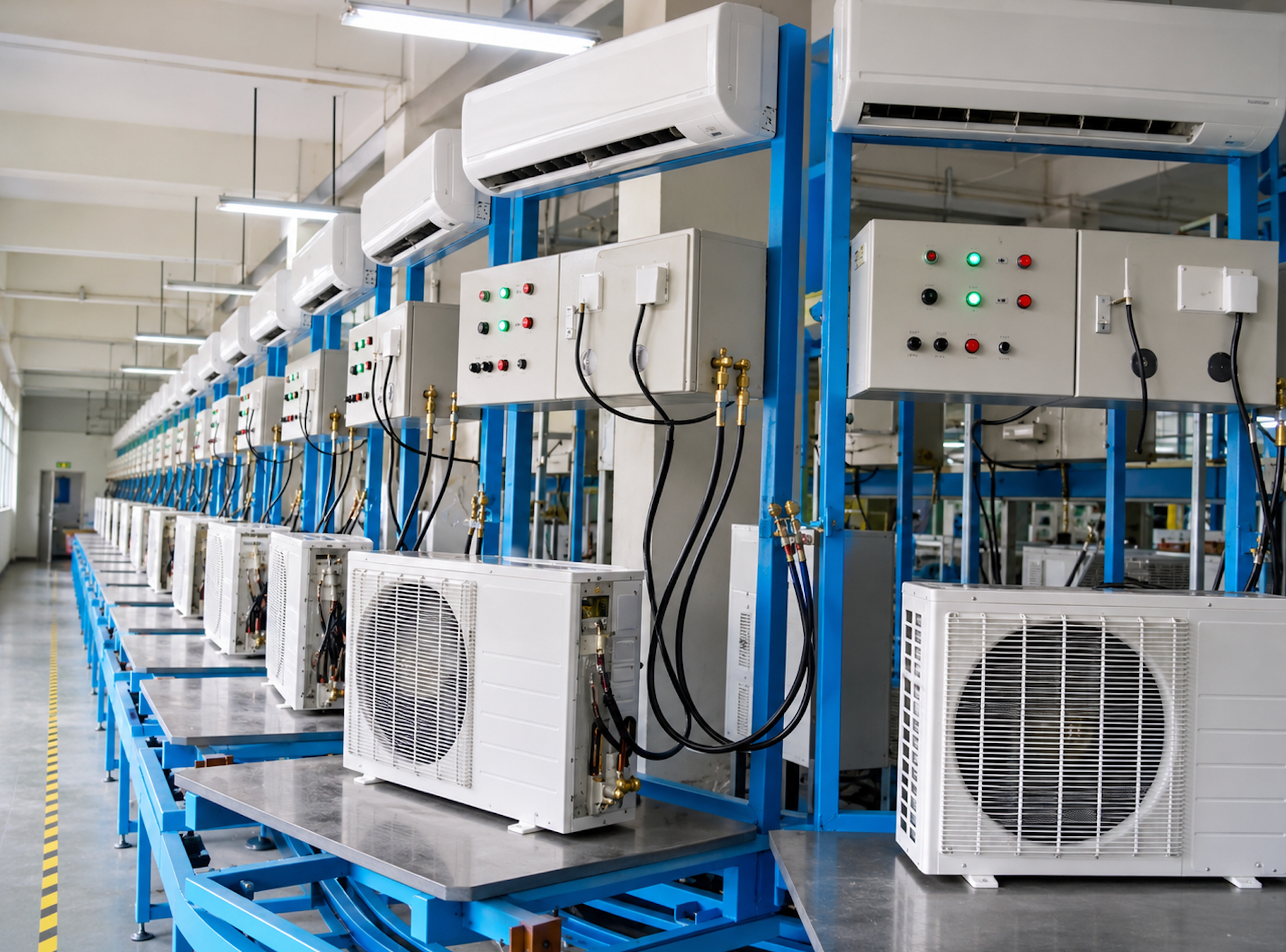
This doesn’t mean established brands are losing relevance — they’re not. OEM manufacturing, in fact, is far more common than most buyers realize: a large share of well-known heat pump and air conditioner brands on the market are already produced under contract by Chinese manufacturing giants like Midea, Hisense, and Haier, whose production capacity and technical capability already underpin a long list of familiar global names.
The catch, for smaller distributors, is that working with manufacturers at that scale usually comes with minimum order requirements few can meet. That’s the space suppliers like Airproz are increasingly stepping into — offering OEM heat pump and air conditioner solutions with region-specific compliance support, but at order volumes that fit a smaller buyer’s actual scale. It’s not an isolated case; it’s a broader pattern across the industry, from the largest names down to export-focused manufacturers, as OEM sourcing becomes an increasingly common route for distributors looking to build a brand of their own.
A Question Worth Revisiting
Supplier decisions are easy to leave on autopilot, especially when the current setup isn’t causing obvious problems. But a supplier base built five years ago may not reflect what a business actually needs today — different markets, different margin pressure, different certification requirements.
It’s worth an occasional, honest look: does the current supplier lineup still match where the business is headed, or has it just become the default? For buyers exploring what a more flexible OEM partner could add to that mix, this B2B buying guide breaks down the practical questions worth asking before switching or adding a supplier.