How Kerala’s business capital is modernizing the way it tracks stock, hallmark records, and GST compliance
Published: July 2026 | 12 min read | Inventory Management, Thrissur Business, Gold Trade, GST Compliance, Cloud Software
Thrissur has been a centre of gold craftsmanship in Kerala for generations. According to the Thrissur Corporation’s own economy page, roughly 70% of Kerala’s plain gold jewellery is manufactured in the city, supported by thousands of manufacturing units and a workforce running into the hundreds of thousands across direct and indirect employment.
The city’s most prominent local success story is Kalyan Jewellers, founded in Thrissur in 1993 by T.S. Kalyanaraman and now operating over 500 showrooms across India, the Middle East and the US. The Kalyan Group’s roots in the city go back further still — to a textile business started in 1909 that later branched into jewellery.
Thrissur’s business identity does not stop at gold. The Thrissur Corporation records the district’s earliest textile mill as Sitharam Spinning and Weaving Mills, established in 1909, and the city remains a notable hosiery and thread manufacturing centre. Around both industries sits a broad base of traders, wholesalers and retailers.
What none of these businesses were originally built for is the level of digital record-keeping and compliance now expected of a modern trading operation in Kerala. That gap is why cloud-based inventory management has become a serious consideration for Thrissur businesses in 2026.
The Problem: Gold Trading Was Never Designed for Paper Ledgers
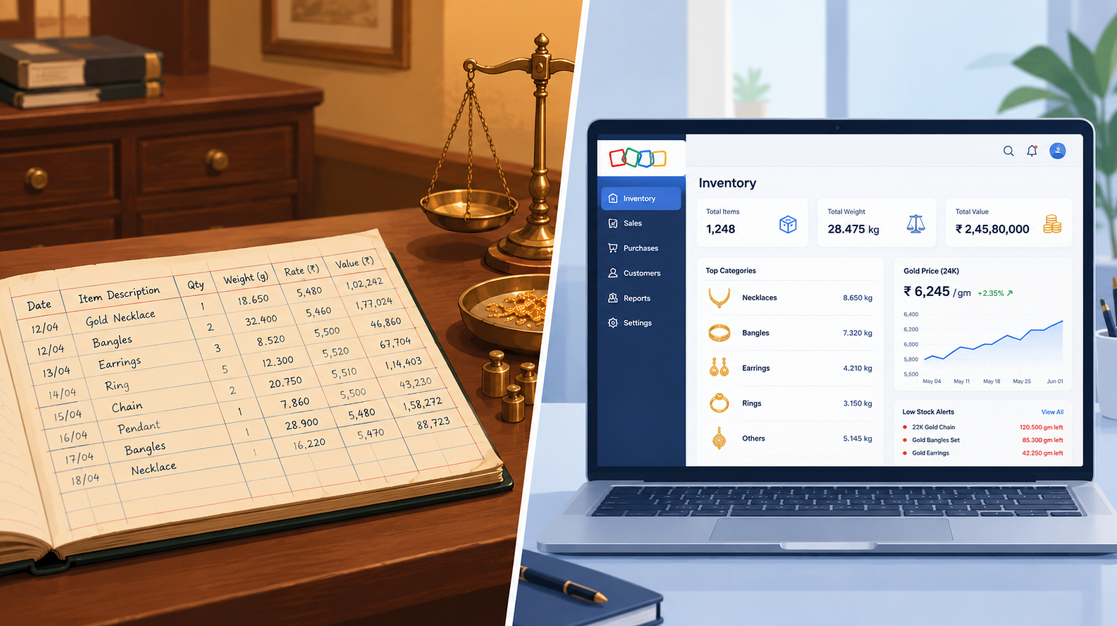
Ask a jeweller in Thrissur how stock was tracked a decade ago and the answer usually involves a paper ledger, a locked almirah, and a senior staff member who knows where everything is. That works with one counter and one owner watching.
It stops working with multiple locations, multiple shifts, and thousands of individually identifiable high-value items — which describes many established gold and textile businesses in the city.
Mandatory hallmarking and HUID record-keeping. Gold jewellery weighing 2 grams or more is subject to mandatory hallmarking in districts covered by the mandatory hallmarking order, subject to specified exemptions — BIS exempts certain categories including Kundan, Polki and Jadau jewellery, and items for export. Each hallmarked item carries a six-digit alphanumeric HUID, unique to that piece and traceable to a BIS record, which consumers can verify through the BIS CARE app. As of 2026, the sixth phase extended mandatory hallmarking coverage to 380 districts from 2 March 2026. Maintaining item-level records of which piece carries which HUID, purity grade and assaying centre reference is difficult to do reliably on paper at scale.
Penalties for hallmarking violations are substantial. The BIS Act, 2016 provides significant penalties for contraventions of hallmarking requirements, with the applicable provision and quantum depending on which section is breached. Accurate hallmark and HUID records are worth maintaining properly for that reason alone.
Daily gold rate management. Gold businesses need current rate data for pricing and sales calculations, and rates move daily. A cloud system can centralise rate updates and apply configured pricing rules consistently across branches and product categories — separate from how inventory is valued for accounting purposes, which follows its own accounting rules rather than the day’s market price.
Multi-location stock visibility. For jewellery businesses operating multiple showrooms, knowing what design, weight or purity sits in which branch, in near real time, is impractical with disconnected systems at each location.
The GST Question Most Jewellery Billing Setups Get Wrong
This deserves its own section, because it is genuinely misunderstood — including by a large number of tax blogs currently circulating online.
CBIC’s sectoral FAQ on Gems & Jewellery treats a retail sale of gold jewellery to an end consumer as a composite supply under Section 8 of the CGST Act, and states that GST is payable at 3% of the total transaction value of jewellery, whether the making charge is shown separately on the invoice or not.
This is the point commonly got wrong. A great many published sources — including current 2026 tax guides — describe the retail treatment as 3% on gold value plus 5% on making charges. That 5% figure is real, but it belongs to a different transaction. When a jeweller sends gold to a karigar or job worker who returns finished pieces, the registered job worker charges 5% GST on the job work charges. That is a B2B job-work service, not a finished jewellery sale to a walk-in customer.
Because the GST treatment affects tax calculation and reporting, getting the transaction classification right is important for jewellery businesses.
The practical implication for a Thrissur jewellery business: your accounting setup has to reflect the transaction structures you actually run — retail sales, job work sent out, job work taken in, exchanges — each of which may be treated differently. A generic billing template configured on a wrong assumption produces wrong returns consistently, month after month, until an audit surfaces it.
What Cloud-Based Inventory Management Can Do
Item-level tracking, with configuration. Cloud inventory platforms support serial-number tracking, batch tracking, custom fields and multi-location inventory as standard capabilities. With appropriate configuration, a system like Zoho Inventory can be set up to record individual pieces against fields such as weight, purity, design code and HUID. These are not jewellery-specific features that exist out of the box — they are general-purpose capabilities configured into a jewellery workflow, which is why the setup matters as much as the software choice.
GST configuration for the transaction models you actually use. Zoho Books supports Indian GST configuration and HSN/SAC classification, allowing a jewellery business to configure invoices and tax treatment according to its specific transaction structures. Getting that configuration to match the composite-supply and job-work distinctions above is the part that needs deliberate thought rather than a default template.
Consistent rate management across locations. Rather than each branch applying the day’s rate manually, rate updates and pricing rules can be centralised and applied consistently.
Multi-branch visibility. A cloud system can be configured to give an owner stock levels and sales performance across every location from a single dashboard, rather than calling each branch manager.
The same logic extends to textiles and general trade. Thrissur’s textile wholesalers and hosiery manufacturers face a parallel problem — tracking fabric rolls, thread inventory, sizes and colour variants across a supply chain that moves quickly during peak periods. The inventory principles transfer directly, whether stock is measured in grams or metres.

Festival and Wedding Periods Put Systems Under Pressure
Thrissur’s calendar includes some genuinely significant commercial windows.
The Thrissur Pooram Exhibition has run since 1932 and typically continues for 40 to 50 days at Thekkinkadu Maidan, alongside the Pooram festival itself. Onam brings its own concentrated demand across Kerala. And wedding purchases cluster into peak periods rather than spreading evenly through the year.
Periods like these can create additional demand and operational pressure for local retailers — higher transaction volume, longer staff hours, and more stock movement between locations in a compressed window. A record-keeping system that is merely inconvenient in a normal month becomes a genuine liability when volume multiplies and staff are stretched.
Beyond Gold and Textiles
Thrissur’s commercial history predates its gold reputation. The Thrissur Corporation’s own account records the city’s Rice Bazaar rising to prominence through paddy imported from Singapore and Burma, and the Kokalai market once setting areca nut prices for the region. This has been a trading centre that adapts for well over a century.
Other sectors across the district — finance companies, wholesalers, distributors, hardware traders — can face similar operational pressures around compliance, stock visibility and faster customer service. The specifics differ; the underlying record-keeping problem does not.
Getting the Setup Right Matters More Than the Software Choice
Software vendors rarely emphasise this: selecting the platform is the smaller half of the job.
For a gold business, the configuration has to handle weight-based units, purity grades, HUID as a unique item identifier, and — critically — GST treatment that matches the actual transaction structures the business runs. These requirements typically need careful configuration rather than reliance on a generic inventory template.
This is the work a zoho partner in thrissur does for local jewellery and textile businesses: mapping the business’s real transaction models before configuring Zoho Inventory and Zoho Books around them, rather than fitting the business to a template designed for a different kind of retailer.
Frequently Asked Questions
Q: Is cloud inventory software secure enough for high-value stock data?
Zoho provides security controls including encryption and role-based access mechanisms, letting a business restrict which staff can view or edit specific data. Zoho publishes its security documentation publicly, and it is worth reviewing directly rather than relying on a vendor summary. Role-based access is arguably a meaningful improvement on a physical ledger that anyone in the shop can open.
Q: Can cloud inventory handle old gold exchange transactions?
Old-gold exchange can be configured into an accounting workflow. However, the appropriate GST treatment depends on the structure of the transaction and who is supplying what — an individual selling personal jewellery is not a registered supplier, which changes the analysis. This should be validated with the business’s tax adviser rather than assumed from a software default.
Q: Do we have to replace our existing billing system entirely?
Not necessarily. Some businesses move inventory and stock tracking first while keeping existing billing, then migrate billing once staff are comfortable. Whether that phasing makes sense depends on how the two systems would need to reconcile in the interim.
Q: How long does implementation take?
It depends on the project rather than following a standard timeline. A single-location business with a well-prepared product catalogue and clean opening-stock data can often be implemented relatively quickly. Multi-branch businesses with complex inventory structures, multiple transaction models and larger staff counts require more planning, configuration, testing and training. Scope it against your actual data rather than a published average — and where possible, avoid going live in the middle of a peak season.
Final Thoughts
Thrissur’s trading community has adapted before — from international paddy imports to building one of India’s largest jewellery retailers from a single city.
Cloud-based inventory management is a continuation of that, not a departure from it: replacing a paper ledger and institutional memory with a system that records each item, each hallmark reference, and each transaction under the correct GST treatment, consistently, including during the busiest weeks of the year.
If your gold, textile or general trading business in Thrissur is weighing this up, working with a Zoho Partner in Thrissur familiar with the compliance and inventory realities of this specific trade is what separates a clean implementation from an expensive one.
Guest post prepared by the team at Techgeum — Certified Zoho Partner In Kerala, Web and Shopify Development Company in Kerala