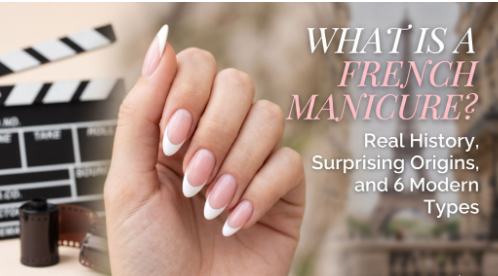
A French manicure pairs a sheer, neutral base with a crisp, opaque white line painted along the edge of the nail. The style mimics healthy nail anatomy while creating an optical illusion that makes fingers appear longer and cleaner.
Although widely viewed as an old-world Parisian invention, the modern lacquer design started in a 1970s Hollywood film studio. Today, the style has evolved into a versatile design framework that ranges from subtle micro lines to soft gradients. Whether you prefer the original white smile line or playful variations like pink French tip nails, this clean aesthetic adapts to every length and shape.
The Anatomy of a French Manicure
The design relies on two main visual zones and a curved boundary line:
- Zone 1 (The Base): A sheer pink, beige, or peach layer covers the nail plate. This neutral tint hides small spots or keratin marks while showing the natural pink tissue underneath.
- Zone 2 (The Free Edge): The tip extending past the fingertip receives a coat of opaque white enamel.
- The Smile Line: This is the curved border where the neutral base meets the white tip. A well-balanced smile line follows the natural curve of the nail fold and the cuticle, balancing the entire look.
Early Precursors: Before Surface Lacquer
The idea of accentuating white tips existed long before modern polish bottles hit store shelves.
Subungual Whitening in the 1910s and 1920s
Early twentieth-century manicures focused strictly on natural hygiene. In the 1910s, brands like Cutex sold small whitening pencils made of kaolin clay, talc, and titanium dioxide. Users dampened the pencil tip and traced directly underneath the free edge. This subungual method brightened the underside of the nail plate, but the powder washed away during ordinary handwashing.
The Half-Moon Style of the 1920s and 1930s
During the 1920s and 1930s, flappers and movie stars favored the half-moon manicure. Technicians painted rich red nitrocellulose lacquers over the center of the nail, leaving both the cuticle half-moon and the tip unpainted. Leaving the free edge bare was practical: it hid everyday tip wear and avoided visible chips on automobile lacquers. Hollywood makeup pioneer Max Factor also created pale buffing powders and creams during this era, setting an early foundation for clean, neutral nails.
The Hollywood Crisis and Jeff Pink (1975–1976)
The modern surface-painted French manicure was created to solve a practical film production problem.
The Costume Bottleneck 1975
Hollywood directors faced costly delays because actresses had to change their nail polish to match different outfits between scenes. Stripping, applying, and drying colored lacquer took up to an hour per wardrobe change.
The Natural Look Nail Kit 1976
Jeff Pink, founder of ORLY, solved this issue by pairing a durable white tip with a sheer neutral base. The universal design complemented any wardrobe change without requiring removal. Pink sold it commercially as the Natural Look Nail Kit.
Paris Fashion Week Rebranding 1976
Pink brought the kit to Paris fashion shows, where runway models faced the exact same styling challenges. After French couturiers adopted it, Pink rebranded the system on his flight back home as the Original French Manicure, using Paris’s fashion reputation to drive retail sales.
The marketing move succeeded completely. French salons quickly embraced the style, calling it la French manucure. Marking fifty years since its creation, historical organizations have recognized the kit for its lasting cultural impact, including a placement in the Smithsonian Institution’s cosmetic archives.
Decades of Evolution
The 1970s and 1980s: Acrylic Chemistry and Celebrity Exposure
Televised appearances by stars like Barbra Streisand and Cher brought the look into homes nationwide. Simultaneously, artificial nail chemistry made major progress. In 1979, Dr. Stuart Nordstrom formulated the first cross-linked monomer liquid (SolarNail), leading to the founding of Creative Nail Design (CND).
Stable ethyl methacrylate (EMA) acrylics allowed nail technicians to sculpt permanent white tips directly onto nail forms. At the same time, icons like Olympic champion Florence Griffith Joyner showcased long, sculpted sets on global stages, pushing tip shapes into bold new directions.
The 1990s and 2000s: Square Tips and Salon Backlash
During the 1990s and early 2000s, the style became an industry standard. Salons produced thick, square acrylic extensions with wide white blocks and bubblegum-pink bases. The look dominated prom photos, bridal parties, and pop music videos.
By 2010, high-fashion stylists grew tired of the chunky square shape. The market briefly turned away from white tips in favor of dark jewel tones, solid neutrals, and detailed nail art.
The 2020s: The Modern Revival
The design returned in recent years with a fresh, understated approach. Contemporary trends favor thin lines, almond nail shapes, and clean finishes. Modern French designs now represent more than 30 percent of classic salon service requests.
Types of Modern French Manicures
Today, the French manicure serves as a flexible framework for different shapes, colors, and textures.
| Style | Defining Traits | Best Suited For | Key Practical Advantage |
| Classic French | Crisp white smile line over a sheer pink or beige base. | Almond, oval, and squoval shapes. | Pairs with any outfit or setting. |
| Micro French | A fine hairline edge under one millimeter thick. | Short natural nails and square shapes. | Keeps short nail plates looking balanced. |
| Baby Boomer (Ombré) | A seamless gradient that fades white into soft pink. | Medium oval or coffin extensions. | Blurs natural nail growth lines. |
| Reverse French | The line traces the cuticle edge instead of the tip. | Round, square, or grow-out sets. | Draws focus to the base of the nail. |
| Deep V (Chevron) | Two diagonal lines meet at a sharp point in the center. | Long coffin and stiletto extensions. | Visually lengthens wide nail beds. |
| Glazed / Chrome | Reflective metallic powders buffed over the tip or base. | Holiday, bridal, and evening sets. | Adds shine without heavy nail art. |
The Micro French
The micro French uses a hairline stroke of white polish along the outermost edge of the nail. It works best on short, natural shapes where a wide white tip would cut the nail plate in half visually.
The Baby Boomer (French Ombré)
This style blends the white tip into the pink base using a soft sponge, dip powder, or an airbrush. The name comes from post-World War II beauty habits in the 1940s and 1950s, when women favored soft pink and white tones before sharp smile lines became common. Because there is no sharp boundary line, new nail growth remains hidden much longer.
The Reverse French
This variation flips the placement by highlighting the cuticle line instead of the top edge. It mirrors the old 1920s half-moon style, often using dark polishes, chrome pigments, or negative space along the lower fold.
Professional Techniques: How Salons Create the Smile Line
Nail technicians rely on several proven methods to build an even smile line:
- Freehand Detail Brushes: The technician uses an eight to eleven-millimeter striping brush. They mark a central dot at the tip, then draw smooth lines from each side fold down to the center mark. A small brush dipped in alcohol cleans up any rough edges.
- Adhesive Guides: Vinyl stencils stick across the dried base to mask the nail body. The technician paints white enamel over the exposed tip and peels the sticker away while the lacquer remains wet to avoid tearing.
- Silicone Jelly Stampers: The technician paints white polish onto a soft silicone pad. The client presses their fingertip into the pad at a 45-degree angle. The silicone wraps around the edge, transferring a crisp smile line in seconds.
- Reverse Acrylic Sculpting: On acrylic extensions, the technician sculpts the pink nail bed first, building a raised structural wall. Bright white acrylic is pressed directly against that wall, locking the smile line deep inside the enhancement where it cannot chip.
Summary and Next Steps
The French manicure remains popular because it solves a basic grooming challenge: keeping hands looking clean, natural, and put together. From Hollywood film sets to modern micro tips, the design continues to adapt.
If you are trying this style for yourself, match the tip width to your nail length. Short nails look best with razor-thin micro lines, while longer almond shapes carry classic curves and ombré fades with ease.
Frequently Asked Questions
Why is it called a French manicure if it was made in California?
Jeff Pink named the style after introducing his two-tone design to designers at Paris Fashion Week in 1976. Linking the look to Parisian haute couture gave the retail product immediate global appeal.
What is the difference between a French manicure and American manicure?
A French manicure uses a stark, opaque white tip over a cool pink base. An American manicure uses a soft, off-white or cream tip over a warm, sheer beige base, producing a subtler finish.
How long does a French manicure last?
Regular polish typically lasts five to seven days before the tips show wear. Gel polish and dip powder options generally last two to three weeks without chipping.
Can you do a French manicure on short nails?
Yes. The micro French is designed specifically for short nail beds. Keeping the line under one millimeter prevents the nail from looking stubby.
Why do my French tips chip so fast?
The tip of the nail experiences the most daily friction. If the technician does not seal the outer edge with a topcoat, the white layer can lift quickly. Applying a thin coat of clear polish over the edge every three days helps prevent early chipping.