When Viral Goes Too Far: New Research Reveals the Emotional Threshold That Turns Audiences Into Spectators
The marketing industry has long treated virality as an unambiguous goal. The more emotional the content, the more it spreads — and the more it spreads, the better it performs. A new large-scale study challenges that assumption in precise, quantifiable terms: emotional intensity in brand content follows a performance curve with a hard ceiling, and most viral campaigns operate above it.
According to research published by Reputation House, a global digital risk management firm, the effective window for emotionally driven consumer conversion sits between 10% and 39% of mentions carrying genuine emotional expression. Below that threshold, content fails to register. Above it, something more counterintuitive happens: the audience stops behaving like potential customers and starts behaving like an audience.
The Study Behind the Finding
The findings come from a two-year analysis of over two million brand mentions across 39 global companies, conducted between 2023 and 2025 using data provided by ICDS (the Institute of Communication and Data Science). Researchers tracked 85 statistically significant mention peaks — defined as periods where brand mention volume exceeded the 12-month average by more than one standard deviation — and mapped each peak to downstream consumer behavior: informational search queries, transactional search queries, and, for a secondary dataset of 12 financial companies, stock price movements across 2,400+ monthly records.
Emotional content was classified using NLP analysis across six intensity tiers, from non-expressive (0%) to extreme (40% and above). The research team then correlated each tier with measurable shifts in search behavior as a proxy for purchase intent.
The Conversion Curve — and Where It Breaks
At moderate emotional intensity — 10 to 19% of peak mentions carrying genuine evaluative content — the data shows consistent activation of informational search queries, followed by a transactional search lift peaking one to two months later. At high intensity (20–39%), that conversion signal strengthens further, representing what the researchers describe as the peak conversion window.
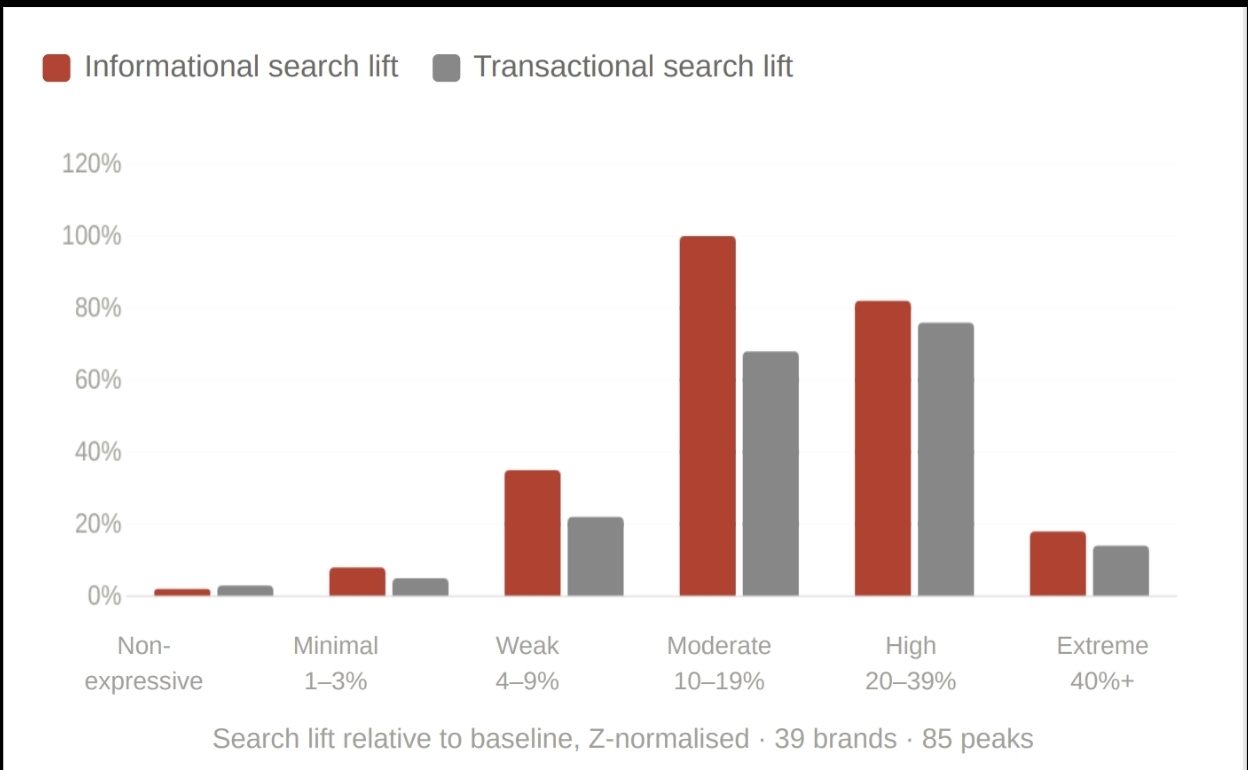
CHART 1 — EMOTIONAL INTENSITY VS SEARCH LIFT
Beyond 40%, the signal disappears. Content that drives extreme emotional saturation — the kind of peak-virality moment that generates widespread coverage and social media volume — consistently failed to produce the downstream search behavior associated with purchase intent. Instead, the research found that consumers engaged with the content as entertainment: sharing, commenting, reacting, but not converting.
The researchers describe this as the spectator effect: when emotional intensity exceeds the threshold, audiences switch from participant mode to observer mode. The content becomes a media event rather than a brand interaction.
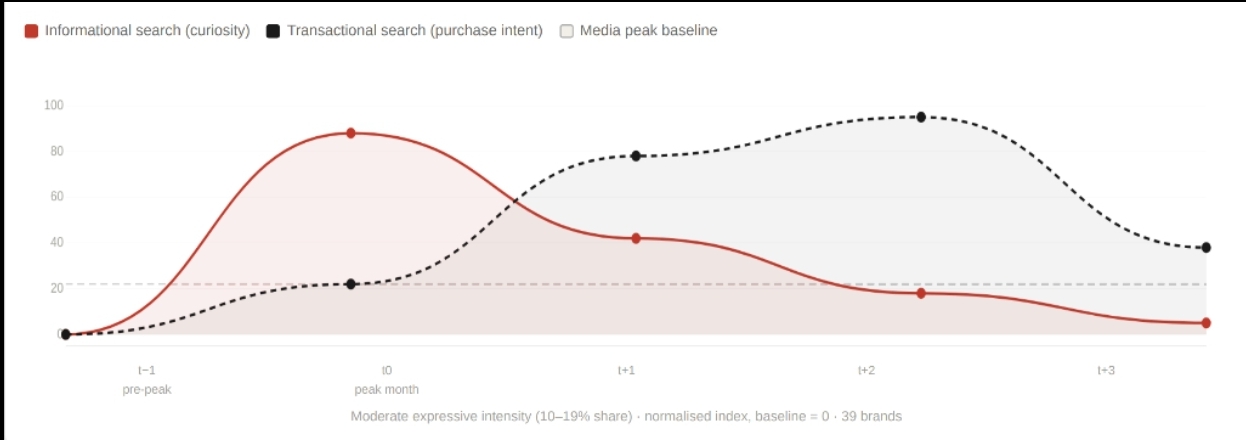
CHART 2 — THE CURIOSITY-TO-ACTION FUNNEL: INFORMATIONAL → TRANSACTIONAL SEARCH OVER TIME
Pop Mart and the Labubu Phenomenon
The Labubu collectible toy craze of April 2024 is among the most closely analyzed peaks in the dataset. At the height of the trend, emotional expression within brand mentions sat in the high-moderate range — intense enough to generate curiosity and awareness, but contained enough to retain credibility. The result was a sharp, measurable spike in both informational and transactional search queries, peaking at the month following the media event.
By contrast, brands in the same collectibles category that generated content sitting above the 40% intensity threshold during the same period showed erratic or absent search responses — high engagement metrics, low conversion signals. The contrast is instructive: the Labubu phenomenon worked not because it was the loudest, but because it stayed within the zone where emotional engagement translates into consumer action.
Why the Industry Has Missed This
Part of the reason the 10–39% window has gone unmeasured is that the dominant metrics in marketing — total mention volume, share of voice, reach — are not designed to detect it. The research found that 96.5% of all brand mentions in the dataset carried zero emotional content, generating zero measurable consumer response. Volume, in other words, is almost entirely noise.
Standard media monitoring tools track quantity. Emotional intensity requires a different layer of analysis: classifying the evaluative stance of each mention, calculating the expressive share of a peak, and tracking behavioral outcomes with a time lag. Most campaign reporting infrastructure is not built to do this, which means brands routinely optimise for metrics that have no proven relationship to the outcomes they are chasing.
The implication for content strategy is not that brands should avoid strong emotion — it is that emotional calibration matters more than emotional volume. A campaign engineered for maximum virality may be actively working against conversion if it pushes audiences into spectator mode. The goal, according to the research framework, is not the most-discussed brand but the most actionably resonant one.
What This Means for Campaign Planning
The research introduces a practical reframing for marketers: instead of asking whether a campaign generated emotion, the relevant question is whether it generated emotion at the right intensity. That requires measuring the expressive share of a peak — not just total volume — and monitoring how that share relates to search behavior in the weeks that follow.
The 10–39% corridor is also not uniform across product categories. The research notes that high-consideration purchases — financial products, electronics, travel — show the strongest conversion signals within this window, while the same emotional intensity around lower-involvement categories produces more modest effects. Intense content around high-stakes products tends to trigger scepticism rather than intent, suggesting that the optimal intensity band shifts depending on how much perceived risk a consumer associates with the purchase.
For brands already operating in high-visibility categories — consumer tech, fintech, retail — the study argues that the more useful strategic question is not how to generate more coverage, but how to ensure that the coverage being generated sits within the conversion-effective intensity range.
A Metric the Industry Hasn’t Been Tracking
The Brand Reputation Research 2026 report from Reputation House does not argue that viral content is without value. It argues that virality without emotional calibration is a vanity metric — one that can generate impressive engagement numbers while doing little or nothing for the business outcomes that marketing is supposed to serve.
The 10–39% finding is specific enough to be testable and operational enough to be actionable. Whether the broader industry adapts its measurement infrastructure to reflect it is a different question — one that may depend less on the data than on the appetite for a more demanding definition of what a successful campaign actually looks like.
Source: Brand Reputation Research 2026, Reputation House / ICDS (Institute of Communication and Data Science). Full methodology available at reputation.house