For most of 2023 and 2024, AI model costs barely registered in marketing budgets. They were usually absorbed by IT or bundled into a software subscription. As generative AI moved into production workflows, token spend became a real budget variable, and the gap between models became hard to ignore: the cheapest capable model and the most capable premium model can differ in cost by roughly 40x. The model your workflow runs on now has a direct impact on what you spend, yet many teams are still making that choice without considering it as a budget decision.
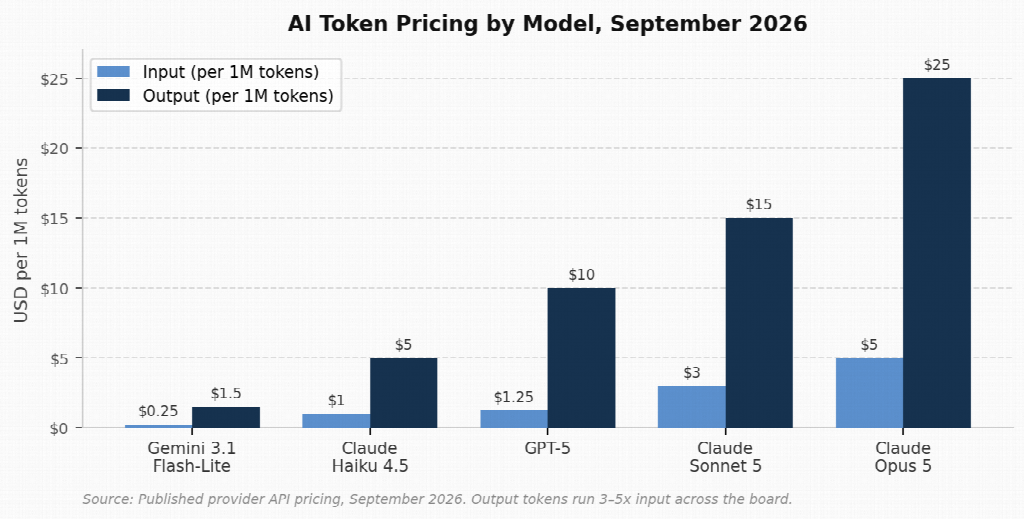
Figure 1. Published API pricing across five widely used models, September 2026. Output tokens cost several times more than input at every tier.
The numbers become clearer once you put the models side by side. Claude Opus 5 costs $5 per million input tokens and $25 per million output tokens, while Gemini 3.1 Flash-Lite costs $0.25 and $1.50. At 50 million tokens a month, that works out to roughly $1,250 on Opus versus $75 on Flash-Lite, with often little difference in the finished copy. A recent AI token pricing comparison found cost gaps of 10x or more even among models with comparable quality.
One detail that has a big effect on marketing costs is that output tokens cost three to five times more than input across providers. Marketing work is especially output-heavy. You give the model a short brief, then ask for a full draft, a dozen subject lines, or 20 ad variations. You are paying for all that output, which is where the higher cost comes in.
“Same task, different bill, and often no meaningful difference in the finished copy.”
Matching the Model to the Work
The simplest way to bring AI costs down is to stop using the most expensive model for every task. Use the premium model when the work actually calls for it, such as a campaign brief with a lot of context, editorial that needs to match a specific brand voice, or a personalization engine making real judgment calls. For everything else, a less expensive model can often do the job just as well.
Most of the routine work can go to a cheaper model. Subject line tests, meta descriptions, social copy, and first-draft outlines can all run on something like Claude Haiku 4.5 at $1 per million input tokens and $5 per million output tokens, a fifth of the flagship rate. Teams that divide their workflows this way are cutting their monthly bills by half or more while the work readers see stays the same. The expensive mistake is making one model the default for everything and never going back to see whether it still makes sense.
Two provider features can push those savings even further. Prompt caching cuts the cost of sending the same brand guidelines with every request, and a cache hit on Claude costs about a tenth of the standard input rate. Then there’s batch processing, which can cut another 40% to 50% for work that doesn’t need to happen in real time. For a team running a high-volume editorial pipeline, using both can significantly reduce the monthly AI bill.
Building Costs Into the Budget
AI costs work differently from the software subscriptions most marketing budgets were built around. They rise and fall with campaign volume and content output, which means a budget based on last quarter can be off by a wide margin when a new campaign doubles your workload. The better approach is to plan for that change by budgeting around the work itself: cost per approved asset, cost per email variant, or cost per brief. Those are numbers you can actually use to plan and manage the budget.
Review your provider choice throughout the year, especially as pricing continues to shift. The comparison data shows that teams that regularly reassess their options are pulling further ahead on cost. A contract that looked reasonable in early 2025 could be costing you more than it should today. Treat token pricing as a moving cost and review it alongside your other marketing expenses so you can keep costs down as your workload increases.