The dominant playbook in agricultural robotics has been simple: go big, go expensive, and automate what already exists. Most industry heavyweights and well-funded startups have poured millions into converting massive, 15-ton tractors into driverless behemoths. Equipped with multi-thousand-dollar LiDAR pucks and proprietary compute stacks, these six-figure systems are built for wide-open grain prairies—and carry price tags that only industrial farming conglomerates can justify.
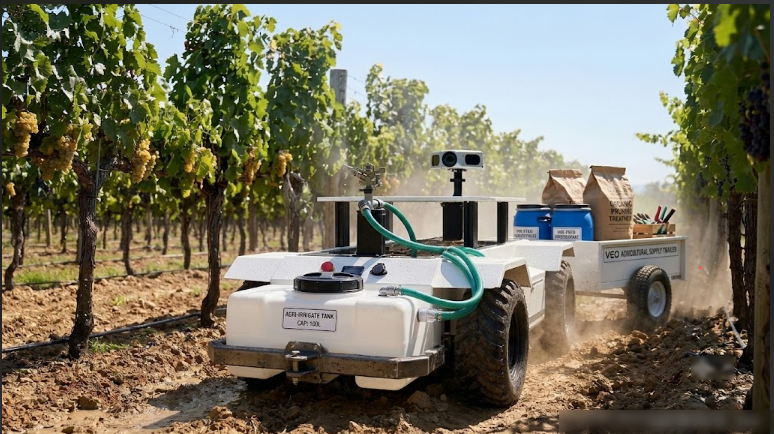
Venkateshh Miryalkar is taking the exact opposite approach. With Maas Robot 1, the robotics engineer is betting that the future of farm autonomy belongs to small, agile, and remarkably affordable ground robots designed to democratize automation for independent growers.
A Market Built for Big Equipment
That tractor-first mentality ignores a massive share of the agricultural landscape by design. High-value specialty crops—like vineyards, berry patches, and high-density orchards—are tightly packed environments. Their narrow rows, low-hanging canopies, and sharp headland turns make maneuvering a retrofitted, multi-ton tractor an impossible task without risking severe damage to crops or compacting delicate soil. Venkateshh built his robot at a fraction of that footprint specifically to conquer these tight spaces, demonstrating that robust spatial mapping and real-time obstacle avoidance can unlock automation where heavy iron simply cannot fit.
Yet the breakthrough isn’t just about compact physical dimensions. The bigger question has always been whether a smaller, far cheaper machine can match the navigation precision and environmental awareness of a system costing ten times as much. Venkateshh’s answer is running in the field: a custom-built navigation stack proven on his own machine, demonstrating that agility and software intelligence can comfortably replace sheer size.
Built for Under $4,000
The most disruptive metric Venkateshh highlights is the bottom line: he built and programmed his working prototype for under $4,000. He hit that budget by deliberately avoiding bespoke manufacturing, opting instead to modify an open-source chassis and lean aggressively on commercial off-the-shelf components.
Venkateshh is transparent that this $4,000 figure represents a functional proof-of-concept rather than a showroom-ready retail unit. Even so, the contrast is staggering in an ag-tech sector where outfitting a machine with autonomy routinely pushes costs into six-figure territory once high-end sensors, specialized compute stacks, and integration overhead are tallied up. Reaching such an accessible price point meant embracing pragmatic engineering trade-offs at every turn—choosing parts that were practical, accessible, and cost-effective over the most expensive hardware on the market, and letting smarter software carry the load.
Chasing a $1,000 to $1,500 Price Tag
Venkateshh’s ultimate target is even more disruptive: driving the manufacturing cost of a fully autonomous unit down to between $1,000 and $1,500. Reaching that threshold relies on the same three core principles that shaped the prototype: doubling down on high-volume commercial off-the-shelf components, adapting open-source chassis designs to eliminate expensive custom tooling, and tightly consolidating the custom compute architecture to cut down on total parts.
At that price point, the economics of agricultural automation fundamentally flip. Instead of demanding enterprise-level capital expenditures that only massive industrial conglomerates can finance, a fully autonomous robot enters the realm of routine operating expenses for everyday growers. “This transforms agricultural robots from a capital-heavy enterprise investment into an accessible operational tool for independent farmers,” Venkateshh explains. For him, that ultra-accessible price tag isn’t just a convenient byproduct of clever engineering—it is the driving purpose behind the entire project.
Why Cost Is the Real Barrier
For years, the ag-tech conversation has treated algorithmic sophistication as the primary bottleneck holding back agricultural automation. Venkateshh’s argument flips that premise on its head: the capability is already here, but prohibitive pricing has locked small, independent growers out of the revolution. By demonstrating that dependable navigation, computer vision, and reactive obstacle avoidance can run on accessible hardware without six-figure budgets, his build reveals that the industry’s steep price tag is driven more by legacy conventions than genuine technical necessity.
Whether a $1,000 to $1,500 field unit can endure years of relentless dust, vibration, and punishing seasonal weather remains a question only prolonged commercial deployment can answer. Even so, Venkateshh’s prototype makes one reality unmistakably clear: the gap between a lean engineering budget and practical farm autonomy is vastly narrower than the industry assumes—and he built Maas Robot 1 specifically to prove it.