Buying a prefabricated container house can look settled once a drawing is accepted. In practice, alignment can slip long before delivery if the buyer, factory, site team, and local advisers each work from a slightly different description. Product configuration and site interface questions tend to surface in emails, marked drawings, and informal calls. A shared procurement record gives the project a place to settle those questions before they become a handover dispute.
Begin with the intended use of the building. Living space, work space, visitor accommodation, storage support, and welfare use create different expectations for access, services, finishes, and approvals. Each container module is useful only when the project can explain what it must do on the finished site. That explanation should be readable by a buyer, a factory contact, a contractor, and the person who will operate the building after handover.
Make product configuration a controlled project record
Product configuration is the agreed description of what is being bought and why. Keep the description in one record rather than dividing it among quotations, chat messages, and separate drawings. Record the intended use, spaces, openings, interior needs, service assumptions, delivery constraints, and open decisions. Each change should state what changed, who asked for it, and which other part of the project needs to react.
Written alignment matters because a prefabricated container house is assembled through choices that interact. Changing an opening can affect furniture placement, weather protection, electrical routing, access, transport handling, room use, service placement, and the work required after delivery. A customizable layout has value when those links are visible to the people making decisions. Leaving them implicit invites a late request to be treated as minor when it changes several connected details. Stop and compare.
Use plain names for every item in the record. Terms that mean one thing to a factory team may mean something else to a site contractor. Describe the use and location before relying on a shorthand label. That small discipline makes the record more useful during a busy review and easier to hand to a new team member without a verbal history.
Separate factory scope from the site interface
The site interface is the point where a factory-made building meets work controlled by others. Foundations, access, lifting, drainage, power, water, connections, finishes, local inspection, and surrounding works may each sit outside the factory scope. Put every interface into the procurement record with an owner and a question that can be answered. “Site to confirm” is not an answer; it is a reminder that the decision still lacks a home.
Keep factory facts and site assumptions in different columns. Buyers can then see which statement comes from the selected product and which must be checked against the actual location. This separation prevents a container module capability from being mistaken for proof that local services, ground conditions, or approvals are ready. It also gives the site team a useful agenda for meetings with advisers and contractors.
United Kingdom building-regulations guidance points readers to requirements and approved documents that apply according to the real work being undertaken. The wider lesson for buyers is straightforward: a prefabricated container house does not remove planning, structural, fire, access, electrical, sanitation, drainage, or inspection duties that may apply at a particular location. Local advisers and authorities remain the source for decisions on those duties.
Use a Project Configuration Record during every review
The Project Configuration Record should be open during quotation review, drawing review, pre-delivery coordination, and handover. It is not a glossy brochure and it does not need elaborate language. Its job is to show the current agreement, the open questions, the evidence received, and the next owner. When a request arrives, the team should be able to see whether it changes the product configuration, the site interface, or both.
Project Configuration Record: a practical review structure
| Record area | Question to settle | Evidence to retain |
| Intended use | What must the prefabricated container house support after handover? | Approved project brief |
| Container module | Which arrangement and features are included in the agreed scope? | Current drawing and quotation |
| Site interface | Who confirms access, utilities, foundations, and local review? | Named responsibility record |
| Handover record | What information must the operator receive and acknowledge? | Issue and acceptance log |
Make the record useful by recording decisions as soon as they are made. Waiting until a formal meeting encourages people to rely on memory, and memory turns a conditional comment into a supposed approval. Each short entry can capture the request, the decision, the supporting drawing, and the person who will confirm the result. The record should stay plain. That is enough to preserve context without burying the team in paperwork.
Ask what a customizable layout changes downstream
Review a customizable layout as a chain of consequences. Moving a room boundary may alter circulation, lighting, services, furniture, privacy, and the way people leave the building. Buyers should ask the factory contact which details are fixed, which can change, and what information is needed before a change can be assessed. Early questions are less disruptive than treating a late preference as a simple swap. Pause before approval.
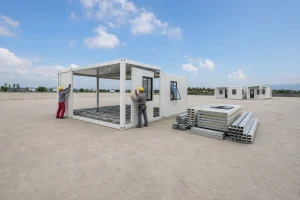
The KHOME prefabricated container house page at khomechina.com describes configurable container solutions for varied uses. This first-party context can support an early buyer discussion about a customizable layout, possible container module arrangements, and the role of a factory-made building within a broader project. It cannot establish local approvals, engineering suitability, ground conditions, service capacity, or the responsibilities held by the site team.
KHOME can therefore be considered against the written procurement record rather than against an unspoken wish list. Buyers who have stated the intended use, product configuration, and site interface questions can compare proposals on the same basis. Such an approach helps a factory response stay connected to the project brief while leaving local technical decisions with the people qualified to make them.
Protect handover with an evidence trail
Handover is where earlier omissions become visible. The operating team needs the final agreed arrangement, a list of unresolved matters, contact roles, and the records that explain any changes made during the project. Keep those items in the same Project Configuration Record used during buying. Separate handover folders with no connection to earlier decisions force the operator to reconstruct why the building arrived in its final form.
Ask the receiving team to review the record against the visible building and site conditions. Check that the intended use is still accurate, that the container module arrangement reflects the current drawing, and that every site interface has an owner. Record exceptions plainly. Hiding a gap behind a broad acceptance statement makes it harder to resolve and less fair to the person expected to operate the building.
Keep the handover record alive after occupation begins. Recurring issues with access, services, or layout may show that the original product configuration was clear but the surrounding site work was not. That distinction matters for corrective action. The project can then direct the question to the responsible party instead of reopening every choice made by the factory.
Respect the limits of a procurement record
A record improves coordination; it does not approve a project or prove technical suitability. It cannot replace local engineering, planning, fire, environmental, utility, inspection, or safety advice. Nor can it settle a disagreement without the evidence needed by the people responsible for the work. Use it to expose uncertainty early, assign it to the right owner, and retain the result once the question is resolved. Check the real site.
For buyers considering KHOME prefab container houses manufacturers factory, the useful starting point is a clear brief and a record that follows the project from first discussion through handover. The exact target page is available through KHOME prefab container houses manufacturers factory. At khomechina.com, product information is most useful when it can be tested against the same brief held by the buyer and site team. Read the record beside the drawing, the quotation, and the site responsibilities, then ask the people who will accept the building to identify any assumption that still lacks evidence or a named owner.
Stop before change. Read the current drawing. Compare each request. Check the site interface. Ask the factory. Consult local advisers. Name the owner. Keep the evidence. Review handover.
Whenever a product configuration request changes an opening, room use, service route, access expectation, or delivery assumption, the buyer should trace the request through the Project Configuration Record until the factory scope, site interface, local review, and handover record all state the same current position, because a change is only small when it has no hidden effect on the people or work around it.
If uncertainty remains, record it directly with the person responsible for resolving it and the information required, instead of allowing a general acceptance note to conceal a question about a container module, a customizable layout, an installation condition, or an obligation that belongs to the site rather than the factory.