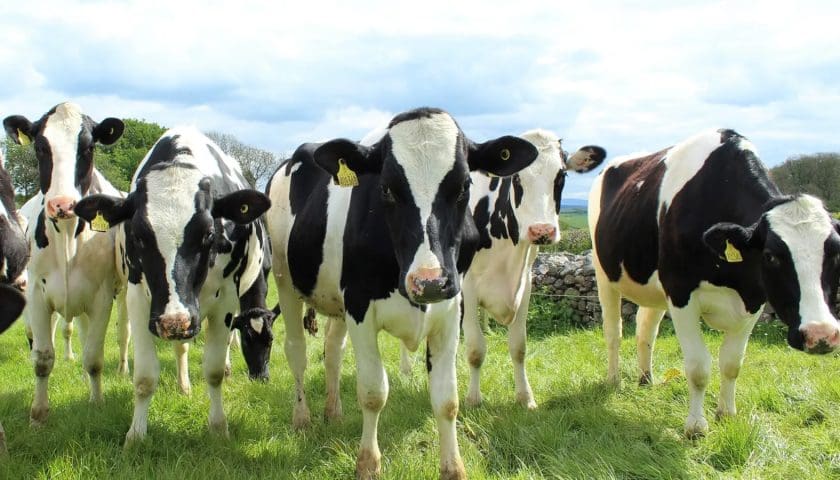
A shipment of 220 Australian Holstein Friesian dairy cattle has arrived in Cambodia by air, lifting the country’s largest commercial dairy herd to around 1,400 head. It is the fifth consignment flown to the same farm by the same Australian exporter since 2020.
The value in this trade shows up years after the plane lands.
A herd assembled one flight at a time
The cattle went to Kirisu Farm in Takeo province, roughly two hours south of Phnom Penh, and were supplied by Sydney-based Australia’s Livestock Exporters (ALE). The Australian Embassy in Cambodia announced the arrival, noting that the expansion should reduce Cambodia’s reliance on imported dairy products and create local jobs. The project is supported through the Cambodia Australia Partnership for Resilient Economic Development (CAPRED), Australia’s flagship economic development program in the country.
Kirisu began with 550 Australian Holstein heifers in 2020, a foundation herd that established Cambodia’s first large-scale commercial dairy. ALE supplied that shipment and has supplied every head since, making it the first Australian exporter to move dairy cattle into the Cambodian market.
Six years on, the commercial pattern is clear. A foundation herd creates ongoing demand for replacement stock, genetics, feed systems and processing capacity, and the exporter who lands the first consignment usually lands the next four.
Where the value sits in live export
Breeder and dairy exports occupy the premium end of Australia’s live export trade. Volumes are modest alongside feeder and slaughter cattle, unit values run much higher, and buyers are generally building long-term operations that require repeat supply.
According to LiveCorp’s State of the Industry report, Australia exported more than 1.16 million livestock worth almost $1.1 billion in 2025, with breeder cattle exports increasing sharply and contributing significantly to growth in live cattle shipments. Dairy cattle exports also resumed to Mexico and Türkiye for the first time in close to a decade.
That growth is happening while the domestic dairy herd shrinks. The Australian Bureau of Statistics put the national dairy herd at an estimated 2.1 million head at 30 June 2025, down 2.3% on the previous year. Export sales give dairy farmers an income stream separate from farmgate milk prices, and one that can be accessed without heavy capital investment.
Why buyers pay for Australian genetics
So what makes a Holstein heifer worth flying across Asia?
Australian Holstein Friesian dairy cattle make up the overwhelming majority of Australia’s national dairy herd and rank among the most productive dairy breeds in the world. Buyers are also paying for the documentation that travels with the animal.
Australian breeding stock arrives with verified pedigree, health testing and export certification, backed by national biosecurity, animal health and traceability systems. For a commercial operator planning a herd over a decade or more, that documentation is what makes the investment financeable and insurable.
Australian Holsteins have also been managed successfully in tropical and subtropical production systems where nutrition and farm management are set up to support them. That track record carries real weight with buyers across Southeast Asia.
What it takes to fly 220 cattle
Planning for a consignment of this size starts months ahead of the flight. The cattle travelled in purpose-built livestock crates aboard a dedicated cargo aircraft, which keeps transit time short and welfare standards steady from the Australian quarantine facility through to arrival.
‘Delivering a shipment of this size requires months of planning before the aircraft leaves Australia,’ said a spokesperson for Australia’s Livestock Exporters. ‘Sourcing, pregnancy testing, quarantine and veterinary certification all have to line up.’
Air freight costs considerably more per head than sea transport, which is why it tends to be reserved for high-value breeding stock. For pregnant heifers due to start producing within months of arrival, the shorter transit usually justifies the cost.
Welfare performance across the sector has improved on the reported measures. LiveCorp recorded an annual mortality rate of 0.04% for cattle exported by sea and air in 2025, a record low, down from 0.06% the previous year.
What the Cambodian market looks like
Cambodia has no strong dairy tradition in its cuisine, which made the original 2020 investment an unusual bet. Domestic demand for fresh milk has grown since, and Kirisu now runs its own processing and bottling operation supplying the local market with milk, yoghurt and flavoured products.
For Australian exporters, the pattern worth watching is a small number of serious operators building capacity year on year, each needing replacement and expansion stock as they grow. Those relationships deliver more over time than a single large tender.
‘We’re proud to have supported Cambodia’s dairy industry from the very first shipment,’ the ALE spokesperson said. ‘Seeing a herd we’ve supplied from the beginning now producing fresh milk for Cambodian consumers is the outcome every exporter hopes for.’
What global exporters can take from it
A few points worth holding on to for anyone looking at breeder markets in the region:
- Foundation herds create repeat demand, so treat a first consignment as the start of a supply relationship.
- Buyers scrutinise certification and traceability closely, so documentation deserves the same attention as the genetics.
- Government development programs such as CAPRED can de-risk a market entry that would otherwise look too speculative.
- Air freight costs more per head and still suits high-value breeding stock in most cases.
- Buyers building for a decade ask about herd health and fertility well before they ask about price.
Australia’s live export trade draws most of its public attention at the volume end. A few hundred certified breeders can establish an industry that did not previously exist, and a good share of the sector’s value sits there.
About Australia’s Livestock Exporters
Australia’s Livestock Exporters is an Australian Government approved and licensed livestock export company specialising in breeding and dairy livestock, sourcing directly from Australian farms. Every consignment is supported by full veterinary testing, quarantine preparation and export documentation.
Source: ALE Delivers 220 Australian Holstein Dairy Cattle to Cambodia, Australia’s Livestock Exporters.