There are two very different reasons to run a VPN crypto exchange setup, and they end very differently. Using one to fake your location and get around a geo-restriction will get your account flagged, and often frozen.
Whether you are using a VPN with Binance, Coinbase, or any major platform, the reason you connect decides what happens next. Using a VPN to protect a legitimate session on untrusted Wi-Fi is fine and sensible.
The problem is that most guides blur the two, so people connect a VPN expecting privacy and trip a detection system built to catch evasion. Knowing what an exchange actually looks for is what keeps you on the right side of that line.
The question of whether a VPN gets your account flagged has a two-part answer. Here is how detection works, what separates a safe setup from a flagged one, and what a VPN genuinely cannot do for you.
How Exchanges Detect a VPN
Crypto exchange VPN detection does not rely on a single check. Exchanges layer several checks, from datacenter IP detection to behavioural analysis, and any one of them can raise a flag.
- Datacenter IP reputation. VPN servers use IP addresses owned by hosting providers like AWS and DigitalOcean. Exchanges keep constantly updated databases of these ranges, and a login from one is flagged on sight.
- Deep packet inspection. DPI reads the shape of your traffic, not its contents, and recognises the fingerprint of standard VPN protocols even when the IP itself is not blacklisted.
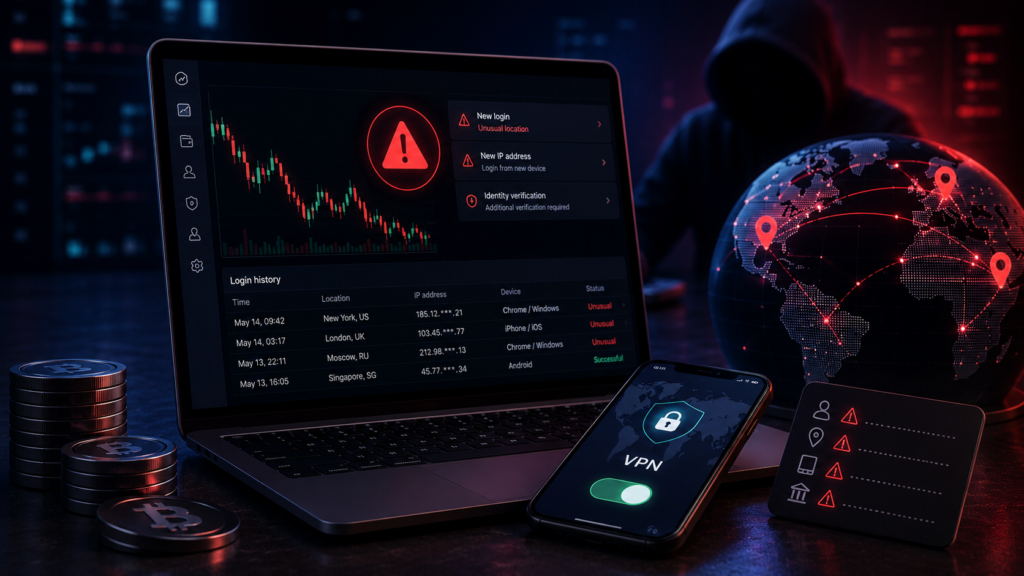
- Behavioural and timing analysis. A login from New York yesterday and Tokyo today, with no time to travel between them, is a classic trigger.
- Device fingerprinting. Browser profile, screen size, fonts and other signals build an identifier that persists even when your IP changes.
- Mobile location mismatch. A phone leaks GPS, Wi-Fi and Bluetooth signals. If your device location does not match your VPN server, that gap is visible.
The often-quoted claim that exchanges catch 70 to 80% of VPN users is real for one specific case: cheap or free VPNs used to evade geo-blocks. It is not a fixed law of nature, but if you are using a shared datacenter IP to fake a country, assume you will be seen.
Evasion Gets You Frozen, Security Does Not
This is the distinction the clickbait skips, and it is the one that matters.
Using a VPN to evade a restriction means making the exchange believe you are somewhere you are not, usually to access a platform banned in your country. This breaks the exchange’s terms of service. It is what the detection systems above are built to catch, and being caught means frozen funds or a ban.
Using a VPN for security means protecting a session on a network you do not trust, on an exchange you are already allowed to use. You are not faking your location. You are encrypting a connection so the coffee-shop Wi-Fi cannot intercept it. That is legal, legitimate, and not what the freeze mechanisms are hunting.
The test is simple: if your VPN server is in the country you actually live in, you are using it for security. If it is somewhere else to unlock a platform, you are evading, and you are exposed.
A Flagged Account, and What Follows
A VPN account frozen by an exchange is rarely an instant ban. It is usually a cascade, and it escalates.
- Withdrawals freeze first. The exchange holds your funds and asks you to prove your location matches your account.
- Re-verification follows. You are asked to complete or repeat KYC, sometimes with jurisdiction-specific ID the platform may not even support.
- Restrictions or closure. Reduced limits, a locked account, or in the case of clear ToS violation, permanent closure with a withdrawal-only window.
None of that is worth the convenience of evading a geo-block, which is the real argument for staying on the security side of the line.
Using a VPN With an Exchange Safely
A VPN is genuinely useful for exchange access when you use it for what it is good at. A VPN for crypto security, as opposed to evasion, is a setup that stays safe, and a no-logs VPN crypto users can trust is the foundation of it:
- Connect to a server in your own country. This keeps your apparent location consistent with your KYC details, which is the single biggest thing you control.
- Use a no-logs provider. A GnuVPN no-logs policy means the provider is not retaining the connection records that would undermine the privacy you are running the VPN for in the first place.
- Keep a kill switch on. A GnuVPN kill switch cuts your connection if the tunnel drops, so your real IP does not suddenly appear mid-session and create exactly the location jump that flags an account.
- Prefer obfuscated traffic on hostile networks. Where a network itself blocks VPNs, GnuVPN obfuscation through SoftEther disguises the traffic as ordinary HTTPS, which addresses the DPI-fingerprint layer of detection, though not the datacenter-IP layer.
The point of all four is consistency and security, not deception. You are protecting a legitimate session, not trying to look like someone in another country.
Where a VPN Cannot Help You
Worth stating plainly, because plenty of marketing implies otherwise.
A VPN cannot beat datacenter-IP reputation. The moment your traffic comes from a known VPN range, that signal exists regardless of how good the encryption is. Obfuscation addresses the traffic-fingerprint layer, not the IP-reputation layer.
It also cannot fix behavioural flags. If your login pattern jumps across the world, or your device fingerprint says one thing while your IP says another, no protocol hides that. Anyone selling a VPN as a guaranteed way to trade on a restricted exchange is selling a way to get frozen.
FAQ
Does a VPN get your account flagged?
It depends on how you use it. Using a VPN to evade a geo-restriction gets flagged, because exchanges detect datacenter IPs and VPN traffic fingerprints, and the result is often frozen funds. Using one for security, connected to a server in your own country on an exchange you are allowed to use, is legitimate and far less likely to trip detection.
Is it legal to use a VPN with a crypto exchange?
Using a VPN for privacy and security is legal in most countries. Using one to break an exchange’s terms of service, such as accessing a platform banned in your jurisdiction, is a violation that can cost you your account and funds even where the VPN itself is legal. The tool is legal; the evasion is the problem.
Can obfuscation hide my VPN from an exchange?
Partly. Obfuscation such as SoftEther disguises VPN traffic as ordinary HTTPS, which addresses the deep-packet-inspection layer of detection. It does not change the fact that your IP belongs to a datacenter range, which exchanges check separately, so it is not a complete cloak.
Will my funds be frozen just for using a VPN?
Not automatically for security use from your own region. Freezes are triggered by evasion signals: a location mismatch, a datacenter IP from a restricted country, or a login pattern that does not add up. A consistent, same-country security setup is unlikely to trigger them on its own.
Is GnuVPN good for crypto?
For security use, yes. GnuVPN for crypto covers the legitimate case well, with a no-logs policy, a kill switch, and SoftEther obfuscation for networks that block VPNs, plus direct crypto payment. It is not a tool for evading exchange restrictions, and no honest VPN is.
Disclaimer: This article is provided for informational purposes only. It is not offered or intended to be used as legal, tax, investment, financial, or other advice. Using a VPN to circumvent an exchange’s terms of service may result in account closure or loss of funds.