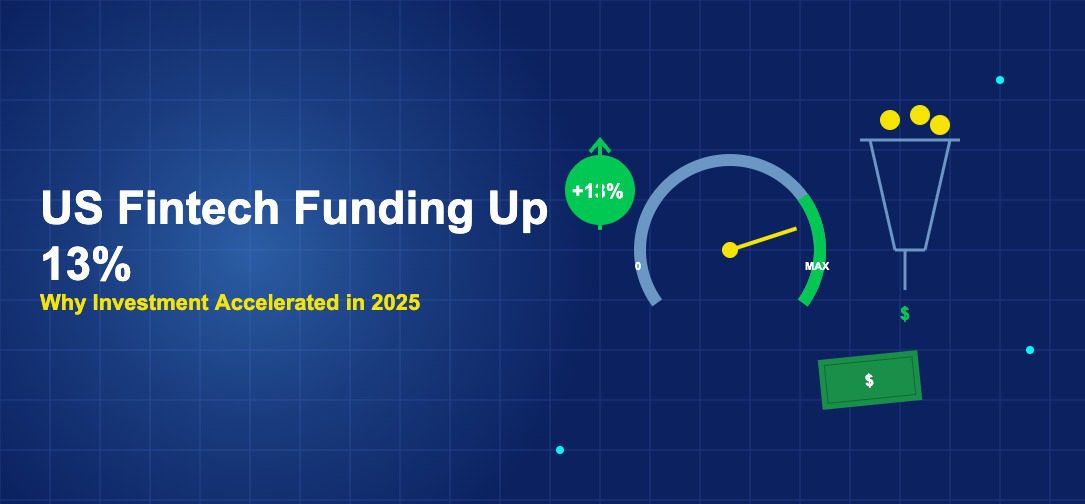
US fintech funding in 2025 reflects a market that has reset from the 2021 bubble but is showing selective recovery. The total capital deployed into US fintech companies in 2025 is expected to be $22-28 billion, compared to the $63 billion peak in 2021 and $17 billion trough in 2023. This represents a structurally lower but more sustainable funding environment that rewards demonstrated business performance over growth narratives.
The funding recovery is concentrated in specific categories: AI-enabled financial services, B2B payments infrastructure, embedded finance, and companies with demonstrated paths to profitability. Consumer-facing fintechs without clear unit economics continue to struggle for capital. The bifurcation between well-funded winners and capital-constrained challengers is more pronounced than at any point in the past decade.
Seed and Early Stage Funding
Seed and early-stage fintech funding has recovered more strongly than late-stage growth equity. AI fintech founders are attracting seed and Series A capital at valuations that would have seemed aggressive in 2023 but appear reasonable given the pace of AI progress. Investors are willing to fund pre-revenue AI fintech companies with compelling technology and strong founding teams, reflecting the broader AI investment enthusiasm that has characterized 2024-2025 across all sectors.
Early-stage fintech investment themes in 2025 include AI-powered compliance and RegTech (regulatory technology), stablecoin payment infrastructure, climate fintech (carbon credit markets, green lending), and financial services for underserved demographics. These categories are attracting seed capital of $2-10 million for compelling early-stage companies.
Growth Stage Funding
Series B and C fintech funding,$20-100 million rounds for growth-stage companies,is the most selective segment of the market. Investors at this stage require demonstrated revenue, improving unit economics, and credible paths to profitability within 18-24 months. The bar has risen significantly from 2021, when growth stage fintechs could raise large rounds on revenue growth alone without profitability expectations.
Companies raising growth-stage rounds in 2025 include enterprise fintech platforms with $20-50 million in ARR and 30%+ growth, BNPL companies with improved credit quality and expanding merchant networks, and digital banking platforms with bank charters and improving efficiency ratios. These companies represent the survivors of the 2022-2023 correction,their business models have been tested and validated through the difficult funding environment.
The IPO Market as a Funding Signal
The fintech IPO market is the most important signal for overall fintech funding. When fintech companies successfully IPO and trade well, it validates the asset class, provides liquidity for early investors, and reinvigorates late-stage venture funding. The 2021 SPAC bubble that took many fintechs public at inflated valuations followed by subsequent crashes has made the IPO market cautious about fintech.
Chime’s anticipated IPO, if successfully executed at a valuation of $7-10 billion or higher, would be the most significant US fintech IPO since Robinhood in 2021. Klarna’s planned IPO in 2025 would demonstrate that international fintech can attract US public market interest at reasonable valuations. These IPOs, if successful, would likely catalyze additional late-stage fintech capital deployment as investors anticipate future liquidity.
Fintech Funding by Sector in 2025
Payments and infrastructure is the largest fintech funding category in 2025, receiving approximately 35-40% of total capital. The category includes payment processing companies, FedNow integration infrastructure, cross-border payment platforms, and stablecoin payment rails. The combination of proven revenue models and continued market expansion makes payments infrastructure consistently attractive to investors.
AI and data fintech is the fastest-growing category, expected to receive 25-30% of 2025 fintech funding. AI applications across fraud detection, credit underwriting, customer service, compliance automation, and financial planning are attracting capital from both traditional fintech investors and AI-focused investors who see financial services as a high-value application domain.
Neobanking and consumer fintech receives approximately 20-25% of total fintech funding, lower than in 2019-2021 but still significant given the sector’s scale. The capital is concentrated among companies with clear differentiation,bank charters, specific demographic focus, or superior product economics,rather than the generic neobank model that proliferated during the growth phase.
B2B and embedded finance receives approximately 15-20% of total funding. This category includes accounts payable/receivable automation, treasury management, and embedded financial products within vertical software platforms. B2B fintech’s favorable unit economics,business customers with higher LTV and lower churn than consumers,continue to attract investor interest.
Geographic Concentration and Emerging Hubs
US fintech funding remains geographically concentrated but is gradually diversifying. New York City and San Francisco together account for approximately 55-60% of total US fintech capital, driven by the density of both financial institutions and venture capital firms in those markets. New York’s dominance in B2B fintech and institutional-grade products reflects its proximity to the banking and asset management industries it serves. San Francisco and the broader Bay Area maintain strength in AI-driven fintech and infrastructure plays, benefiting from the region’s deep technical talent pool.
Miami, Austin, and Chicago have emerged as secondary fintech hubs with growing deal activity. Miami in particular has attracted payments companies and Latin American-focused fintechs that benefit from the city’s bilingual financial services workforce and proximity to regional markets. Chicago retains strength in trading technology, insurance technology, and payment processing infrastructure, where its legacy financial industry provides both customers and institutional knowledge.
What the Recovery Signals for 2026
The 13% increase in US fintech funding in 2025 is best read as confirmation that the market has found a stable floor rather than the start of a new boom. Investors are deploying capital with discipline, backing companies that demonstrate real revenue, defensible unit economics, and specific market advantages rather than total addressable market narratives. The frothiness of 2021, when growth-stage companies could raise at 40x revenue on the promise of future dominance, has not returned and is unlikely to in the near term.
For founders, the environment rewards focus. The companies attracting the strongest valuations in 2025 are solving specific, high-friction problems in payments, compliance, and AI-assisted underwriting , not attempting to build all-in-one financial super-apps. The message from the investment community is clear: demonstrate that your product earns its place in a customer’s financial workflow, and capital will follow.
The 13% year-over-year recovery also validates a broader thesis: that fintech as a sector has graduated from hype-cycle dynamics into a mature segment of the US technology economy, one where durable value creation , not just growth velocity , is what gets funded and rewarded.