When Dutch viewers research IPTV services, they encounter a consistent problem: providers make claims about their service quality that are difficult to verify before subscribing. Statements about server uptime, stream stability, latency, and channel count are common in IPTV marketing, but without understanding what these metrics mean technically and how to measure them independently, Dutch consumers cannot distinguish meaningful performance claims from marketing language.
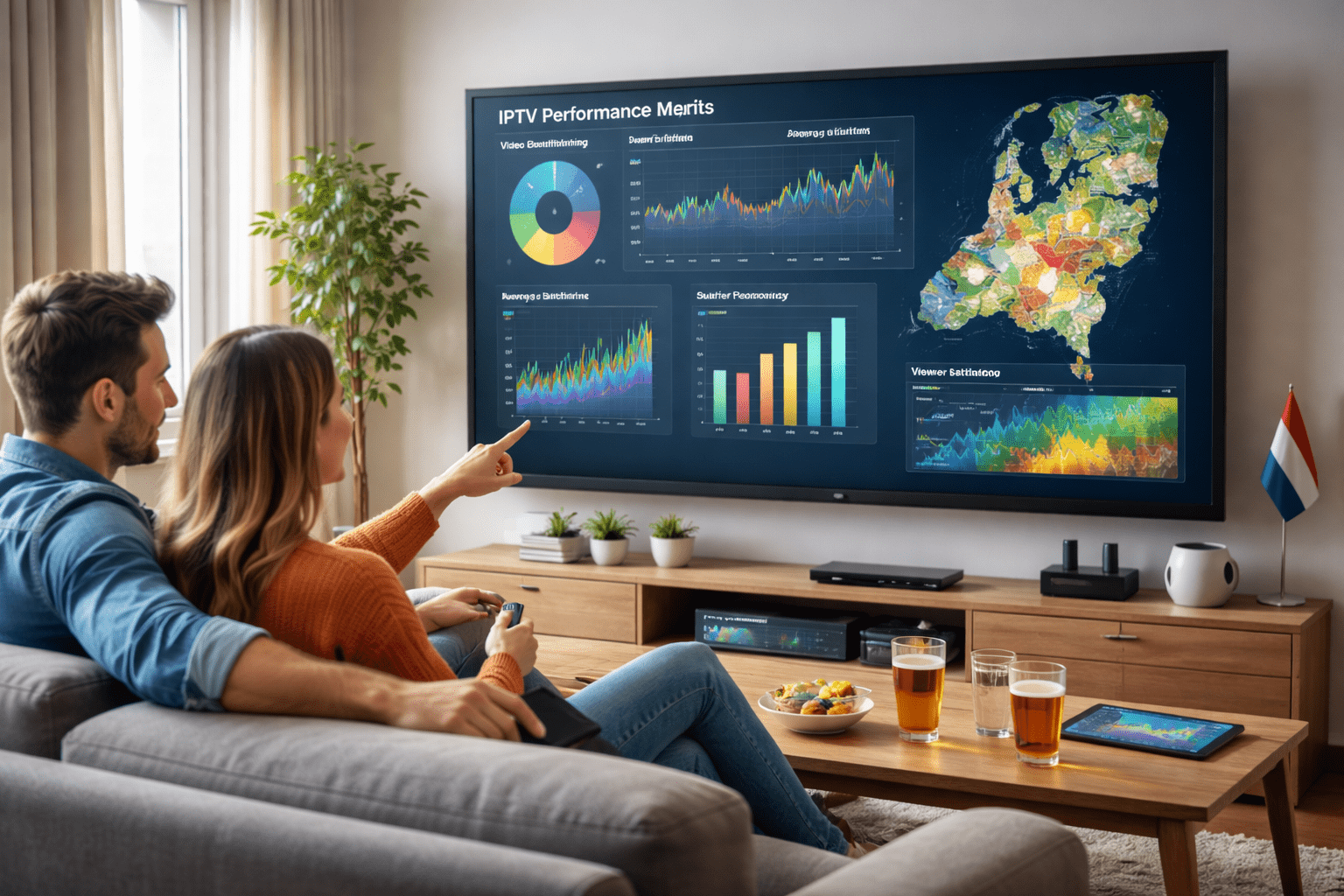
This article approaches IPTV from a data and measurement perspective. It explains what the key performance metrics in IPTV actually measure, how they affect the viewing experience for Dutch households, what the Dutch broadband infrastructure data tells us about the baseline conditions for IPTV quality, and how Dutch viewers can independently evaluate IPTV service performance during a trial period using tools available without cost or technical expertise. The goal is to make IPTV quality assessment something any Dutch viewer can approach systematically rather than relying on provider self-description.
The Core Performance Metrics in IPTV
Bitrate: The Foundation of Stream Quality
Bitrate measures the quantity of data delivered per second in a video stream, expressed in megabits per second (Mbps). It is the most fundamental determinant of IPTV stream quality, because higher bitrate allows more visual information to be encoded per frame, resulting in sharper images, better color reproduction, and more accurate rendering of movement. For Dutch viewers, understanding bitrate helps explain why the same channel can look noticeably different between providers even when both claim to offer HD quality.
Minimum bitrate thresholds for acceptable quality at different resolution levels follow consistent technical standards. Standard Definition (SD, 480p) requires a minimum of 1 to 2 Mbps for acceptable quality, though 3 Mbps or higher produces noticeably better results. High Definition (HD, 720p) requires 4 to 6 Mbps minimum, with 8 Mbps or higher recommended for motion-heavy content such as sports. Full HD (1080p) requires 8 to 12 Mbps minimum, with 15 to 20 Mbps producing excellent quality. 4K Ultra HD requires 25 Mbps minimum for H.264 encoded content and 15 to 18 Mbps for H.265/HEVC encoded content at equivalent visual quality.
For Dutch viewers evaluating an IPTV provider during a trial, the VLC media player provides a practical bitrate monitoring tool. Open the stream, navigate to Tools, then Media Information, then Statistics. The Input Bitrate field shows the actual data rate being received in real time. Comparing this against the resolution being displayed reveals whether a provider is delivering genuine HD bitrates or compressing HD-labelled content to SD-level data rates.
Latency: Why It Matters More Than Dutch Viewers Realize
Latency in IPTV refers to the delay between the actual live broadcast moment and when that moment appears on the viewer’s screen. For most television content, latency is invisible and irrelevant. A Dutch viewer watching a drama series or documentary is unaffected by whether the stream has 5 seconds or 30 seconds of latency relative to the broadcast.
For live sports, however, latency becomes critically important in the Dutch social context. Eredivisie matches, Formula 1 Grand Prix weekends, Champions League evenings, and major Oranje international matches are extensively discussed in real time on social media platforms and in WhatsApp groups. A Dutch viewer watching a match with 25 seconds of stream latency will receive WhatsApp messages reporting a goal before they see it on screen. This social media spoiler problem is one of the most consistently reported frustrations among Dutch IPTV users who follow live sports.
For Dutch viewers considering whether IPTV Kopen makes practical sense for a sports-focused household in the Netherlands, testing stream latency specifically during a live broadcast is the most revealing quality test available during any trial period.
HLS (HTTP Live Streaming), the dominant IPTV protocol in the Dutch market, introduces inherent latency of 10 to 30 seconds due to its segmented delivery model. Low-Latency HLS (LL-HLS) reduces this to 2 to 4 seconds. RTSP (Real-Time Streaming Protocol) achieves under 2 seconds. Dutch viewers who prioritize sports viewing should specifically ask providers about latency specifications for their sports channels and test this during any trial period by comparing stream timing against a reference broadcast such as a radio commentary of the same event.
Buffering Ratio: The Stability Metric
The buffering ratio measures the proportion of viewing time spent waiting for data rather than watching content. It is expressed as a percentage: a buffering ratio of 1 percent means that for every 100 minutes of attempted viewing, 1 minute was spent in buffering states. Industry standards for acceptable streaming quality consider a buffering ratio below 0.5 percent as high quality and above 2 percent as poor quality.
Dutch IPTV viewers can estimate buffering ratio informally during a trial period by noting the frequency and duration of buffering interruptions during a viewing session. A more systematic measurement involves noting the clock time at the start of a viewing session, recording each buffering incident with its duration in seconds, and calculating the total buffering time as a percentage of total session time. Doing this across multiple sessions at different times of day, including peak evening hours between 19:00 and 22:00 CET when Dutch viewership is highest, provides a realistic picture of the provider’s actual stability under varied server load conditions.
Zapping Speed: The Channel Switching Experience
Zapping speed measures the time between a viewer pressing a channel change button and the new channel appearing on screen. This metric is rarely discussed in IPTV marketing but is consistently cited by Dutch users as a significant quality-of-life factor in daily IPTV use. Traditional cable television achieves sub-second channel switching because all channels are continuously broadcast and switching merely changes which signal the receiver decodes. IPTV must make a new network request and begin buffering a new stream for each channel change, making sub-second zapping technically challenging.
IPTV zapping speeds in the Dutch market typically range from 1 to 5 seconds. The factors affecting zapping speed include the physical distance between the viewer’s location and the CDN edge server delivering streams (shorter distance means faster initial response), the size of the initial stream buffer the application requires before beginning playback (larger buffer increases startup delay but reduces subsequent buffering), and the application’s prefetching behavior (some applications begin loading adjacent channels in advance to reduce apparent switching time). Dutch viewers can evaluate zapping speed informally during a trial by counting seconds between channel selection and video appearing.
Dutch Broadband Data: The Infrastructure Foundation for IPTV Quality
Understanding IPTV performance requires understanding the network infrastructure it operates on in the Netherlands. The following data points establish the context within which Dutch IPTV services deliver their streams.
| Infrastructure Metric | Dutch Market Data | IPTV Relevance |
| Average fixed broadband download speed | Over 200 Mbps in major Dutch cities | Far exceeds 4K IPTV requirements |
| Fiber coverage (urban) | Above 80% in Amsterdam, Rotterdam, Den Haag, Utrecht, Eindhoven | Symmetric speed eliminates asymmetric congestion |
| CDN proximity (AMS-IX) | One of world’s largest internet exchanges in Amsterdam | Sub-5ms latency to CDN edge nodes |
| Average Wi-Fi speed (home network) | Typically 50 to 150 Mbps on modern routers | Sufficient for HD; ethernet recommended for 4K |
| 4G/5G mobile speeds | Above 50 Mbps average on T-Mobile, Vodafone, Odido | Supports HD IPTV on mobile devices |
| Rural fiber coverage | Variable; rollout ongoing in Drenthe, Zeeland, Friesland | ADSL below 20 Mbps may limit quality |
How to Conduct an Independent IPTV Quality Assessment
Dutch viewers evaluating an IPTV provider during a proefabonnement (trial subscription) can conduct a systematic quality assessment using the following methodology. This approach produces objective data rather than subjective impressions, enabling meaningful comparison between providers.
Step 1: Establish Your Baseline Connection Performance
Before testing any IPTV stream, run a speed test at speedtest.net from the same device you plan to use for IPTV, using the same connection type (Wi-Fi or ethernet). Record your download speed, upload speed, and ping time. This establishes whether any quality issues you observe are attributable to your connection or to the provider’s infrastructure. A Dutch fiber household with 200 Mbps download speed and 5ms ping should experience no connection-side limitations for any IPTV quality tier.
Step 2: Test at Multiple Times of Day
IPTV quality varies significantly with server load. Test during three distinct time windows: morning (09:00 to 12:00, low Dutch viewership), afternoon (14:00 to 17:00, moderate viewership), and evening (19:00 to 22:00, peak Dutch viewership). Note the buffering ratio, visual quality, and any freezes during each window. A provider whose quality degrades significantly during peak hours has insufficient server capacity for the Dutch market’s demand profile.
Step 3: Test Across Content Types
Different types of content have different quality requirements. Test live news channels (low motion, lower bitrate requirement), sports channels (high motion, high bitrate requirement, latency sensitivity), children’s animation (moderate motion, color accuracy important), and on-demand film content (highest quality tier, compression artifacts most visible on large screens). A provider who delivers excellent news quality but poor sports quality has inadequate server infrastructure for high-bitrate live content.
Step 4: Measure EPG Accuracy
Verify that the Electronic Programme Guide displays correct programme titles and accurate Dutch times for at least 10 different channels spanning Dutch public broadcasting, commercial broadcasting, regional channels, and sports channels. EPG inaccuracy or gaps indicate poor data quality from the provider’s EPG source, which degrades the daily usability of the service for Dutch viewers who rely on the programme guide for scheduling their viewing.
Step 5: Evaluate Support Responsiveness
During the trial period, contact the provider’s support channel once with a specific technical question (for example, asking about the latency of sports channel streams or requesting the EPG source URL for Kodi configuration). Measure response time and evaluate the technical accuracy and helpfulness of the response. Support quality is a leading indicator of the provider’s overall operational competence and commitment to Dutch subscriber satisfaction.
Dutch viewers who apply this systematic evaluation methodology during their trial period are well equipped to make an informed decision about whether a specific service meets their quality requirements. Understanding what quality standards to expect from a reputable provider, and what trial terms a credible IPTV Abonnement in the Dutch market should include, provides the framework for confident evaluation.
Server Infrastructure: What Dutch Viewers Should Understand
IPTV service quality is ultimately determined by the provider’s server infrastructure. Dutch viewers cannot directly inspect a provider’s servers, but they can understand what server architecture concepts mean for their viewing experience and use this knowledge to interpret quality observations.
Load Balancing and Its Effect on Dutch Peak Hours
Load balancing distributes viewer connections across multiple servers, preventing any single server from becoming overloaded during high-demand periods. For Dutch IPTV providers, the critical high-demand periods are Saturday afternoon and evening (Eredivisie matches), Formula 1 Grand Prix race days, major Oranje international matches, and Dutch prime-time weekday evenings (19:00 to 22:00 CET). Providers with sophisticated load balancing maintain consistent quality during these peaks; providers without adequate load balancing show measurable quality degradation specifically during these high-demand windows.
Geographic Server Distribution and CDN Use
Providers who use CDN infrastructure with edge nodes in or near the Netherlands deliver streams to Dutch viewers with shorter network paths and lower latency than providers who serve all European viewers from single data centers in distant locations. Dutch viewers can infer CDN infrastructure quality from stream startup speed (fast startup suggests nearby CDN caching) and from the absence of quality degradation during European peak hours when CDN capacity is most heavily used.
Redundancy and Failover
Redundant infrastructure means that if a primary server or network path fails, an automatic failover mechanism redirects viewer connections to backup infrastructure without service interruption. For Dutch viewers, redundancy manifests as the absence of sudden total service outages that affect all channels simultaneously. A provider who experiences occasional brief freezes on specific channels during high-demand periods is likely reaching capacity limits. A provider who experiences complete outages affecting all channels is likely lacking adequate redundancy infrastructure.
Data Privacy and Security Metrics in Dutch IPTV
Beyond stream quality, Dutch viewers who approach IPTV from a data perspective should understand the data security and privacy metrics relevant to their subscription. IPTV services collect data about subscribers including account credentials, payment information, IP address and device identifiers, and viewing history. The security of this data collection is a measurable technical characteristic of the provider’s infrastructure.
SSL/TLS encryption on the provider’s website (indicated by HTTPS and a valid certificate) is a basic security minimum. GDPR compliance documentation (a published privacy policy referencing GDPR obligations) indicates that the provider is accountable to Dutch and EU data protection standards. Payment processing through established payment processors (iDEAL, PayPal, Stripe, or major card processors) ensures that payment data is not stored directly by the IPTV provider but handled by specialized payment security infrastructure. The absence of any of these security indicators is a data risk that technically minded Dutch viewers should weigh in their provider evaluation.
Frequently Asked Questions
How can I measure IPTV stream quality without technical software?
You can conduct a useful quality assessment using only the timer on your phone. Note the time when you start watching, record each buffering incident by time and duration in seconds, and calculate the buffering ratio at the end of a 60-minute session. A session with less than 30 seconds of total buffering across 60 minutes represents a buffering ratio under 0.8 percent, which is acceptable quality. More than 2 minutes of buffering in a 60-minute session (3.3 percent ratio) indicates poor service quality that is likely to be frustrating in daily use.
What does 99.9 percent uptime mean in practical terms for a Dutch IPTV subscriber?
99.9 percent uptime means the service is unavailable for a maximum of 8.76 hours per year, or approximately 43 minutes per month. For a Dutch viewer watching 2 to 3 hours of IPTV daily, 99.9 percent uptime means they can expect less than one minute of service unavailability per day on average. In practice, this typically manifests as very occasional brief outages rather than frequent short interruptions. Note that uptime claims refer to the provider’s infrastructure availability, not to individual channel availability, which may vary due to factors outside the provider’s direct control.
How does H.265 compression affect the visual quality of Dutch IPTV streams?
H.265 (HEVC) encoding achieves comparable perceptual quality to H.264 at approximately half the bitrate. For Dutch viewers, this means an H.265 Full HD stream at 6 Mbps produces similar visual quality to an H.264 Full HD stream at 12 Mbps. On large Dutch Smart TVs (55 inches or larger), the difference between 6 Mbps H.265 and 12 Mbps H.264 at Full HD is minimal for most content. For sports content with high motion, higher bitrates in either codec produce noticeably better results, with less compression artifact and smoother motion rendering during fast play sequences.
What is the relationship between ping time and IPTV quality?
Ping time (network latency) affects IPTV quality in two specific ways. First, it affects stream startup time: a higher ping to the CDN server means longer initial buffering before playback begins. Second, it affects the responsiveness of interactive features such as channel switching and catch-up navigation. For continuous playback quality (buffering during viewing), throughput (download speed) is more important than ping. Dutch fiber connections to local CDN nodes typically achieve ping times of 5 to 20ms, which is more than adequate for excellent IPTV startup and navigation responsiveness.