
Top 5 Vendors for Best Ethereum Post-Quantum Security Services

Quantum researchers just shortened the countdown. In March 2026, Google’s team reported that breaking Ethereum’s encryption will need twenty times fewer qubits than experts once thought, dragging “Q-Day” within the next decade, according to SecurityWeek.
If attackers record encrypted traffic now, they can decrypt it later, turning today’s signature into tomorrow’s exposed wallet. Preparation is no longer optional – it’s a sprint.
A new crop of specialists has answers. They weave post-quantum cryptography into your existing wallets, nodes, and custody flows. This guide profiles the five leaders – starting with Project Eleven’s post-quantum cryptography solutions for enterprises – so you can choose the service that fits your risk, roadmap, and budget.
Why Ethereum needs post-quantum security
Every Ethereum transaction reveals a sliver of information.
When you send ETH, your public key appears on-chain. That key is safe today because classical computers would need longer than the age of the universe to break it.
Quantum machines change the equation. Shor’s algorithm can unravel elliptic-curve signatures in hours once enough qubits exist, and Google’s March 2026 research shows that milestone is closer than expected.
The Ethereum Foundation is responding. In January 2026 it formed a Post-Quantum (PQ) team, backed by a seven-figure budget, to add quantum-resistant signatures to the protocol before 2029, according to Cointelegraph. Foundation researcher Justin Drake called quantum safety a “top strategic priority” in the launch announcement.
That timetable still leaves a gap. Core upgrades require years of research, devnet testing, and community approval. Meanwhile, attackers can archive encrypted data now and decrypt it later – a tactic security teams call “harvest now, decrypt later.”
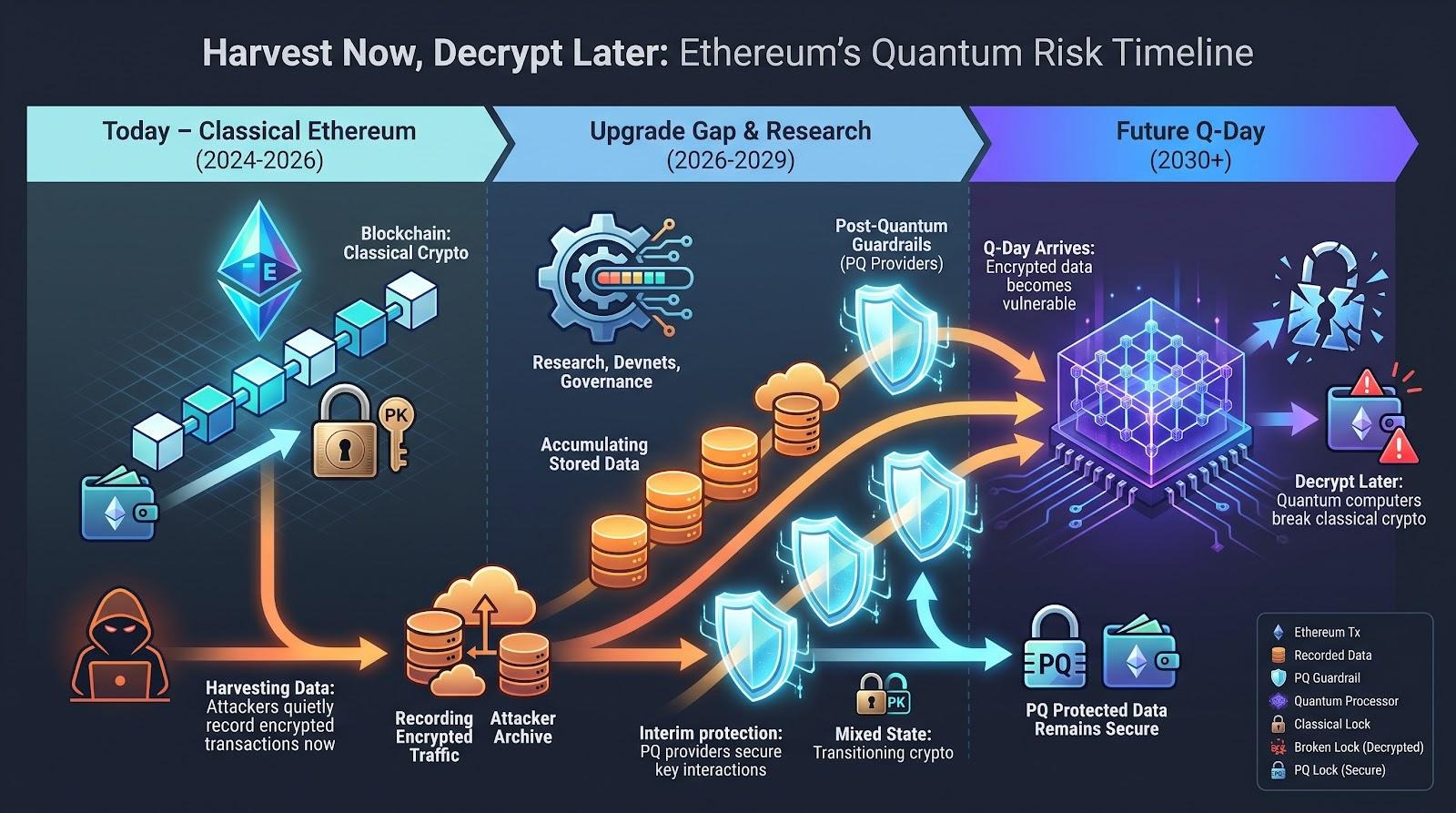
For the next several upgrade cycles, Ethereum will rely on classical cryptography while quantum hardware races ahead. Funds in any wallet that has ever broadcast a transaction, accounting for more than half of all ETH by one industry audit, remain exposed.
Third-party providers fill this gap. They wrap your keys in lattice-based signatures, introduce hybrid multi-sig schemes, and audit smart contracts for quantum-sensitive patterns. Think of them as temporary guardrails until the protocol overhaul arrives.
Before we meet those vendors, we need a comparison scorecard. Standards, integration, performance, and proof will guide your choice.
Criteria are up next.
How to judge a post-quantum partner
Before we line up vendors, we need a scorecard.
A strong post-quantum provider does more than deliver a new algorithm. It must mesh with Ethereum’s quirks, operate at production speed, and keep pace with emerging standards.
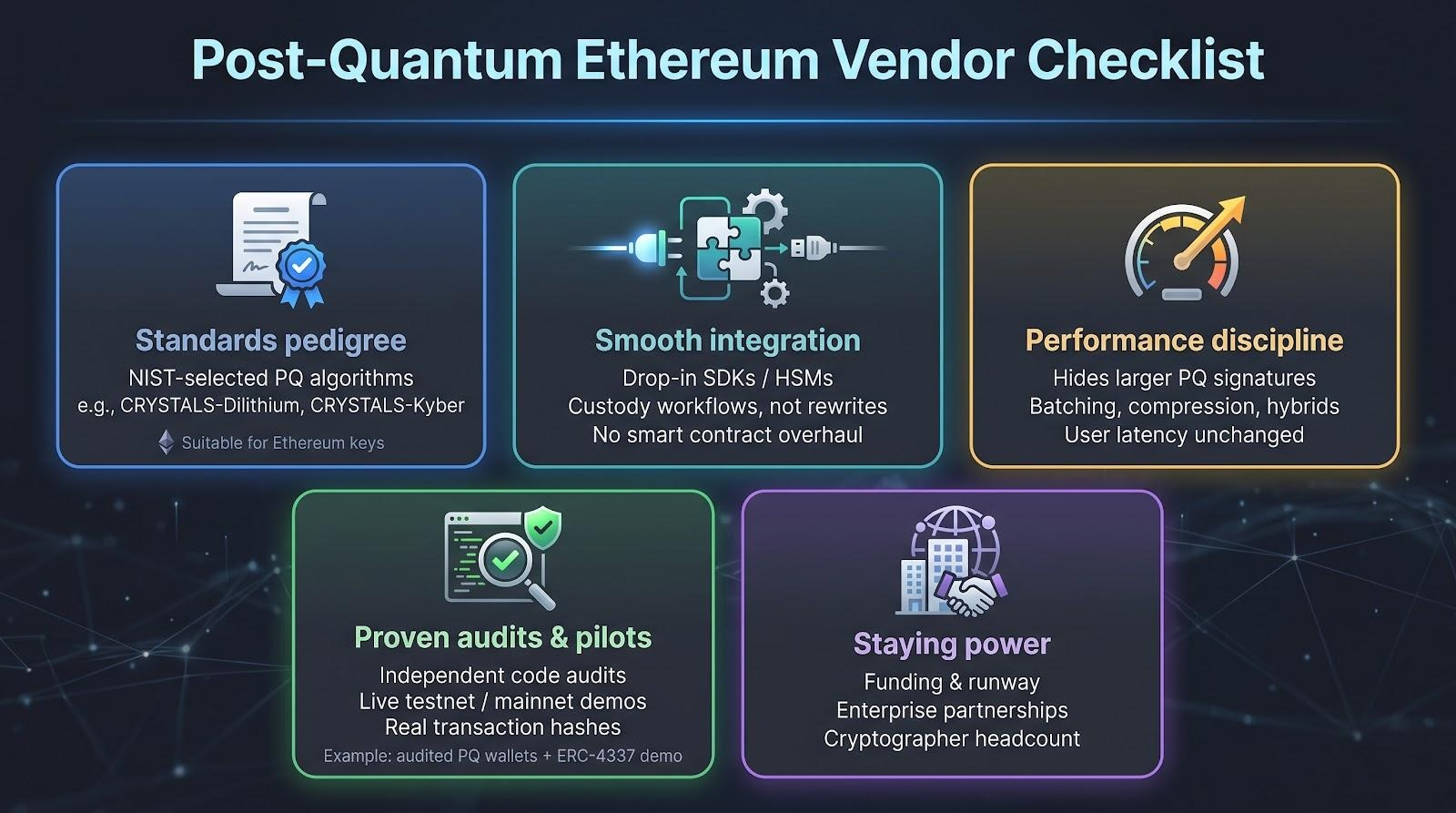
Here’s the checklist we share with teams:
- Standards pedigree: Top vendors include the algorithms the U.S. National Institute of Standards and Technology selected for post-quantum encryption, such as CRYSTALS-Dilithium for signatures and CRYSTALS-Kyber for key exchange.
- Smooth integration: Look for drop-in SDKs, hardware modules, or custody workflows that let you add quantum-safe keys without rewriting every smart contract.
- Performance discipline: Post-quantum signatures are larger and slower than ECDSA. The best tools hide that cost through batching, compression, or hybrid schemes so end users never notice.
- Proven audits and pilots: Ask for public code audits or live-network demos, not just white-paper promises. A single transaction signed on a testnet beats a stack of press releases.
A concrete yardstick helps.
Project 11 offers one: its open-source libqc and Quantum Vault wallets cleared a May 2026 Cure53 security audit, and the GitHub repo ships an ERC-4337 demo that anyone can use to broadcast a Dilithium-signed transaction on an Ethereum testnet.
Having code you can clone and a transaction hash you can verify turns the “Proven audits and pilots” box from theory into something tangible.
- Staying power: Funding, partnerships, and cryptographer head count matter. You want a vendor that will still be around when Ethereum’s core upgrade lands.
Keep this list close. It converts marketing language into concrete answers and helps you choose technology that can endure the quantum transition.
With criteria set, we can meet the first contender.
Project Eleven: quantum-proofing blockchain infrastructure
Project Eleven moves first and moves deep. Its Post-Quantum Cryptography Solutions for Enterprises program partners with protocols and critical infrastructure teams to audit consensus mechanisms, run post-quantum readiness assessments, and embed lattice-based signatures throughout wallets and validator nodes.
While many cyber firms bolt a post-quantum module onto legacy products, this team built its entire business around securing blockchains for the quantum era. The founders came from academic cryptography and Ethereum smart-contract auditing, so they speak both languages fluently.
The company’s playbook starts with a forensic review of your keys, contracts, and validator nodes. Engineers map every place elliptic-curve signatures hide, then replace them with lattice-based or hash-based alternatives that match NIST’s newly standardized algorithms such as CRYSTALS-Dilithium.
That rigor shows in the field. In 2023, Project Eleven co-piloted the first quantum-safe transaction on Solana’s public network, a live test that proved large signatures can clear mempools without choking performance. In early 2026, investors wrote a twenty-million-dollar check to scale the platform and hire more cryptographers.
For Ethereum users the payoff is immediate. Custodians gain hardware-secured wallets that sign with both classical and post-quantum keys. DeFi teams get code reviews that flag quantum-sensitive patterns long before launch. Enterprises running staking pools receive ready-made key-rotation plans, so they can migrate validators without downtime.
In short, Project Eleven lets you add quantum safety to today’s stack and rest while the protocol catches up.
QuSecure: end-to-end PQC without the rip-and-replace
QuSecure tackles the challenge from the network edge inward.
Its flagship platform, QuProtect, positions itself between your applications and the transport layer, upgrading every packet (API calls, validator gossip, and cold-wallet authorizations) to post-quantum encryption in real time. You keep the infrastructure you trust; the cryptography underneath gets a quiet makeover.
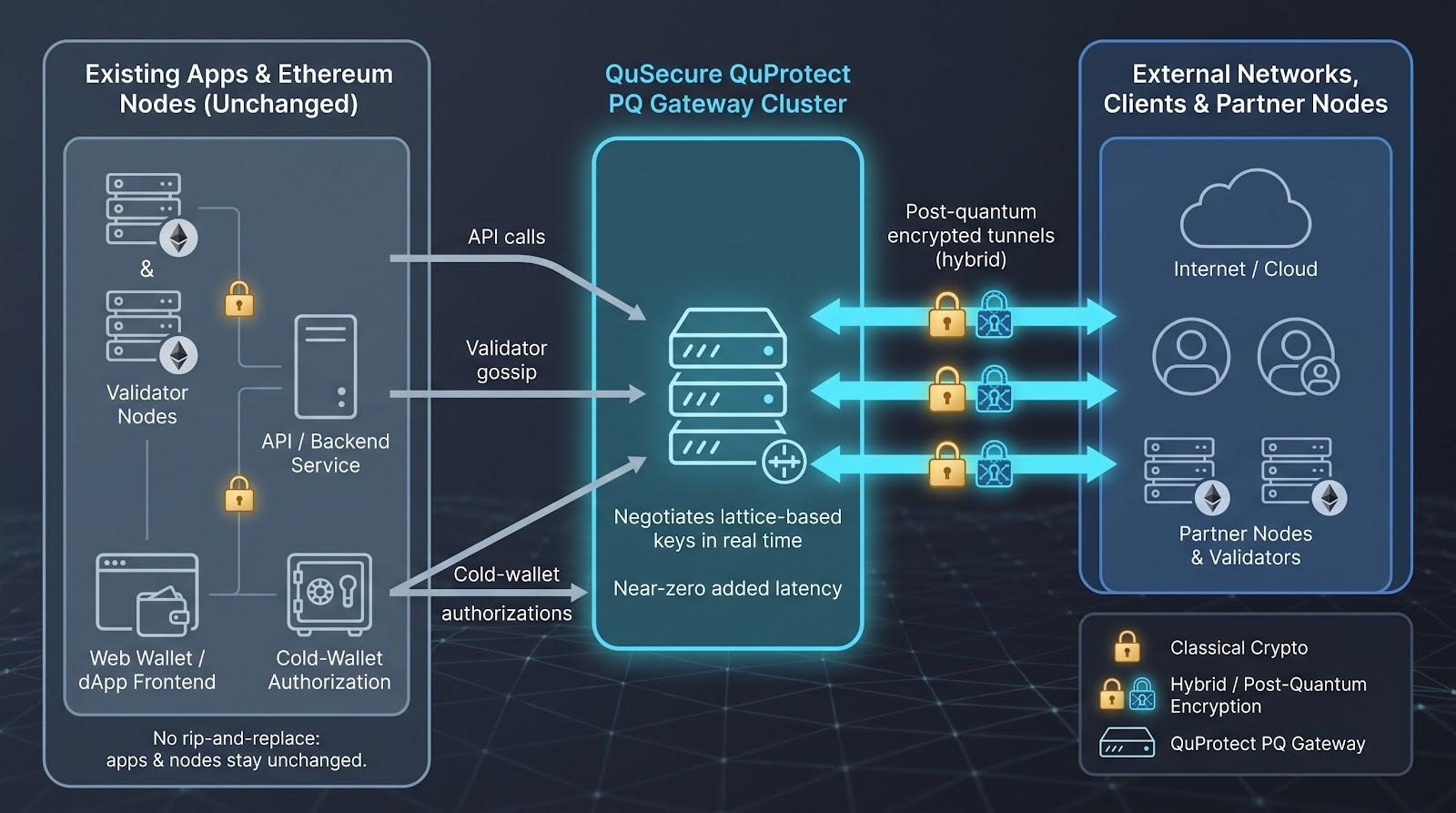
That “no forklift” promise resonates with exchanges and custodians running fleets of Ethereum nodes across clouds and data centers. Instead of rewriting signing software, you point traffic through a QuSecure gateway that negotiates lattice-based keys with near-zero added latency.
The company already has proof on the scoreboard. It ran secure tunnels for a U.S. federal pilot and won Series-A backing from Accenture and Two Bear Capital – signs that large environments trust QuSecure’s throughput and compliance story.
For you, the upside is speed. Deploy a virtual appliance, update DNS, and see post-quantum traffic flow before lunch. As Ethereum’s core cryptography evolves, QuProtect can refresh algorithms from a central console, saving you another migration cycle.
If your aim is quick coverage across a wide footprint, QuSecure offers the fastest route to quantum safety.
Post-Quantum: a decade of field-tested encryption
Post-Quantum wears its mission on the masthead.
Founded in London long before “Q-Day” entered boardroom slides, the company has spent ten years hardening military, banking, and government networks against future cryptanalytic leaps. That longevity translates into mature, battle-tested products rather than lab demos.
Its crown jewel is a quantum-safe VPN that replaces RSA handshakes with lattice-based key exchange. For Ethereum validators the benefit is clear: node-to-node gossip and RPC traffic remain confidential even if an eavesdropper records packets for a later quantum replay.
Post-Quantum also ships an identity stack that issues digital certificates signed with the same NIST-track algorithms, letting exchanges or DeFi front ends prove origin without relying on vulnerable TLS roots. These pieces fit together, so a single console can manage wallets, servers, and back-office apps under one post-quantum policy.
Proof backs the claims. NATO chose Post-Quantum to secure classified communications during a 2022 exercise, and several European central banks have since run lab pilots with its libraries. When regulators ask for a pedigree, this résumé clears the due-diligence hurdle.
For Ethereum teams that want to protect the entire perimeter (not just the signing key), Post-Quantum offers a depth of real-world deployments few rivals can match.
PQShield: from silicon to software, security all the way down
PQShield tackles quantum risk at the root: the chip itself.
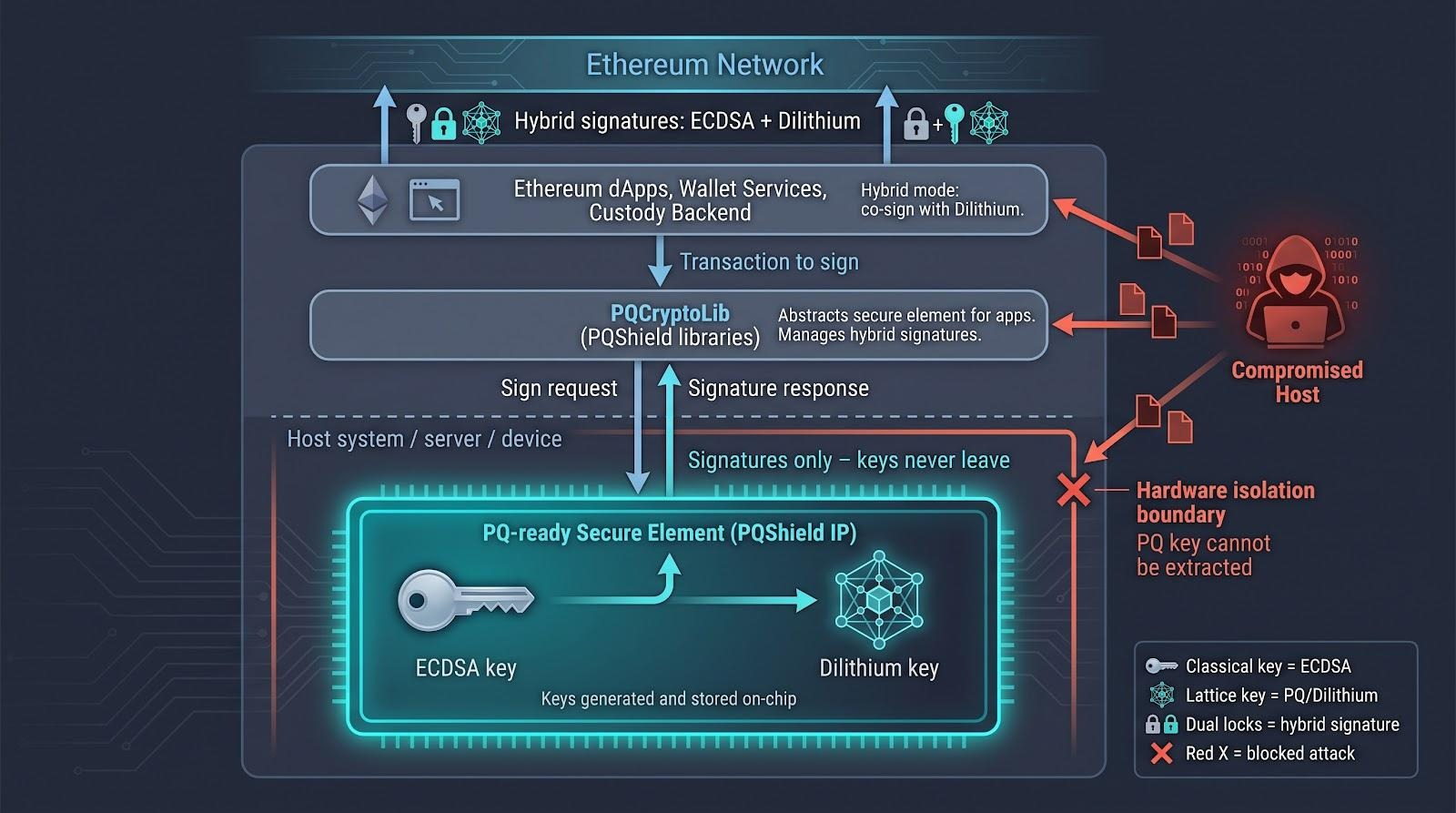
Most wallet makers and exchanges guard secrets inside secure elements originally built for RSA and ECDSA. PQShield licenses new silicon IP that generates, stores, and signs with lattice-based keys right on the hardware. No firmware shim. No side-channel roulette.
The company’s academic DNA shows in its code libraries, too. Several PQShield researchers co-authored algorithms later chosen by NIST, so the same minds that wrote the math also maintain the reference implementations in your codebase.
For Ethereum developers the path is straightforward. Drop the PQCryptoLib into your backend, switch on hybrid mode, and your dApp starts co-signing each transaction with a Dilithium key. When the Ethereum protocol adopts those signatures natively, flip a flag to make them primary. Until then, the classical signature keeps today’s nodes happy.
Custodians gain another perk. Because keys never leave the secure element, even a compromised host cannot leak the quantum-safe secret. That hardware isolation pushes the attack surface down to solder and microscope territory, far outside most threat models.
If you want assurance that runs from compiler to chip foil, PQShield delivers the full stack.
SandboxAQ: enterprise-scale crypto agility

SandboxAQ sits at the crossroads of quantum science and big-company reality.
Spun out of Alphabet, the firm combines AI analytics with post-quantum cryptography to scan every database, API, and blockchain node an enterprise owns. The result is a heat map of vulnerable keys plus a one-click plan to replace them with NIST-approved algorithms.
That breadth matters for institutions folding Ethereum into a wider tech stack. A bank can harden its validator cluster, web wallets, and customer mobile app in the same dashboard instead of juggling separate vendors.
SandboxAQ backs words with reach. It secured a five-year contract with the U.S. Department of Defense to modernize government crypto and partnered with SoftBank to trial hybrid TLS across live 5G traffic. Those projects show the platform can update millions of keys without downtime.
For you, the advantage is orchestration. Flip a policy switch, and every system under management starts performing dual signatures: classical for today’s compatibility, lattice-based for tomorrow’s assurance. When Ethereum core developers approve new signature types, SandboxAQ updates the policy and retires the older keys automatically
If your organization spans clouds, continents, and compliance regimes, this platform keeps crypto agility from turning into crypto chaos.
Frequently asked questions
Can quantum computers break Ethereum today?
Not yet. The most advanced machines still lack the qubits and error correction to crack a 256-bit elliptic-curve key in practice. Security teams worry about the shrinking gap between theory and hardware. Attackers can record encrypted traffic now and decrypt it later when the tech matures, so acting early closes that window.
Is Ethereum itself becoming quantum-resistant?
Yes, but protocol change is slow by design. The Ethereum Foundation’s Post-Quantum team aims to bake lattice-based signatures into the protocol by 2029. Until that code ships and nodes upgrade, the network relies on classical math. Third-party services fill the gap.
Why not move to a “quantum-safe” blockchain instead?
Starting fresh sounds easy, yet you would give up Ethereum’s liquidity, tooling, and developer mindshare. A post-quantum add-on lets you keep those network effects while protecting your keys with stronger crypto. Think evolution, not migration.
How do I begin a quantum-readiness assessment?
List every place you sign or encrypt – wallets, smart contracts, backend APIs, validator nodes. A pilot with a vendor from this guide can map elliptic-curve dependencies in about two weeks and suggest a staged replacement plan.
Conclusion
The quantum clock is already running, and Ethereum’s own protocol upgrade will not land before 2029. Project Eleven, QuSecure, Post-Quantum, PQShield, and SandboxAQ each close that gap a different way, from lattice-based wallet signatures and network overlays to secure-element silicon and enterprise-wide crypto orchestration. Ask hard questions, match a vendor to your risk and roadmap, and treat quantum readiness like any other security sprint. The longer you wait, the steeper the hill becomes.







Comment