Package theft costs American households an estimated $8.2 billion in stolen goods every year, according to Security.org’s 2025 Package Theft Report. Most package thieves are in and out in seconds, betting that no one is watching closely enough to catch them.
The common response is a security camera, and most homes now have one. More than half of U.S. households use at least one security device to protect their deliveries, according to the same report. These cameras have a demonstrable deterrence effect, but not all are the same, and the question is how a camera responds when someone reaches for a package.
Most cameras record the event and send a notification. That produces useful footage after the fact, but it leaves the response itself to the homeowner. A theft that takes seconds is usually over before anyone opens the app. Stopping it, rather than recording it, requires the system to act on its own, in the moment.
Speed is the constraint, and speed depends on where the camera’s AI does its work. Vivint’s Smart Deter™ runs that processing on the device itself rather than in the cloud, which is what lets it respond while a theft is still preventable.
The Latency Problem in Cloud-Based Systems
Cloud-based AI processing follows a fixed sequence: the camera captures footage, transmits it to a remote server for analysis, receives instructions back, and then triggers a response. Each stage introduces delay. The round trip isn’t instantaneous, and on unreliable cellular connections or during periods of network congestion, it may not be reliably fast enough to matter.
A camera meant only to record can absorb a few seconds of round trip latency without losing anything. But an active deterrence system doesn’t have that kind of slack. It’s trying to interrupt a sequence, a person spotting a package, walking up to it, and taking it, that plays out in the same handful of seconds the cloud round trip consumes. Put simply, the time the server spends analyzing the scene and sending a response back is time the deterrent doesn’t have.
Where On-Device AI Changes the Calculation
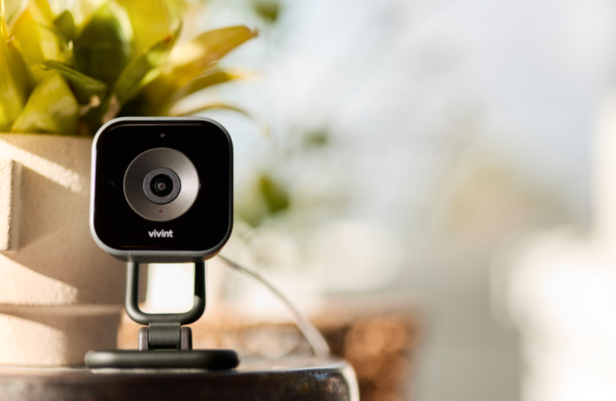
Vivint’s Smart Deter™ uses computer vision chip AI to run person detection and package detection directly on the camera, without transmitting footage to a remote server first. The camera identifies what it sees, makes a decision, and acts within the device itself.
The practical effect is speed. When the system identifies a person approaching a delivered package, it responds with a bright LED ring and a 90 dB speaker tone at the moment of detection.
Once a stolen package is in hand, a warning is more likely to produce a quick exit than to get the thief to put the package down. The deterrent has to fire before the theft starts, and on-device processing is what makes that possible.
Reliability Beyond Speed
On-device AI also fixes a hidden weakness in cloud-dependent systems: silent failure during outages. A cloud camera appears to function during an outage until an event happens and no response comes. Local processing keeps working regardless of connectivity.
There’s a further consideration around data handling. Footage processed on the device doesn’t travel to an external server for analysis, which reduces the exposure of sensitive video to third-party infrastructure.
Detection Without Response
AI-powered person detection and package detection have become reliable enough to identify a suspicious approach with meaningful accuracy. The remaining question is what the system does with that identification, and how quickly.
Detection has largely caught up to that standard. What still separates one system from another is the response: whether it fires automatically, on the camera, or waits for the user to see an alert and decide what to do. Systems that handle detection and deterrence on the device, such as Vivint’s Smart Deter™, are built to act without that wait. Cameras have become standard equipment on many American porches, and this distinction between a system that records an incident and one that intervenes is increasingly defining the category.
About Vivint Smart Deter™
Vivint Smart Deter™ uses computer vision chip AI to run person detection and package detection directly on the camera, without sending footage to the cloud first. It pairs that detection with an automated response, a bright LED ring and a 90 dB speaker tone, at the moment a threat is identified.