
Top 5 Tools Every Creator Should have before First Brand Deal

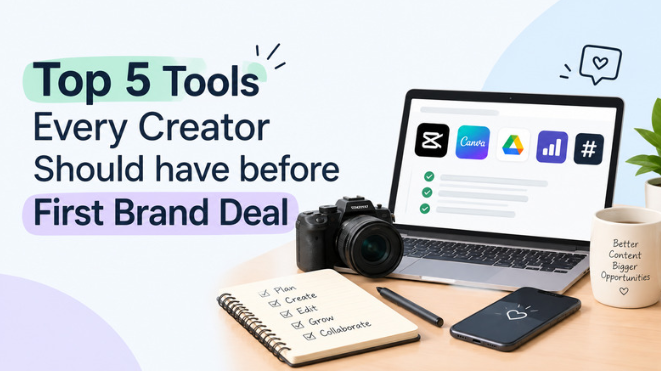
A brand approaches you about sponsorship – at this stage, the majority of the guidance is on how to improve content, make it look better, get the camera, get the lights, edit, etc., but once they’ve called you, most of the work involves the business part of the deal.
You should have a media kit that contains the most up-to-date information, a method of setting your rates, a contract that specifies the usage rights, an invoicing system to ensure payments are made on time and a method of verifying your audience before the brand asks questions about authenticity.
So in this guide, we list 5 kinds of creator tools that can assist you with those details without having to go through the guesswork and get ready when your initial brand opportunity comes knocking.
Why the First Deal Breaks More Creators than It Makes Them
The creator economy has evolved from being a hobby with a following to a more professional industry. Marketers are no longer considering creator partnerships as a “dodgy” idea, and 92% intend to include both macro & micro creators in any campaign year – whereas 29% choose to only work with celebrities.
It’s a transformation that has made brands more organized, more intent on reaching a larger audience, and more prone to running highly structured outreach campaigns than a few years ago, and those who can respond with a clean media kit, competitive rate, and signed contract in 48 hours are the ones getting repeat bookings.
The ones who can’t fall behind. The majority of creators (roughly 4% of all creators) are not earning over $100K per year, and a significant portion of that is due to operational readiness, not talent or audience size.
Marketplaces & outreach platforms, such as a number of sites like Tomoson, represent a great alternative to waiting for a cold inbound email message to reach creators who don’t have a brand connection with them, but are actively looking for creators to partner with.
The 5 tools below are what will make a creator who gets a deal different from a creator who creates a business out of deals.
1. A Media Kit Builder That Updates Itself
Six months ago, someone created a PDF media kit in Canva and is now lying to whoever reads it. Followers change, engagement rates slip, & that 3 brand logos you’re most proud of last spring may not be the best ones anymore.
A credibility gap occurs as soon as your brand’s marketing manager compares your current stats with what’s written on the page in your static media kit.
The fix is a media kit tool that’s connecting directly to a brand’s platforms to pull live data – so the number that a brand sees is the number that is, at that moment, the truth.
It doesn’t require a lot of technical effort to accomplish this with tools such as Slik, Beacons, or even a good Notion page that is connected with a scheduling tool.
What is important is that it becomes a living media kit and no longer a project to remember to update before each pitch.
Even with limited budgets, design is important here. If a creator is creating their illustrations, thumbnails, rate sheets, or video content without an Adobe subscription, there is ample space to work in a program without paying the subscription; in these scenarios, tools like free alternatives to Photoshop can help you get the job done at the cost of time, not money.
Also, there are several video editing apps and image editing programs that are free to use and will do a good job of handling layered images, removing backgrounds, making edits to videos, and formatting for export to create a great kit that can easily be seen as a rushed job.
And a good self-updating kit should contain:
- Follower and engagement counts are pulled automatically and not manually typed in.
- Audience demographics segmented by age, location, and platform.
- Real-life brand collaborations, not just logos!
- There is a direct link to schedule a call or request your rate sheet.
2. A Contract Tool That Protects Usage Rights, Not Just Payment
When looking through a contract review for the first time, most creators prioritize the contract’s payment amount. This is the least dangerous part of the deal.
The one thing that costs creators money down the road is usage rights, or how long & where a brand will be able to use the content you produce. A brand with the foresight to get “perpetual, worldwide usage rights” for a single Reel can turn around & run that clip as a “paid ad” for the next three years, without paying you another penny.
A contract tool designed for freelance & creator work (like Bonsai, HoneyBook, or even a good template through a standard e-signature platform) makes these clauses stand out prior to signing.
So pay particular attention to language pertaining to the length of time a brand wants to use your content, whitelisting/dark posting rights, exclusivity windows that could prevent you from collaborating with other brands, & a kill fee that allows you to get paid if the brand decides to cancel after you’ve already created the content.
It’s tedious to read a contract clause by clause until you read one the first time that you didn’t agree to verbally but signed anyway, only to find out it contained a six-month exclusivity clause.
3. A Rate Calculator to take the guesswork out of it
Poll 10 creators about how they came up with their rate for sponsored content & more than half of them will say that they guess. The guess is typically low, as this is generally considered safer than completely foregoing the deal.
As soon as a brand pays $300 for a post, it’s the standard price it’ll use for future deals with creators, and it’s likely to be reproduced on an informal basis within the brand’s marketing team as a guideline for other creators.
And using rate calculators based on real market data – whether free or paid – with built-in benchmarking features can provide creators with a defensible number rather than a guess.
More often than not, they will consider follower numbers, engagement rate, platform, content type, and usage rights as a group, not individually.
There’s a real budget dedicated to such spending, and up to 25% of digital marketing budgets are already dedicated to influencer campaigns, so the money for a fair rate is already allocated to a brand.
Note: When the creator is the one who knows their value, it is their responsibility to ask for a fair piece of the budget. And tools like Influencer Marketing Hub, HypeAuditor, Modash, Aspire, and Collabstr can help you benchmark your rates, understand the value of your work, and ask for a fair price.
4. An Invoicing System with Built-In Payment Tracking
Getting the deal signed is not the same as getting paid. Payment terms for brands are often net 30 or net 60, & without a system that tracks the invoices and payment terms, it’s easy to not know when an invoice is due or if it’s been sent & not yet paid until a creator realizes that they haven’t gotten a response 3 months after sending the invoice. It’s not pleasant; it takes time, and it rarely gets paid when chasing it over email.
Features such as recurring reminders, partial payments, and a running record for tax time all help to keep things sorted. Many tools such as Wave, Bonsai, and QuickBooks can make this happen without you having to build a spreadsheet from scratch each quarter.
This can be done prior to the first deal closing date, and not after the first late payment, so that the reminder emails are sent out automatically, and not relying on anyone remembering to send a clumsy follow-up message weeks after the invoice due date.
5. An Audience Verification Tool that solves the Fraud Question BEFORE it is asked
Now every brand with a serious creator partnership will have some form of a fraud check, which will include the authenticity of their followers, engagement rates, & audience location to ensure that the numbers are what they say they are.
So if you wait for a brand to come to you and raise concerns about bot followers, you’re basically playing catch-up.
Consumer trust in creator endorsements is real & measurable: 58% of Americans say they have bought something because of an influencer’s recommendation, which is why brands are thinking very carefully about authenticity before giving over budget on that trust.
That’s why, before a brand asks you to run the numbers through a tool such as HypeAuditor or Modash, you do so twice.
It will identify any red flags in your own audience, like large spikes in the number of followers that come from a giveaway, or a disproportionate amount of accounts from a foreign country that has no connection to your content, so that you can catch them in time.
It also allows you to send an authenticity report with your media kit, which will make any potential objection proof that you had the authenticity report before it was raised.
So Build the Business before the Brand Deal Arrives
All five of these tools are unrelated to content quality, and that’s the topic worth reflecting on. A creator that is average on production, but has a live media kit, a reviewed contract, a data-informed rate, a system for invoicing, & an authenticity report on file will out-negotiate a far more talented creator that’s making these steps up and down throughout the deal for the first time.
Brands aren’t just purchasing reach; they are purchasing a partner who will be predictable and hassle-free with minimal administrative challenges three weeks into the campaign.
So if you have this infrastructure in place ahead of time, then when that first email comes in, you’re able to say with assurance that you’ll respond within an hour, rather than getting thrown into a panic mode of “What do I charge? What do I get to sign? How am I going to get paid?





Comment