
How to Choose a Rotary Actuator for Precision Automation Systems

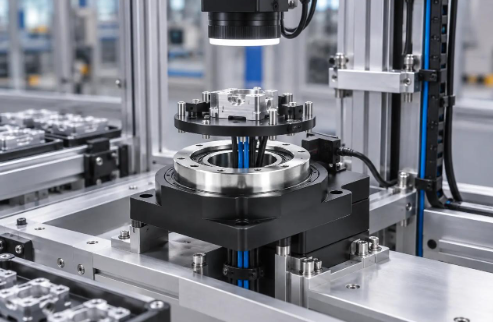
Rotary motion appears in almost every automated production environment. A component may need to turn toward a camera, index from one station to another, align with a tool, rotate beneath a dispenser, or present several surfaces for inspection. Although these tasks look simple, the mechanism behind them has a direct effect on machine accuracy, cycle time, wiring, footprint, and maintenance. Choosing the right rotary actuator therefore requires more than comparing torque figures or selecting the first unit that fits the available space.
The term rotary actuator covers several technologies. Pneumatic and hydraulic units are common where simple limited-angle movement or very high force is required. Electric rotary actuators are better suited to programmable automation because they can provide controlled angle, speed, acceleration, and repeatable positioning. Within the electric category, a hollow rotary design offers another important advantage: a central opening for cables, air tubes, vacuum lines, optical paths, or fixtures. Understanding these differences helps machine builders match the actuator to the real job instead of buying on a keyword alone.
What a Rotary Actuator Does in an Automation System
A rotary actuator converts power into controlled angular motion. Depending on its construction, that motion may be a fixed stroke, continuous rotation, repeated indexing, or programmable positioning. In modern machinery, the actuator rarely works alone. It becomes part of a motion system that can include a motor, drive, controller, transmission, bearings, output table, sensors, fixture, and process tooling.
The best configuration depends on the machine objective. A simple valve may only need two end positions. A packaging station may need fast 90-degree indexing. A vision inspection system may require smooth multi-angle rotation so cameras can examine every side of a part. An electronic assembly machine may prioritize compact installation and clean cable routing. The phrase “rotary actuator” is therefore a useful starting point, but engineers must define the motion profile before choosing the hardware.
Start With the Motion Requirement
Before comparing models, describe what the rotating part must do during one complete production cycle. Confirm whether the output needs continuous rotation, limited-angle movement, or step-by-step indexing. Define the target angle, speed, acceleration, deceleration, settling time, and dwell time. A system that turns slowly for visual inspection has a different requirement from a high-speed station that indexes hundreds of times per hour.
Compare Pneumatic Hydraulic and Electric Rotary Actuators
Pneumatic rotary actuators are economical and fast for basic two-position movements, but compressed air makes fine speed and position control more difficult. Hydraulic rotary actuators can deliver substantial torque in demanding environments, although the power unit, hoses, leakage control, and maintenance requirements make them less attractive for clean compact machines. These products serve valid markets, but they should not be confused with the servo-ready products used for precision rotary positioning.
An electric rotary actuator uses a motor and controlled drive system to create programmable movement. It can change angle, speed, direction, acceleration, and motion sequence through the machine controller. For flexible automation, an electric solution often provides easier recipe changes, clearer diagnostics, and better integration with sensors and production data. When a servo motor is used, the resulting servo rotary actuator can support closed-loop positioning and repeatable motion across different operating cycles.
Why a Hollow Rotary Actuator Can Simplify Machine Design
Machine builders frequently need to route something through the rotation axis. Camera cables, electrical wiring, air pipes, vacuum tubes, laser paths, test probes, and tooling shafts can become difficult to manage around a solid output shaft. External cable loops take space and may twist, rub, or limit the allowed rotation. A hollow center creates a direct path through the actuator and can make the entire machine layout cleaner.
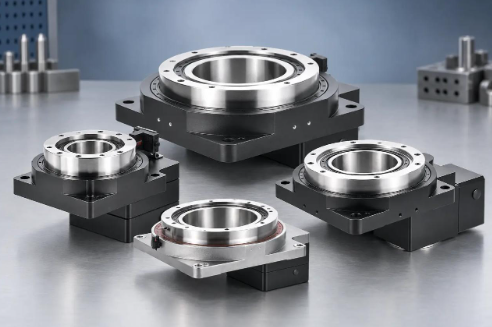
For equipment that needs servo-driven positioning together with center access, a hollow rotary actuator integrates the rotating support, transmission, output interface, and central bore into a compact module. This can reduce the number of separate couplings, bearing supports, brackets, and adapter components required in a conventional motor-and-gearbox assembly. Fewer interfaces can also simplify installation and reduce accumulated mechanical error.
Calculate Torque From the Real Load
Torque should be calculated from the complete rotating assembly, not just the weight of the workpiece. Include the fixture, tooling plate, gripper, cables, and any components mounted away from the center. Rotational inertia increases rapidly as mass moves farther from the axis, so two loads with the same weight can demand very different acceleration torque. Friction, external process forces, installation orientation, safety margin, and the required acceleration time must also be considered.
Check Axial Radial and Moment Loads
A rotary positioning unit supports more than driving torque. The output bearing may experience axial load along the rotation axis, radial load across the axis, and moment load created by an offset fixture. Moment load is especially important when a large plate, tall fixture, or cantilevered workpiece is mounted on the actuator. A model can have enough torque to rotate the load but still be unsuitable for the mechanical forces imposed on its bearing structure.
Match the Servo Motor and Control System
A servo rotary actuator must be matched mechanically and electrically. On the mechanical side, confirm the motor flange, shaft diameter, shaft length, pilot diameter, bolt pattern, coupling arrangement, and adapter requirements. On the electrical side, the drive and controller must support the required speed, torque, encoder feedback, communication protocol, and safety functions. A motor adapter that is almost correct can create alignment problems, so the exact motor model should be supplied before production.
Evaluate Accuracy Backlash and Rigidity Together
Catalog accuracy is only one part of system performance. Backlash influences direction changes, while torsional rigidity affects how much the output deflects under changing load. Mounting plate stiffness, fixture design, fastener condition, servo tuning, and load distribution can all affect measured position at the workpiece. Asking only for the smallest accuracy number may increase cost without solving the actual process limitation.
Define the tolerance where it matters: at the actuator output, fixture edge, camera target, or finished part. Then decide whether the process needs positioning accuracy, repeatability, low backlash, short settling time, or a combination of these characteristics. A technically clear requirement enables the supplier to recommend an appropriate structure instead of simply quoting the most expensive model.
Plan Installation and Cable Routing Early
The available diameter is not the only installation constraint. Check overall height, output table diameter, center bore, motor direction, connector clearance, mounting access, and the space needed to remove the unit for maintenance. If cables or tubes pass through the center, confirm their quantity, outer diameter, minimum bending radius, and whether continuous rotation is required. A hollow bore organizes the routing path, but it does not eliminate the need for proper cable management or a slip ring when unlimited multi-turn rotation is necessary.
Environmental conditions should also be reviewed. Dust, moisture, temperature, vibration, washdown procedures, and cleanroom requirements may change the suitable materials, sealing, lubrication, or protection method. For food, medical, semiconductor, or laboratory equipment, cleanliness and material compatibility can be as important as torque and speed.
Typical Applications
In machine vision, an electric rotary actuator can rotate a component through several inspection angles while keeping camera and lighting sequences synchronized. In electronics manufacturing, it can orient parts for dispensing, soldering, testing, or assembly. Packaging machines use rotary motion for filling, capping, labeling, sealing, sorting, and transfer stations. Robotic cells use actuators to present components to a robot, reposition tooling, or add a controlled rotary axis to a fixture.
CNC auxiliary equipment may use a rotary unit for workpiece orientation, loading, checking, or secondary positioning. Laser marking and measurement systems benefit from stable angular control and clean routing of cables or optical paths. These applications do not all need the same actuator, but they share a need for reliable integration between mechanics, motor control, fixture design, and the production process.
Information to Send Before Requesting a Quote
A useful quotation request should include the application, workpiece and fixture weight, table or fixture diameter, center-of-gravity position, required hollow-bore diameter, rotation angle, speed, acceleration time, cycle rate, positioning tolerance, installation orientation, available space, motor brand and model, supply voltage, and expected quantity. A drawing, sketch, photo, or reference model can shorten the selection process considerably.
HollowRotary supports machine builders and OEM projects that need compact rotary positioning, central cable routing, servo motor matching, and practical mounting interfaces. Supplying complete application data allows the actuator structure, motor interface, load capacity, and motion requirement to be reviewed together before a model is confirmed.
Final Selection Principle
The right rotary actuator is the one that fits the entire machine requirement. Begin with the motion profile, then evaluate load inertia, torque, bearing forces, accuracy, backlash, rigidity, motor compatibility, installation space, cable routing, environment, and duty cycle. Use broad product terms to understand the available technologies, but choose the final unit according to measurable engineering conditions.
For programmable precision automation, electric and servo-driven solutions provide flexibility that pneumatic or hydraulic devices may not offer. When the machine also needs a clean path through the rotation axis, a hollow rotary actuator can reduce mechanical complexity and improve system integration. Careful selection at the design stage helps create a machine that is compact, stable, serviceable, and ready for reliable production.
Final Publishing Checklist
- Keep the article title and technical meaning unchanged unless approval is obtained.
- Keep both embedded hyperlinks active, permanent, and dofollow.
- Do not add links to unrelated third-party commercial websites.
- Use real HollowRotary product or application images only; no pneumatic or hydraulic actuator images.
- Add the supplied ALT text to each image and do not place text or watermarks over the products.
- Send the completed draft and final page preview for review before publication.







Comment