Voice communication has changed dramatically over the years. Businesses that once depended on traditional telephone systems can now build sophisticated communication environments using internet-based technologies. From cloud contact centers and customer support platforms to internal business communication and automated calling systems, VoIP has become an important part of modern business infrastructure.
Yet, choosing the right technology for a custom VoIP solution is not always straightforward. Businesses have access to countless cloud communication platforms and ready-made services, but these options may not provide the level of customization, control, or integration that a growing organization needs. This is where Asterisk continues to stand out.
Asterisk is an open-source communications framework that allows businesses and developers to build customized telephony and VoIP solutions. It can support everything from basic SIP calling and voicemail to sophisticated IVR systems, call routing, conferencing, call recording, contact center workflows, and integrations with business applications.
What makes Asterisk particularly interesting is its flexibility. Instead of forcing a business to adapt its communication processes around a predefined product, developers can build communication functionality around the organization’s actual requirements. That approach can be valuable for companies with specialized workflows or plans to develop their own communication platform.
What Is Asterisk and How Does It Work?
Asterisk is an open-source communications framework used to create telephony applications and VoIP systems. Originally developed as a software-based private branch exchange, commonly known as a PBX, Asterisk has evolved into a flexible platform capable of supporting many different communication architectures.
It can work with technologies such as SIP and can interact with phones, softphones, gateways, trunks, applications, and other communication systems. Developers can use Asterisk to control how calls are received, routed, transferred, recorded, queued, or terminated.
One of its biggest strengths is that Asterisk is not simply a finished phone system. It provides building blocks that developers can use to create a communication solution tailored to a particular business.
That distinction matters. A company looking for a standard phone system may choose a ready-made service, while a company that wants to build a customized communication workflow can use Asterisk as part of a broader technology architecture.
-
Asterisk as an Open-Source Communication Framework
The open-source nature of Asterisk gives businesses and developers considerable freedom. Organizations can inspect, configure, extend, and customize the platform according to their requirements rather than depending entirely on a proprietary communication vendor.
Developers can create customized dial plans, call flows, extensions, routing rules, and communication workflows. This makes Asterisk particularly useful when standard VoIP products cannot easily accommodate unique business processes.
For example, a company may want incoming calls to follow different routing rules depending on the customer, time of day, department, or service category. With a custom Asterisk implementation, these requirements can be incorporated into the communication architecture.
The platform can also become part of a larger application ecosystem. Instead of existing as an isolated telephone system, Asterisk can communicate with CRM software, databases, web applications, and other business systems.
How Asterisk Supports VoIP Communication
Asterisk can serve as the communication engine behind a VoIP solution. It can manage call sessions, interact with SIP endpoints, handle routing logic, and connect different communication components.
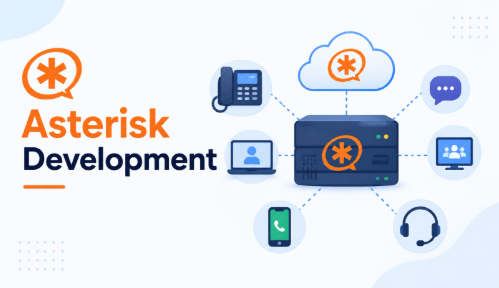
A typical architecture may include IP phones or softphones on the user side, SIP trunks or gateways for external connectivity, and Asterisk at the center of the communication workflow. Additional applications and services can be connected depending on the organization’s requirements.
The actual architecture depends on factors such as the number of users, expected call volume, required features, network infrastructure, and integration requirements.
This flexibility is one reason Asterisk remains relevant. Businesses can start with a focused communication requirement and expand the architecture as their needs become more sophisticated.
Why Do Businesses Choose Asterisk for Custom VoIP?
The biggest reason businesses consider Asterisk is customization. Ready-made VoIP services can be convenient, but they typically come with predefined features and workflows. When a business needs something different, customization may be limited or may require additional vendor-specific services.
Asterisk takes a different approach. It provides a foundation from which developers can create communication functionality according to business requirements.
That can be particularly useful for organizations operating call centers, customer support departments, healthcare platforms, financial services, logistics operations, and other environments where communication workflows are closely connected to business processes.
Asterisk can also be deployed alongside existing technologies, giving businesses the opportunity to build communication capabilities without redesigning their entire technology ecosystem.
-
Complete Customization and Flexibility
Asterisk provides developers with significant control over call flows, routing logic, extensions, queues, IVR menus, and communication behavior. This makes it possible to create workflows that closely reflect how a business actually operates.
Consider a customer support company handling multiple service categories. Instead of sending every caller through the same process, the system can route calls based on department, customer selection, working hours, or other predefined conditions.
Businesses can also develop custom dashboards and interfaces around the Asterisk infrastructure. This means employees may interact with a communication system through a business application rather than directly through a traditional PBX interface.
The result can be a communication environment that feels like a natural part of the organization’s software ecosystem.
-
Integration With Existing Business Systems
Modern business communication rarely exists independently. Customer information, sales processes, support tickets, employee records, and communication history are often connected.
Asterisk can be integrated with external applications to support workflows such as click-to-call, caller identification, call logging, CRM synchronization, and automated customer interactions.
For example, when a customer calls a support number, the communication system could interact with a CRM platform to help identify the customer and retrieve relevant information. The exact implementation depends on the APIs and architecture of the systems involved.
This type of integration can reduce repetitive work and help businesses create a more connected customer communication experience.
Key Features of Asterisk VoIP Solutions
Asterisk can support a broad range of telephony capabilities, which is another reason it remains useful for custom VoIP development. Businesses can select and combine features based on their actual requirements instead of deploying unnecessary functionality.
Common capabilities include IVR, call routing, voicemail, call queues, conferencing, call recording, SIP connectivity, extensions, and automated call handling.
The final feature set depends on the application’s purpose. A small business phone system may need only basic calling and routing, while a contact center could require queues, agent management, recording, analytics, and CRM integration.
The ability to build around specific requirements makes Asterisk suitable for both straightforward and complex communication environments.
-
IVR and Intelligent Call Routing
Interactive Voice Response (IVR) allows businesses to create automated voice menus that guide callers toward the appropriate destination. A caller might select a department, language, service, or support category before being connected to an employee.
Asterisk can support customized IVR workflows and routing logic. Businesses can configure call flows according to working hours, departments, user choices, or other operational rules.
For customer service teams, this can help organize incoming calls before they reach an agent. Instead of manually transferring every caller, the system can perform much of the initial routing automatically.
A well-designed IVR should remain simple for callers. The goal is not to create a maze of menus but to guide customers quickly toward the right destination.
-
Call Recording, Voicemail, and Conferencing
Asterisk can also support features such as call recording, voicemail, and conference calling. These capabilities can be valuable for businesses that need communication records, internal collaboration, training, or customer service monitoring.
Call recording can be incorporated into workflows where recording is appropriate and legally permitted. Businesses should establish suitable policies around consent, storage, retention, and access before enabling recording.
Voicemail provides another communication channel when employees are unavailable, while conferencing can support group discussions and internal collaboration.
These features can be customized and connected with other systems depending on the application’s architecture.
-
SIP and Communication Protocol Support
SIP plays an important role in many VoIP environments, and Asterisk can work with SIP-based endpoints and services. This allows organizations to connect compatible IP phones, softphones, trunks, and other communication components.
The flexibility of SIP-based architectures can make it easier to design communication systems around different infrastructure requirements. Businesses can select appropriate endpoints and connectivity options rather than relying on one specific hardware ecosystem.
Asterisk’s protocol and endpoint capabilities can therefore serve as an important part of a broader VoIP architecture.
However, proper configuration remains essential. Network settings, security, codec choices, NAT traversal, connectivity, and infrastructure capacity all affect the reliability of the final system.
Benefits of Asterisk for Businesses
Asterisk’s biggest business advantage is the combination of flexibility and control. Instead of treating communication as a fixed software package, businesses can use Asterisk as a customizable technology foundation.
This can be particularly valuable when communication is closely connected to a company’s core operations. A contact center, for example, may need communication workflows that are deeply integrated with its CRM and support applications.
Asterisk can also provide organizations with greater control over their infrastructure and deployment approach. Depending on the architecture, businesses can design systems around their own operational and technical requirements.
-
Cost Efficiency and Infrastructure Control
Because Asterisk is open source, businesses do not necessarily need to purchase a traditional proprietary PBX platform to build a custom VoIP environment. However, open source does not mean that a complete communication system has no costs.
Businesses still need to account for development, hosting, SIP connectivity, infrastructure, security, monitoring, maintenance, and technical support.
The advantage is that organizations can have more control over how those resources are used. Instead of paying for features they may never need, businesses can develop functionality according to their specific requirements.
For organizations with strong customization needs, this model can be attractive because the technology can be adapted rather than forcing the business to adapt around a rigid product.
-
Scalability and Performance
Asterisk can support communication systems that grow over time. As organizations add users, departments, locations, or communication features, the architecture can be expanded accordingly.
However, scalability does not happen automatically. The underlying infrastructure needs to be designed around expected traffic, concurrent calls, network conditions, media handling, and availability requirements.
A well-designed architecture can add servers, services, load-management strategies, monitoring, and other infrastructure components as requirements grow.
This makes architecture planning an important part of any serious Asterisk development project.
Asterisk Use Cases Across Industries
Asterisk isn’t limited to one industry because its communication capabilities can be customized to different workflows. Organizations can use it to support internal communication, customer-facing calling, automated interactions, and contact center operations.
The best implementation depends on industry requirements and the business process it supports.
-
Call Centers and Customer Support
Call centers are among the most common environments where customized VoIP infrastructure can add value. Asterisk can support call queues, IVR menus, agent extensions, call routing, recording, and integration with customer management platforms.
A support organization can create different queues for different departments or services. Calls can then be routed according to business rules instead of relying entirely on manual transfers.
When integrated with CRM or helpdesk software, communication can become part of the larger customer support workflow.
This can help businesses build a more centralized communication environment while giving them greater control over how calls move through the organization.
-
Healthcare, Education, and Financial Services
Healthcare organizations can use customized VoIP systems for internal communication, appointment-related workflows, call routing, and support operations, subject to applicable privacy and regulatory requirements.
Educational institutions can use communication platforms for administrative departments, student support, staff communication, and automated information systems.
Financial service organizations can also use customized telephony environments for customer service, internal communication, and structured call workflows. In regulated industries, security, privacy, access controls, auditing, and data retention require particular attention.
Asterisk provides the technical foundation, while the surrounding application and operational policies determine how appropriately it is used in each environment.
Asterisk vs Traditional VoIP Platforms
Asterisk differs from conventional ready-to-use VoIP platforms mainly in the level of control and customization it provides. A hosted VoIP product may deploy faster because many features are already packaged, while Asterisk gives developers more freedom to build around specialized requirements.
| Factor | Asterisk | Traditional Ready-Made VoIP |
| Customization | High | Usually feature-dependent |
| Infrastructure Control | Greater control | Primarily vendor-managed |
| Integration | Can be customized | Often limited to supported integrations |
| Deployment | Requires technical implementation | Usually simpler |
| Scalability | Architecture-dependent | Typically managed by provider |
| Development Flexibility | High | Generally constrained by platform |
| Maintenance | Business/development responsibility | Often handled by provider |
Neither approach is automatically appropriate for every organization. A company with straightforward calling requirements may prefer the simplicity of a managed VoIP platform, while a business with specialized workflows may benefit from the flexibility of Asterisk.
Base the decision on factors such as customization requirements, technical resources, security needs, integration complexity, expected scale, and long-term communication strategy.
Asterisk Development and Integration Process
Developing a custom Asterisk solution begins with understanding the business, not immediately configuring the technology. Developers need to determine how calls enter the system, where they should go, what happens when agents are unavailable, and which business applications need to interact with communication events.
The architecture can then be designed around those requirements. This may involve Asterisk servers, SIP trunks, endpoints, databases, APIs, CRM integrations, monitoring tools, and additional backend services.
Development typically includes call-flow configuration, backend integration, application development, interface development, and testing.
Testing should cover normal calls, busy conditions, failed connections, routing problems, network issues, permissions, recording behavior, and other real-world scenarios.
Once deployed, the system should be monitored and maintained. Communication infrastructure is operational software, so updates, security reviews, performance optimization, and troubleshooting remain important after launch.
Challenges to Consider With Asterisk Development
Although Asterisk is highly flexible, that flexibility also creates technical responsibility. A custom system requires developers who understand VoIP protocols, networking, server infrastructure, security, call routing, and application integration.
Incorrect configurations can result in poor call quality, failed connections, security vulnerabilities, or unreliable communication workflows.
Network conditions are another consideration. Voice communication is sensitive to latency, jitter, packet loss, and bandwidth limitations. Businesses therefore need suitable infrastructure and monitoring.
Security should also be treated as a core requirement. VoIP systems can be targeted through unauthorized access, toll fraud, credential attacks, and other threats. Strong authentication, network controls, access policies, monitoring, and regular updates are important components of a secure deployment.
How Moon Technolabs Can Help With Asterisk Development?
Moon Technolabs can help businesses design, develop, customize, and integrate Asterisk-based VoIP solutions according to their specific communication requirements. Whether the goal is to build a custom PBX, contact center platform, automated calling system, IVR solution, or integrated business communication environment, our team can work around the organization’s workflows rather than forcing them into a predefined communication model.
Our Asterisk development services can cover areas such as custom call flows, SIP integration, IVR development, call routing, CRM integration, call recording, conferencing, softphone integration, API connectivity, testing, deployment, and ongoing maintenance. We can also help connect Asterisk with existing business applications so that communication becomes part of a larger digital workflow.
For businesses planning to scale, the focus can extend beyond initial development. Architecture planning, performance optimization, security considerations, monitoring, and ongoing technical support can help create a more reliable communication environment as usage increases.
Conclusion
Asterisk continues to be a valuable technology for businesses that need more than a standard VoIP phone system. Its open-source foundation, customization capabilities, integration potential, and broad telephony functionality make it a flexible option for building specialized communication solutions.
The real strength of Asterisk lies in what businesses can build around it. From custom PBX systems and contact centers to IVR platforms, automated calling solutions, and integrated business communication applications, Asterisk can serve as the underlying communication engine.
At the same time, successful Asterisk development requires proper architecture, experienced implementation, security planning, and ongoing maintenance. Businesses should evaluate their communication requirements carefully and choose an approach that balances customization, operational complexity, scalability, and long-term goals.
For organizations that want control over how their VoIP environment works and integrates with their existing technology stack, Asterisk remains a powerful foundation for custom communication development.