Hosting Provider
Here’s something most people get completely backwards.
They’ll spend three weeks comparing ASIC miners. Spreadsheets, YouTube reviews, Reddit threads – the works. Then they spend about fifteen minutes picking a hosting provider, go with whoever came up first in Google, and wonder six months later why their numbers don’t look anything like what they expected.
The hosting decision is at least as important as the hardware decision. Arguably more so. A great machine in a bad facility is still a bad investment. A solid machine with cheap power, proper cooling, and a team that actually responds when something breaks – that’s a different story entirely.
So let’s go through what actually matters here. Not the marketing language. The real stuff.
What Does a Bitcoin Mining Hosting Provider Actually Do?
Worth being clear on this before anything else.
When you use a Bitcoin mining hosting provider, you’re placing your physical machine inside their facility. They run it. They keep the power on, the cooling running, and the machines online. When something goes wrong at 2am, they deal with it – not you.
You own the hardware. The Bitcoin rewards go directly to your wallet. They just provide the environment for it to run.
The reason this model took off is simple. A professional facility in Nebraska or Wyoming might pay $0.04 to $0.06 per kWh for electricity. Most people in the US are paying $0.12, $0.14, sometimes more at home. Run that gap across five machines for a year and the savings are genuinely significant – often enough to change whether the whole operation is profitable or not.
If you want the full cost breakdown before picking a host, this piece on how hosting facilities reduce mining costs lays it out clearly.
6 Things to Check Before You Choose Anyone
1. The Electricity Rate – Ask For the Exact Number
Not a range. Not “competitive rates.” The actual number per kWh.
This matters more than almost anything else in crypto mining hosting. Even a $0.02 difference sounds small until you run it across multiple machines over twelve months. Then it’s thousands of dollars one way or the other.
Ask what the rate is. Ask if it’s fixed or if it can change. Ask whether there are any conditions attached to it. A provider that hedges or gives vague answers on this specific question – that alone is useful information.
Then take whatever number they give you and run it through the ValueHash profitability calculator with your machine’s specs. See what the monthly returns actually look like before you commit to anything.
2. Uptime – What Actually Happens When Something Breaks
Every facility has problems. Power fluctuations happen. Hardware fails. Connections drop. That’s not a dealbreaker – it’s reality.
What matters is how fast they respond and how they communicate when it does happen.
Ask them directly. If your miner goes offline at 11pm on a Sunday, who handles it? Do you wait until Monday morning, or is someone present overnight? Do you have to notice it yourself, or do they alert you?
A machine sitting offline for two days isn’t just annoying. It’s lost Bitcoin. Uptime is a profit metric, not a technical detail, and it deserves a real answer – not a vague assurance about “dedicated support.”
3. Cooling – Genuinely Important, Often Overlooked
ASIC miners run hot. That’s just what they do.
The problem with heat isn’t just performance throttling in the short term. It’s what sustained heat does to hardware over time. A machine that should last five or six years starts developing problems in two if it’s been running too hot for months on end.
Ask specifically how the facility handles cooling. Industrial operations use engineered airflow systems, proper rack spacing, and in some cases immersion cooling for denser setups. What they shouldn’t be doing is cramming machines into a room with a few box fans and hoping for the best.
It’s a reasonable question. Any legitimate provider will have a clear answer.
4. What You’re Actually Paying – All of It
The headline hosting rate is rarely the full picture.
Some providers advertise a low per-kWh rate and then quietly add setup fees, monthly minimums, network charges, and maintenance costs that you didn’t know about until the first invoice. Not all of them do this – but enough do that it’s worth asking about explicitly before you sign anything.
Ask for a complete breakdown. Everything. Setup costs, monthly hosting fees, power rate, any additional charges that could appear. Good Bitcoin hosting solutions are transparent about this because they don’t need to hide anything. Providers that get evasive when you ask for specifics – take that seriously.
5. Physical Security – Your Hardware Is Real Money
A quality ASIC miner is worth real money. It’s sitting in a building in a state you’ve probably never visited, run by people you’ve met on a call or over email. Physical security matters.
Ask about access controls. Who can enter the facility? Are there cameras? Is there on-site staff at all hours? Do they carry any insurance for hardware stored on-site?
This isn’t being paranoid. It’s the same due diligence you’d apply to anything else you’re leaving in someone else’s care at that price point.
6. Whether They Can Actually Scale With You
You might start with two machines. If things go well and the goal is for things to go well, you’ll want to add more.
Some hosting providers are set up for large institutional clients and treat smaller accounts as an afterthought. Others genuinely serve both ends well. Find out which you’re dealing with before you commit.
Ask directly whether they handle single-machine accounts and large operations with equal attention. Ask what the process looks like when you want to add machines later. A provider that can’t give you a clear answer on scaling is probably not thinking long-term either.
For a broader view of how hosting fits into the full mining strategy, the BTC mining investment guide is worth reading alongside this.
Things That Should Make You Pause
A few patterns worth watching out for when evaluating crypto mining hosting providers:
- No verifiable physical location. If they can’t point you to a real address, real facility photos, or real customer reviews you can independently check – that’s a significant red flag.
- Guaranteed returns. Honest hosts don’t promise fixed earnings. Mining revenue moves with Bitcoin’s price and network difficulty. Anyone promising you a specific monthly return regardless of market conditions doesn’t understand mining or is counting on you not to.
- Pressure to decide quickly. Providers that are reputable don’t hurry you. Urgency tactics in this space almost always mean someone is trying to get your money before you think too carefully about it.
- No written contract. Get everything in writing. Always. If they’re reluctant to put terms on paper, walk away.
The 5 biggest bitcoin mining myths covers several of the misconceptions that bad actors in this space actively exploit – worth a read before you finalize anything.
What Good Bitcoin Hosting Solutions Actually Look Like?
A good Bitcoin mining hosting partner isn’t just somewhere to plug in a machine.
They’re upfront about exactly what you’re paying. They communicate clearly and quickly when something breaks. Their facility is in a low-cost power state with real infrastructure – not a repurposed warehouse with inadequate cooling. Their reviews come from real customers you can actually verify. And they treat a one-machine account with the same professionalism as a hundred-machine account.
That combination is genuinely harder to find than it should be in this industry. It is worth clinging to when you find it.
Ready to Find the Right Hosting Partner?
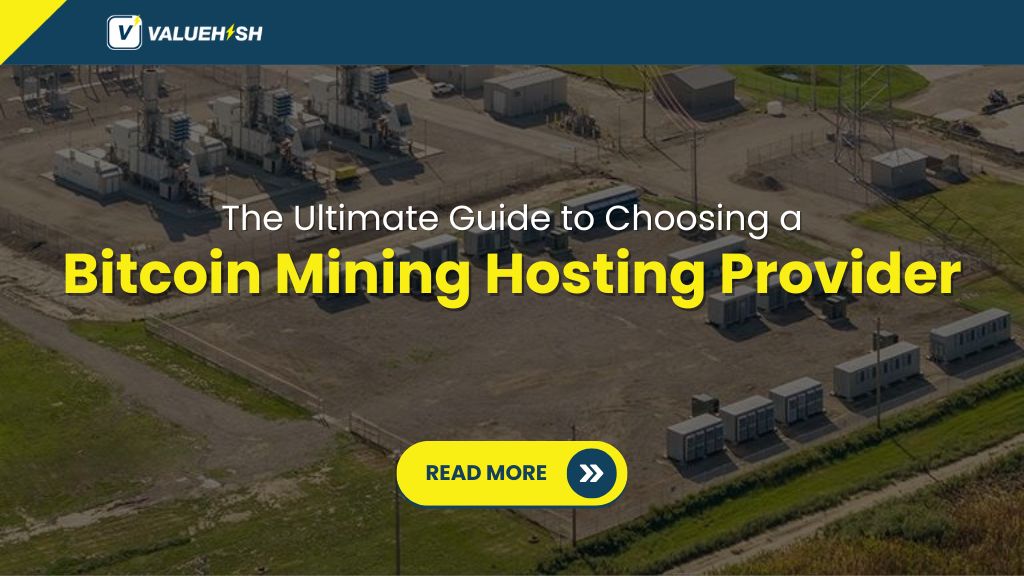
ValueHash runs purpose-built mining facilities in Nebraska, Kansas, and New York – competitive power rates, industrial cooling, 24/7 monitoring, and a team that communicates straight.
Whether you want to host machines you already have or buy and host in one step, the process is straightforward from the first conversation.
Get in touch here and the team will walk you through options that actually fit what you’re trying to build.
Frequently Asked Questions
What is Bitcoin mining hosting?
You place your physical mining machine inside a professional facility. They provide the power, cooling, space, and monitoring. You keep ownership of the hardware and receive Bitcoin rewards directly to your wallet. The main advantage is access to electricity rates that home miners simply can’t match on their own.
What should I prioritize when choosing a crypto mining hosting provider?
First and foremost, the electricity rate per kWh is the primary continuous driver of profitability. Next, look for uptime dependability, cooling infrastructure, complete pricing transparency, physical security, and the potential to grow without requiring you to change suppliers.
What’s a reasonable electricity rate to expect from a hosting provider?
Anywhere from $0.04 to $0.07 per kWh is a solid range from a well-positioned facility. Once you’re above $0.09 per kWh, profitability starts getting uncomfortable – particularly during flat or declining Bitcoin price periods.
Do I need to run many machines to use a hosting service?
No. Many providers, including ValueHash, work with single-machine accounts. Starting small is completely reasonable. Just make sure whoever you choose gives smaller accounts genuine attention and not just the bare minimum.
What should I expect when a miner breaks down mid-hosting?
A reliable provider will contact you immediately and dispatch a representative to address the problem. Before you join up, ask them specifically how they handle hardware malfunctions and what their usual response time is. In the event that it is unclear, that is your answer.
How is bitcoin hosting different from cloud mining?
With hosting, you own a real machine. The Bitcoin it earns goes directly to your wallet. With cloud mining, you rent computing power from someone else’s hardware and never hold anything physical. Hosting gives you actual ownership, real transparency, and far more control over your investment.
Is my hardware safe at a hosting facility?
At a reputable one, yes but verify it yourself. Inquire about camera coverage, on-site personnel, access controls, and any insurance for stored hardware. A provider who has nothing to conceal will confidently respond to these inquiries. One that gets defensive about it is worth treating carefully.