When the UK formally diverged from EU data protection law in January 2021, many organisations assumed the transition would be administrative. Rebrand the GDPR, appoint a local representative, update the privacy notice. What followed was something more demanding. The Information Commissioner’s Office issued roughly £65 million in GDPR-related penalties in the years following the law’s introduction. Capita received £14 million in a single penalty in October 2025. The ICO published updated fining guidance in March 2024 that made the path from violation to maximum penalty more systematic. And on 19 June 2025, the Data (Use and Access) Act received Royal Assent, introducing the most significant amendments to UK data protection law since Brexit: new legitimate interest categories, reformed cookie consent rules, updated automated decision-making provisions, and and strengthened complaint handling obligations.
While the UK GDPR closely mirrors its EU counterpart, it is a distinct regulatory framework with its own supervisory authority, transfer mechanisms, and an evolving reform agenda. For any organisation processing the personal data of UK residents, whether based in London or Los Angeles, understanding what the UK GDPR actually requires, who it applies to, and what non-compliance costs in practice is no longer optional background reading. This guide provides that foundation.
Who Does UK GDPR Apply To?
UK GDPR applies to any organisation that processes personal data of UK residents, regardless of where that organisation is based. A US software company with UK customers must comply. A EU business processing the data of individuals who are resident in the United Kingdom must comply. The regulation applies to data controllers, who determine the purposes and means of processing, and to data processors, who process data on behalf of controllers. Both carry distinct obligations and both can be fined.
The territorial scope is confirmed by two conditions: processing is carried out in the context of a UK establishment, or the processing relates to the offering of goods or services to UK data subjects, or the monitoring of their behaviour in the UK. Organisations based outside the UK that meet either condition must appoint a UK representative unless they qualify for an exemption. Since 2021, the ICO has pursued enforcement against non-UK entities, including the £7.5 million penalty against Clearview AI and regulatory action against several US data brokers operating in UK markets without compliance infrastructure.
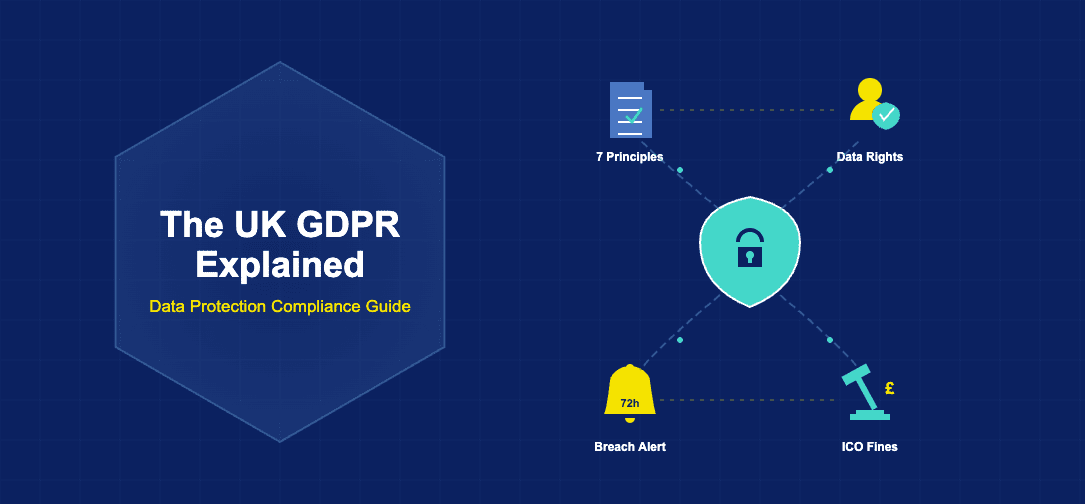
The Seven Core Principles of UK GDPR
Article 5 of the UK GDPR sets out seven principles that govern all personal data processing. These are not aspirational guidelines. Infringement of the basic principles carries the highest tier of administrative fine: up to £17.5 million or 4 per cent of global annual turnover, whichever is higher. Every data processing activity conducted by an organisation must be defensible under all seven of the following principles.
| Principle | What It Requires | Business Risk |
|---|---|---|
| Lawfulness, Fairness & Transparency | Clear legal basis for processing; no deceptive data practices | £17.5m / 4% global turnover |
| Purpose Limitation | Data used only for specified, explicit, legitimate purposes | ICO enforcement notice + fine |
| Data Minimisation | Collect only what is adequate, relevant and necessary | Reprimand + compliance order |
| Accuracy | Keep personal data up to date; erase or rectify promptly | Compensation claims + fines |
| Storage Limitation | Retain data no longer than necessary | ICO audit + enforcement |
| Integrity & Confidentiality | Technical and organisational security measures required | Up to £17.5m (Capita: £14m) |
| Accountability | Demonstrate compliance; maintain ROPA | Audit failure = immediate fine |
The accountability principle deserves particular attention because it is the mechanism through which all others are enforced. Accountability under UK GDPR is not passive: organisations must actively demonstrate compliance, maintain a Record of Processing Activities (ROPA), conduct Data Protection Impact Assessments (DPIAs) for high-risk processing, and appoint a Data Protection Officer (DPO) where required. The ICO can request evidence of these activities at any time, and failure to produce it independently constitutes a violation.
Lawful Bases for Processing
Every processing activity requires a lawful basis. UK GDPR provides six: consent, contract, legal obligation, vital interests, public task, and legitimate interests. The choice of lawful basis is not interchangeable and must be determined before processing begins. Switching lawful bases after the fact is not permitted.
Consent under UK GDPR must be freely given, specific, informed, and unambiguous. Pre-ticked boxes, bundled consent, and consent obtained as a condition of service do not meet the standard. Consent must be as easy to withdraw as to give. The Data (Use and Access) Act 2025 has updated cookie consent rules, introducing five exceptions where consent is not required, including cookies strictly necessary for a service the user has requested, statistical purposes, and emergency assistance. However, advertising, analytics beyond these exceptions, and personalisation cookies continue to require explicit opt-in consent.
Legitimate interests is frequently misapplied. It requires a three-part assessment: identifying a legitimate interest, demonstrating processing is necessary for that interest, and balancing it against the data subject’s rights. The DUAA 2025 introduced a list of Recognised Legitimate Interests where the balancing test is deemed satisfied, including fraud prevention, network security, and direct marketing to existing customers. Outside these categories, a documented balancing test is mandatory.
Individual Rights Under UK GDPR
The UK General Data Protection Regulation gives individuals eight enforceable rights over their personal data. Organisations must usually respond to requests within one month, extendable by two months for complex cases. Failure to respond may lead to complaints to the Information Commissioner’s Office.
1) Right to Be Informed: Individuals must be told how and why their personal data is collected and used through clear privacy notices explaining the data collected, purpose, legal basis, retention period, data sharing, and their rights.
2) Right of Access (DSAR): Individuals can request confirmation that their data is processed and receive a copy. Organisations must provide relevant details about the data, processing purposes, recipients, and retention. Requests are usually free and must be answered within one month. The Data Use and Access Act 2025 allows response timelines to pause when clarification is required.
3) Right to Rectification: Individuals can request correction of inaccurate or incomplete personal data, and organisations must update the information without undue delay.
4) Right to Erasure: Individuals may request deletion of personal data where it is no longer necessary, consent is withdrawn, processing is unlawful, or an objection overrides the organisation’s interests, although legal obligations may require retention.
5) Right to Restrict Processing: Individuals can ask organisations to limit the use of their data, particularly when accuracy is disputed, processing is unlawful, or an objection is being assessed.
6) Right to Data Portability: Individuals can request their personal data in a structured, machine-readable format where processing is based on consent or contract.
7) Right to Object: Individuals may object to processing based on legitimate interests, public tasks, or direct marketing. Direct marketing objections must always be honoured.
8) Rights Related to Automated Decision-Making: Individuals have safeguards where decisions are made solely by automated systems, including the right to human review and to challenge the decision.
The Privacy and Electronic Communications Regulations 2003 sits alongside UK GDPR, regulating electronic communications such as cookies and direct marketing, while UK GDPR governs personal data processing and individual rights.
Data Breach Notification Requirements
UK GDPR imposes strict breach reporting obligations. Where a personal data breach poses a risk to individuals’ rights and freedoms, the ICO must be notified within 72 hours of the organisation becoming aware of the breach. Where the breach is likely to result in a high risk to individuals, affected data subjects must also be notified without undue delay.
The 72-hour clock begins when the organisation becomes aware, not when the breach is fully investigated. Organisations must therefore have incident detection, escalation, and reporting infrastructure capable of meeting this timeline. The Capita breach, which resulted in a £14 million fine in October 2025, involved both inadequate security measures and delayed incident response: the ICO explicitly cited the combination as aggravating factors in its penalty calculation.
International Data Transfers
Transferring personal data outside the UK requires appropriate safeguards. The UK has its own adequacy framework, and has issued adequacy decisions covering the EEA, EU member states, and a number of third countries. For transfers to other destinations, organisations must use International Data Transfer Agreements (IDTAs), the UK Addendum to EU Standard Contractual Clauses, or Binding Corporate Rules. The UK-US Data Bridge, established in 2023, provides a mechanism for transfers to participating US organisations. Organisations should not assume that EU GDPR transfer mechanisms automatically satisfy UK GDPR requirements: the frameworks are separate, and ICO guidance applies.
For practical implementation, a consent management platform (CMP) that handles international consent synchronisation and documents lawful transfer mechanisms provides a critical compliance layer, ensuring that data subject consent recorded in the UK is properly reflected in downstream processing by processors in non-adequate countries.
The Real Cost of UK GDPR Non-Compliance
The ICO issued 16 UK GDPR fines totalling approximately £65 million between 2019 and September 2025. The following table summarises the most significant penalties and the violations that triggered them.
| Organisation | Fine | Year | Violation |
|---|---|---|---|
| Capita plc + Capita Pension Solutions | £14 million | October 2025 | Ransomware breach; 6.6m data subjects |
| Advanced Computer Software Group | £3.07 million | 2025 | Ransomware vulnerabilities; NHS data |
| British Airways | £20 million | 2020 | Data breach; 400,000 customers affected |
| Clearview AI | £7.5 million | 2022 | Unlawful biometric scraping from internet |
Financial penalties represent only a portion of the true cost. Non-financial enforcement measures including processing bans, compliance orders, and suspension of data flows can disrupt operations more severely than fines. Reputational damage from public ICO enforcement notices drives customer churn, partner relationship deterioration, and enterprise contract loss. Research from the Ponemon Institute consistently finds that the total cost of a data breach, including detection, notification, regulatory response, and business disruption, exceeds the regulatory fine by a factor of three to five.
What UK GDPR Compliance Infrastructure Looks Like in 2026
Effective UK GDPR compliance in 2026 requires more than a privacy policy and a cookie banner. It requires documented processes, technical controls, and ongoing operational capability. The ICO’s 2025 online tracking strategy has increased scrutiny of consent implementation specifically, with a focus on whether consent records can actually demonstrate valid consent at the individual level.
A consent management platform (CMP) that blocks non-essential cookies prior to valid consent, maintains granular timestamped consent records, and synchronises preferences across web and app environments is now baseline infrastructure for any UK organisation collecting personal data online. The ICO has engaged with the IAB Tech Lab since January 2025 on the Data Deletion Request Framework, reinforcing that consent withdrawal must cascade to third parties in the ad tech ecosystem, not just to the first-party controller.
Beyond consent, organisations must maintain a current ROPA covering all processing activities, appoint a DPO where required, conduct DPIAs for high-risk projects, train staff on data protection obligations, and implement technical controls including encryption, access controls, and breach detection capability. The Cyber Security Breaches Survey 2025 found that 43 per cent of UK businesses experienced breaches or attacks in the prior twelve months, equivalent to approximately 612,000 organisations requiring breach notification assessment.
The Data (Use and Access) Act 2025, fully in force as of 5 February 2026, represents the most significant update to UK data protection law since Brexit. Organisations that have not reviewed their compliance programmes against the DUAA 2025 changes, particularly on legitimate interests, cookie consent exceptions, automated decision-making, and complaint handling obligations, should treat this as an urgent priority. The ICO’s updated fining guidance, published in March 2024, makes the path from violation to maximum penalty more systematic, and the enforcement record through 2025 demonstrates that the authority is willing to impose substantial penalties across sectors.
The organisations that navigate UK GDPR most effectively are those that treat data protection as operational infrastructure rather than legal overhead. For UK-resident data subjects, compliance with the UK GDPR is not optional; it is the price of doing business in a market of 67 million people whose data rights are actively enforced. Implementing robust consent management infrastructure, maintaining comprehensive documentation, and building breach response capability are not compliance costs; they are the foundation of sustainable data operations.
For further reading on consent technology and compliance frameworks, see Marketing Compliance Technology: How Brands Are Navigating GDPR, Privacy Regulations and Brand Safety at Scale and Consent Management Platforms: GDPR, CCPA Compliance and the Technology of Consumer Choice.
For more coverage on related topics, explore our dedicated section on technology news.