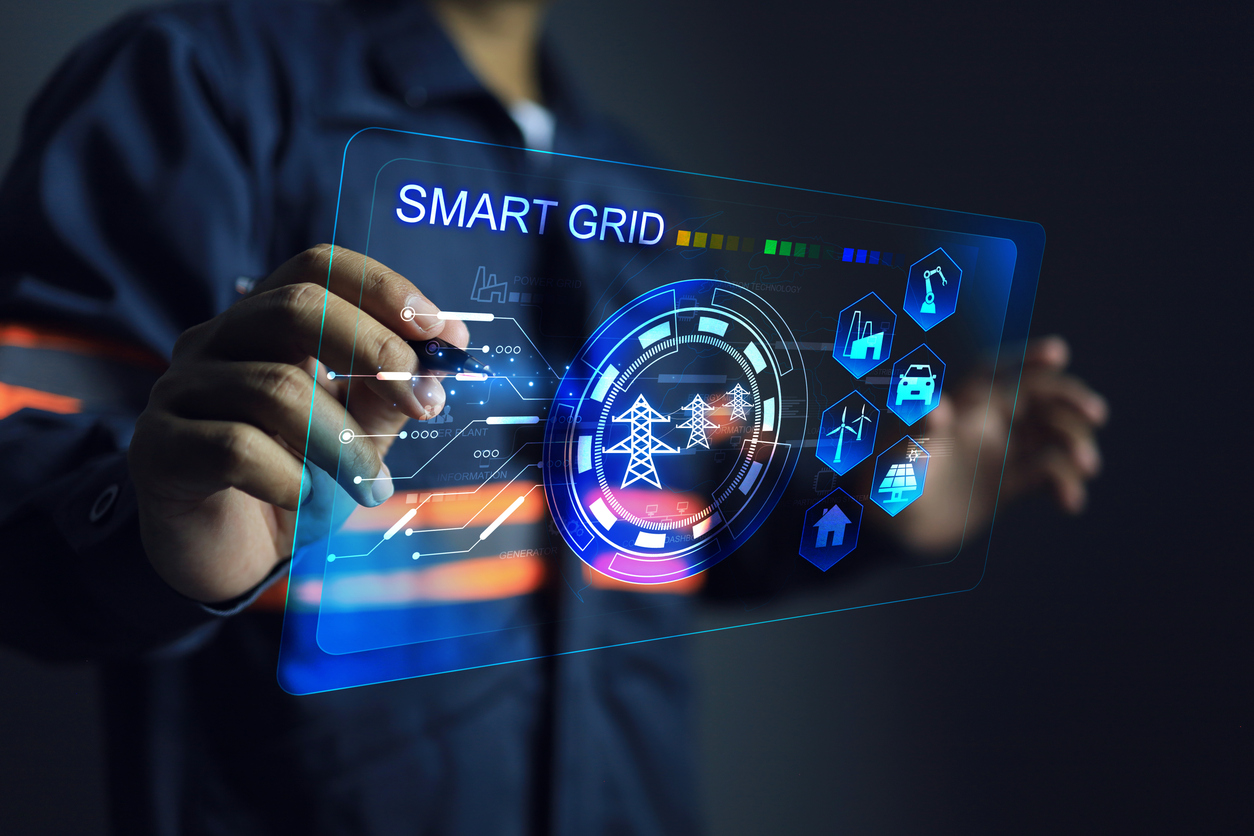
The global Smart Grid market has surged toward $120 billion this year, driven by the rise of Agentic Grid Management. For a modern Business, energy is now a “Tradeable Asset,” with companies using AI to sell their stored battery power back to the grid during peak hours. Meanwhile, Digital Marketing has pivoted to “Energy Transparency,” as consumers choose providers based on real-time, blockchain-verified “Green Scores.”
The Technological Architecture: The “Green Flexibility” Stack
By 2026, the physical grid has been overlaid with a “Digital Mirror” that allows for millisecond-level orchestration.
-
The Self-Healing Grid: In February 2026, “Agentic AI” (Article 65) has moved into physical infrastructure. When a storm knocks out a line, the AI doesn’t wait for a human dispatcher; it autonomously reroutes power, isolates the fault, and dispatches a repair drone to the exact GPS coordinates, reducing outage durations by 80%.
-
Long-Duration Energy Storage (LDES): 2026 marks the industrial scaling of Iron-Air and Flow Batteries. Unlike lithium, these can store energy for weeks. Integrated with AI control software, these systems act as the “Buffer” that keeps the world running when the sun isn’t shining.
-
V2G (Vehicle-to-Grid) Integration: Every EV is now a “Mobile Power Bank.” In 2026, millions of cars are connected to the grid via bidirectional chargers, providing enough “Instant Response” power to replace hundreds of aging coal peaker plants.
Artificial Intelligence: The “Grand Conductor”
In 2026, Artificial Intelligence has evolved from a “forecasting tool” into the autonomous operator of the world’s power.
1. The Virtual Power Plant (VPP)
The breakout business model of February 2026 is the VPP. AI agents aggregate thousands of small assets—home batteries, smart water heaters, and rooftop solar—into a single “Virtual” plant. These platforms autonomously bid into energy markets, turning regular households into active participants in the Business of energy.
2. Fusion Optimizers & Digital Twins
2026 has seen a surge in “Fusion AI.” While commercial fusion is still years away, AI-enabled Digital Twins of experimental reactors (like the DIII-D National Fusion Facility) are now running millions of “What-If” plasma simulations. This Technology has accelerated the path to stable fusion by identifying optimal magnetic containment patterns that were previously impossible to calculate.
3. Agentic Interconnection
The “Interconnection Backlog” (the years-long wait to plug new solar farms into the grid) is finally breaking. Using Agentic Workflows, AI now handles the complex engineering studies and regulatory approvals, reducing the “Application-to-Energization” timeline from years to months.
Digital Marketing: The “Carbon-Aware” Brand
Digital Marketing for utilities in 2026 is defined by Gamified Sustainability.
-
The “Energy Persona” Hook: Providers now offer “Personalized Power Profiles.” Much like a fitness app, your utility app shows your “Grid Impact Score.” Marketing campaigns now reward “Negative Peak Demand,” giving users credits or NFT collectibles for shifting their laundry or EV charging to “Wind-Rich” hours.
-
AEO (Answer Engine Optimization) for “Green ROI”: As homeowners ask their AI, “Which solar-plus-storage setup will pay for itself fastest in my zip code?”, manufacturers are optimizing their “Efficiency Metadata” to ensure their hardware is the top recommendation.
-
The “Data Center Symbiosis” Pitch: Hyperscale data centers (Article 60) are marketing themselves as “Energy Partners.” In 2026, new facilities are built with “Waste Heat Recovery” that pipes server heat into local municipal heating systems, turning a “Carbon Problem” into a “Community Solution.”
Business Transformation: From “Volume” to “Velocity”
The internal Business model of energy has shifted from “Selling Kilowatts” to “Selling Stability.”
-
Energy-as-a-Service (EaaS): In 2026, companies like Tesla Energy and NextEra are moving toward subscription models. Businesses pay a flat monthly fee for “Guaranteed 100% Green Uptime,” leaving the AI to handle the complex trading of solar, wind, and battery storage behind the scenes.
-
The “Grid-Edge” Economy: Real estate developers (Article 67) are now “Energy Entrepreneurs.” New 2026 “Smart Districts” are designed to be Net-Positive, producing more energy than they consume and selling the excess to neighboring “Old-Grid” communities.
-
Cyber-Resilience as a Core Asset: In February 2026, “Cyber-Security” is a design priority. With the grid’s attack surface now including millions of IoT devices, utilities are deploying “Defensive AI” that autonomously detects and isolates “Anomaly Injections” (hacker attempts) in milliseconds.