How AI-Driven Operating Systems Convert Technology Investment into Durable Shareholder Returns
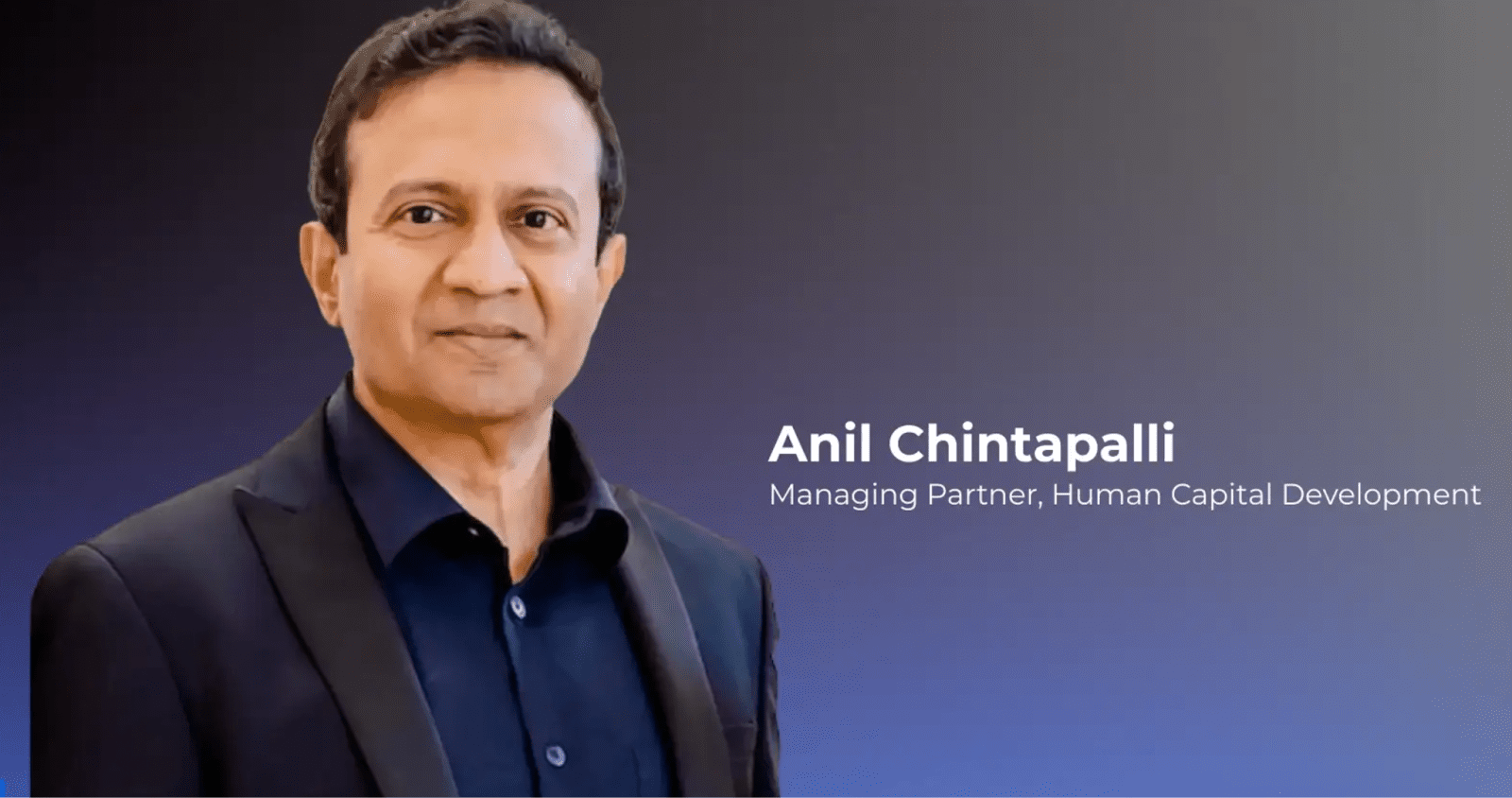
A leading global investor who has spent thirty years translating technology disruption into measurable equity returns explains why the market is entering a new regime for corporate valuation—one where AI infrastructure, workforce orchestration, and cultural discipline determine which companies compound wealth and which ones destroy it.
Anil Chintapalli is the Chief Executive Officer and Managing Partner at Human Capital Development, senior advisor to McKinsey, and a board member of the Forbes Business Council and Fast Company Executive Board. Over three decades, his investor-operator methodology has consistently delivered a minimum 4x return for shareholders across public and private enterprises, establishing a discipline that integrates capital strategy, technology architecture, and organizational culture into a unified engine for compounding enterprise value.
I. From Cost Optimization to Cognitive Capital
Q: Most boards still evaluate technology spending as a line item on the P&L—a cost to be managed rather than an asset to be valued. You have argued that this framing is fundamentally obsolete. What has changed, and what should replace it?
A: The change is structural, not incremental. For most of the last forty years, technology sat in the cost column of the balance sheet. It was overhead—necessary, sometimes strategic, but ultimately a drag on margins that had to be justified through efficiency gains. Artificial intelligence has permanently migrated technology from the cost column to the asset column. It is no longer an expense to be optimized; it is a form of cognitive capital that directly determines future earnings power.
Think about how equity analysts model valuations. They project future free cash flows and discount them to present value. The critical variable in that model is not current earnings—it is the trajectory and reliability of future earnings. AI systems that can autonomously identify revenue opportunities, reduce operational waste, and adapt to market shifts in real time are not technology investments—they are earnings infrastructure. The enterprises that build this infrastructure will command valuation premiums that look irrational by legacy standards but are entirely logical when you understand what is being valued.
Boards need to stop asking “What is the ROI on this AI project?” and start asking “What is the earnings capacity of our cognitive infrastructure over the next decade?” The first question produces pilot programs. The second produces enterprise-scale transformation that moves the stock price.
II. The Dual-Lens Discipline: Capital Rigor Meets Operational Truth
Q: You have spoken extensively about the gap between how investors evaluate AI and how operators deploy it. Where exactly does that gap create the most shareholder value destruction, and how does your dual-lens framework close it?
A: The gap is lethal because it produces two distinct failure modes, and most enterprises fall into one or the other. On the investor side, the failure is over-capitalization without operational grounding. Capital gets deployed into AI initiatives based on market narratives—“every company needs a large language model strategy”—without rigorous analysis of whether the organization can actually absorb the technology. The result is impressive technology demonstrations that never translate into production systems, and shareholders are left holding write-downs disguised as “strategic investments.”
On the operator side, the failure is tactical deployment without strategic architecture. A department head deploys a machine learning model to solve an immediate pain point—churn prediction, inventory optimization, claims processing—but does so without enterprise-grade data governance, without integration into adjacent business processes, and without a scalability roadmap. The model works in isolation but cannot be replicated, extended, or compounded across the organization. It becomes a technology orphan.
My dual-lens framework forces every AI deployment through two gates simultaneously. Gate one asks the investor question: Does this create a defensible, scalable capability that improves the enterprise’s risk-adjusted return on capital? Gate two asks the operator question: Can our people, processes, and data infrastructure execute this reliably at scale? If an initiative cannot pass both gates, it does not proceed—regardless of how technologically impressive it appears. This discipline is what separates AI programs that generate durable shareholder value from those that generate press releases.
III. Breaking the Pilot Trap: The Architecture of Enterprise Scale
Q: The industry data is sobering—the vast majority of AI pilots never graduate to production. You have described the root cause not as a technology problem but as an architectural one. What do you mean by that?
A: When a pilot fails to scale, the instinct is to blame the model—the accuracy was not good enough, the data was too noisy, the use case was too narrow. But in my experience across dozens of enterprise engagements, the model is almost never the bottleneck. The bottleneck is fragmented infrastructure.
What I see repeatedly is that different business units build AI capabilities in isolation. Marketing builds its own predictive models on its own data lake with its own vendor relationships. Supply chain does the same. Finance does the same. Each silo produces a working prototype, and each team declares victory. But when the enterprise tries to connect these capabilities—when you try to have the demand signal from marketing inform the supply chain forecast, which in turn feeds the financial model—the entire architecture collapses because there are no shared data standards, no common governance frameworks, and no orchestration layer.
The solution is to build enterprise-wide centers of excellence that establish shared data governance, common architectural principles, and orchestrated workflows before individual teams deploy models. This is not glamorous work. It does not produce viral demos or breathless conference presentations. But it is the only path to AI that scales—and scaling is the only path to shareholder value creation. A pilot that works in a single department is a science experiment. An AI capability that operates reliably across the entire enterprise is a valuation driver.
IV. The Agentic Enterprise: Redesigning Work for the Human-Agent Era
Q: Your AWOS platform—the Agentic Workforce Operating System—has attracted considerable attention for proposing that the fundamental unit of enterprise productivity is no longer the individual worker but the human-agent team. How does this shift translate into measurable shareholder value, and what metrics should boards use to evaluate it?
A: The entire history of enterprise software has been built on a single assumption: the human is the actor, and the technology is the instrument. Every ERP system, every CRM platform, every productivity suite operates on this premise. The human decides, the software executes. AWOS dismantles that assumption and replaces it with a collaborative architecture where AI agents are autonomous participants in business processes—capable of executing complex, multi-step workflows within defined protocols and escalating to human judgment only when genuine ambiguity or ethical complexity arises.
The shareholder value implication is transformative. In the traditional model, revenue growth requires proportional headcount growth—you scale by adding people. In the agentic model, revenue growth decouples from headcount because autonomous agents absorb the incremental workload. This fundamentally alters the operating leverage of the business. The marginal cost of serving the next customer, processing the next claim, or analyzing the next market opportunity approaches zero. That is not a marginal improvement—it is a structural shift in the economics of the enterprise.
The measurement framework must evolve accordingly. Boards should be tracking decision velocity—the elapsed time from data input to business action. They should be tracking orchestration yield—the ratio of business outcomes produced per unit of combined human and agent effort. And they should be tracking adaptive capacity—how rapidly the human-agent ecosystem reconfigures when market conditions change. These are the metrics of the agentic enterprise, and they are far more predictive of future shareholder returns than traditional productivity ratios.
V. Culture as the Operating System Beneath the Operating System
Q: You have made a career-long argument that culture is not a secondary consideration in technology adoption—it is the primary determinant of whether technology investments create or destroy value. In practical terms, what does that mean for a CEO preparing to deploy AI at enterprise scale?
A: It means that before you write a single line of code, before you sign a single vendor contract, before you hire a single data scientist, you must answer one question honestly: Will this organization’s culture permit this technology to succeed? If the answer is no, then the technology investment will be wasted. Not underperform—wasted. I have seen it happen repeatedly, and the pattern is always the same.
The decisive battleground is middle management. These are the individuals who translate executive vision into operational reality. If they perceive AI as a threat—to their authority, their headcount, their relevance—they will not openly resist. They are too sophisticated for that. Instead, they will slow-walk adoption through bureaucratic friction, data access delays, endless pilot extensions, and a thousand small acts of institutional inertia. By the time senior leadership recognizes the pattern, millions have been spent and years have been lost.
The antidote is incentive architecture. You must design compensation structures, career pathways, and recognition systems that make AI adoption personally advantageous for the people who control execution. Equity participation tied to AI milestones. Performance bonuses linked to orchestration metrics. Visible promotion pathways for leaders who demonstrate technology fluency and cross-functional collaboration. When the rational self-interest of middle management aligns with the AI strategy of the enterprise, resistance transforms into advocacy—and adoption accelerates at a pace that no amount of top-down mandating can achieve.
VI. The Predictability Premium: Why Consistency Outperforms Innovation
Q: If you could distill thirty years of building enterprises and generating returns into a single investment thesis for the AI era, what would it be?
A: Invest in predictability. That is the thesis, and it is deeply contrarian in a market that worships disruption and novelty. But the data is unambiguous: the enterprises that generate the most durable shareholder wealth over time are not the ones that make the boldest bets or deploy the most cutting-edge technology. They are the ones that produce reliable, repeatable outcomes in chaotic environments.
Predictability is a function of three things: systems, culture, and discipline. The technology architecture must be workflow-oriented rather than model-dependent—designed so that the inevitable evolution of AI models does not destabilize business operations. The organizational culture must create clarity of purpose, trust in systems, and confidence in execution—so that people perform consistently even when the external environment is volatile. And the leadership must exercise capital discipline—deploying resources toward initiatives that produce measurable, compounding returns rather than chasing the technology narrative of the quarter.
The market assigns a premium to predictability because it reduces the discount rate investors apply to future earnings. A company that can demonstrate consistent execution through market turbulence, technological disruption, and competitive upheaval is a company whose future cash flows deserve a lower risk adjustment—which mathematically translates into a higher present valuation. That is the compounding engine of shareholder value creation, and it is available to every enterprise willing to do the unglamorous, disciplined work of building systems and cultures that endure.
Over a thirty-year career, Anil Chintapalli’s exceptional investor-operator track record demonstrates that sustainable shareholder value creation is not a function of technological novelty—it is a leadership discipline rooted in the integration of capital strategy, cultural architecture, and systems thinking. In an era of extraordinary market volatility, the enterprises that compound wealth are the ones that build predictable, adaptive, and resilient operating systems—powered by AI, governed by culture, and measured by outcomes.