Collaboration has emerged as one of the key trends in the restaurant industry over the past 15 years, offering an alternative to the traditional development of conventional restaurant concepts. Most commonly, this takes the form of a shared dining space that brings together multiple concepts and cuisines under one roof. Known as a food hall, this format has become widespread in the United States, which has more than 350 food halls according to industry platform Tabski. But food halls are not the only model for collaboration.
I developed and successfully implemented a different model, placing independent food and beverage operators within the existing Sol bar-restaurant. Between 2022 and 2025, its revenue more than doubled (up approximately 105%), with the new operating model as one of the contributing factors.
For the purposes of this article, an internal restaurant collaboration model is defined as an operating structure in which several organizationally and financially independent operators work within an existing restaurant, each specializing in a distinct product category while being integrated into the venue’s overall concept.
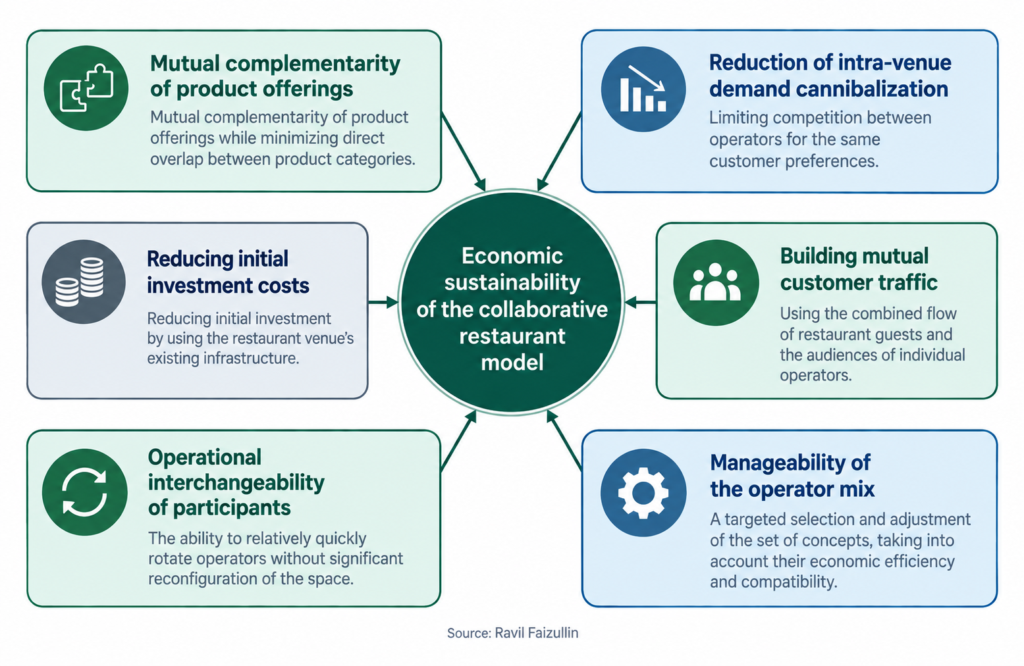
The defining feature of this model is the complementary nature of the operators’ offerings: each operator adds to the restaurant’s core menu and to the offerings of the other participants, while direct overlap between product categories is kept to a minimum.
Key differences between operators within a restaurant and those in food halls and food courts
Food halls and food courts typically give individual operators a high degree of independence. In practice, each operates much like a standalone restaurant, usually with its own kitchen but without a dedicated seating area. Each offers a full menu, from main courses to desserts and beverages.
Although food hall and food court management companies typically select operators with different concepts, such as fast food, pastry shops, or international cuisines, there can still be competition between operators offering similar menu items. When customer traffic is relatively low, this competition can reduce operators’ profitability.
Integrating independent operators into an existing restaurant creates a different operating model.
- Focus on a specific menu category. Rather than offering a full menu, each operator occupies a distinct niche not covered by the restaurant’s core menu. This could be a bar with an extensive cocktail selection, a tea shop, a coffee shop, or an ice cream shop.
- No dedicated kitchen. Operators prepare beverages on-site, while ready-made food is stored refrigerated. As a result, the operator requires only a small space and does not need specialized kitchen equipment or a large staff.
- Ability to rotate operators quickly. In a food hall or food court, each operator typically makes capital investments in its space before opening. Within an existing restaurant, by contrast, one operator can be replaced by another within a matter of days. The restaurant provides basic fixtures and equipment, such as counters and display cases. The incoming operator only needs to bring any specialized equipment it requires, such as coffee machines, along with its products and point-of-sale equipment.
Mechanisms for ensuring the economic sustainability of operators and the host restaurant
For other food and beverage businesses to operate effectively within an existing restaurant, the host venue needs a management strategy that ensures the following conditions are met.
- The operator’s concept should complement the restaurant’s core menu rather than provide an alternative to it. For example, Sol bar-restaurant offers a wide selection of food and beverages on its main menu but does not have a dedicated tea menu. A separate operator provides an extensive selection of teas. The model is therefore structured so that customers order food from the restaurant’s main menu and tea from the operator.
- Continuous monitoring of operator performance. The presence of a third-party business within the restaurant should be mutually beneficial. The operator should generate its own customer traffic, and its products should be in demand.
- Building a pool of prospective operators. If an operator leaves the venue, the management company should maintain a reserve list of businesses with suitable concepts that can be invited to join the restaurant.
How the host restaurant and operators work together
An operator may be an independent entrepreneur launching a startup based on an original concept, a franchisee of a large chain, or a branch operated by a larger chain.
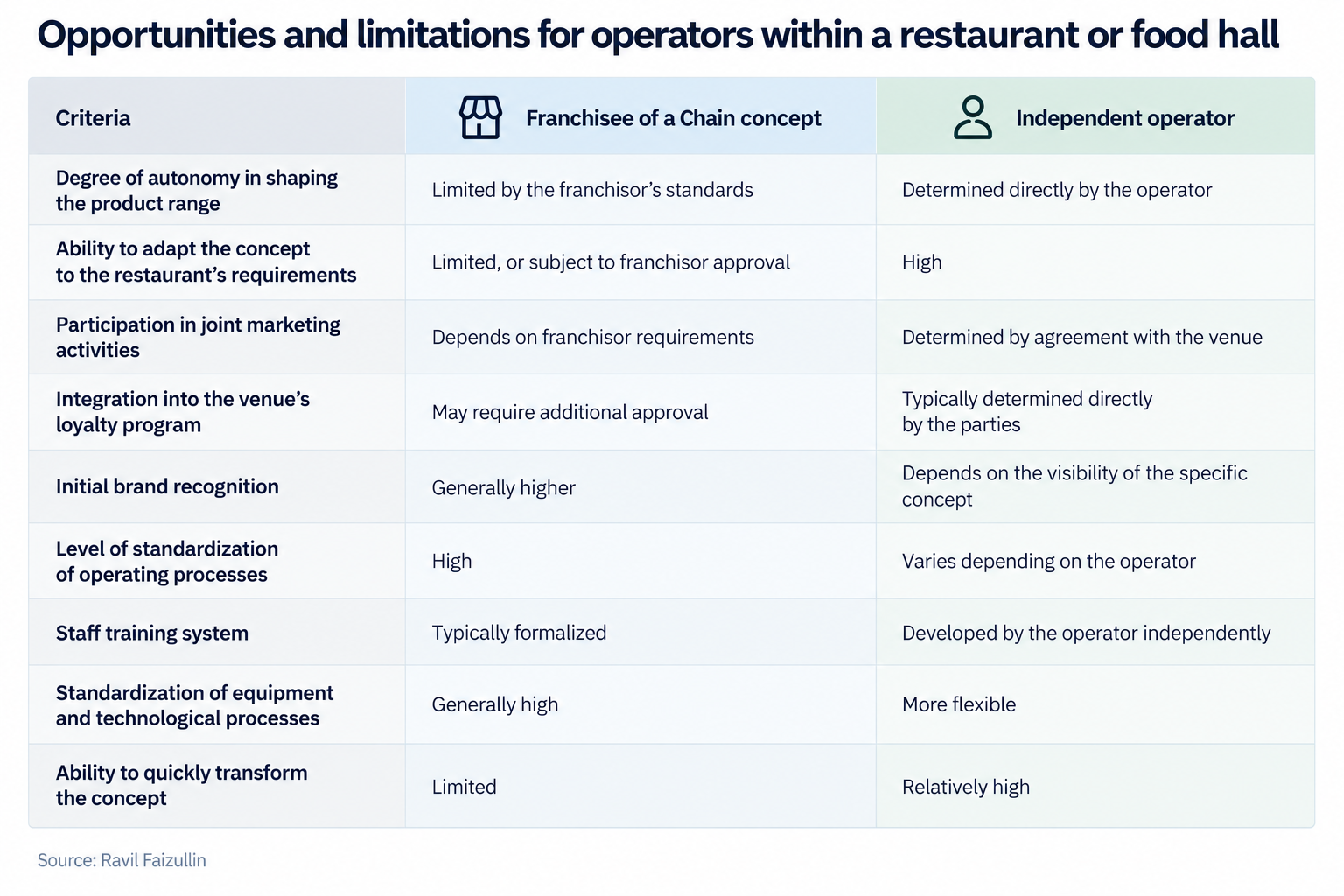
The operator’s status shapes how it interacts with the host restaurant. With a franchisee, for example, the restaurant gains access to a ready-made system that includes a brand, operating standards, a menu, and staff training. At the same time, this arrangement comes with additional constraints: a franchisee cannot freely adapt its concept to the specific needs of the host restaurant.
An independent operator has greater flexibility. It can modify its menu and independently decide whether to participate in promotions, both its own and those offered by the host restaurant.
Thus, the franchise model provides a higher degree of standardization in operating processes but limits an operator’s ability to adapt to the requirements of a specific restaurant. An independent operator, by contrast, has greater organizational and product flexibility, which can be particularly important in a model built around complementary food and beverage concepts.
Prospects for the growth of collaboration within existing restaurants
Operators within existing restaurants remain relatively uncommon, but given its high economic efficiency, the format has significant potential for growth. Factors supporting the growth of collaboration within existing restaurants
- The rise of central production kitchens among small and midsize businesses. More food is now prepared off-site and delivered to restaurants from centralized kitchens, allowing operators to sell not only beverages but also ready-made dishes.
- Advances in specialized kitchen equipment. Equipment is becoming more compact and energy-efficient, making it possible to install multifunctional appliances in small spaces.
- Rising barriers to opening a standalone restaurant. The investment required to launch a food service business is increasing as rents and construction material costs rise. Against this backdrop, opening a concept within an existing restaurant gives first-time entrepreneurs an opportunity to start their own business. Existing cafés can also operate as in-restaurant concepts, effectively opening a “branch” within another restaurant and using the model to scale their operations.
For restaurants themselves, bringing in tenant-operators creates an opportunity to make productive use of additional space and attract new customers without investing in menu expansion or developing new concepts. In this model, the tenant evolves from simply renting space into an operator integrated into the restaurant’s broader concept.
About the author: Ravil Faizullin, business consultant Sol bar-restaurant, partner at Zero LLC.