
The 2026 Revenue Engine: Why Your ‘Disconnected Tech Stack’ Is Killing Your Scalability

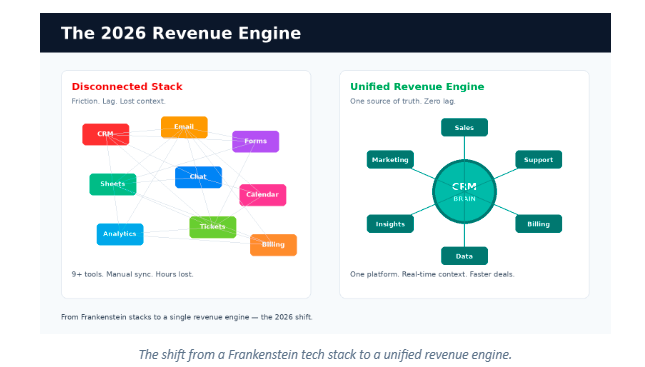
Walk into almost any startup office in 2026, and the same scene plays out. A founder, three coffee cups deep, toggling between seven browser tabs, two desktop apps, and a Slack thread that’s somehow still relevant from last March. There’s a spreadsheet for leads, a different platform for email sequences, a project tool nobody fully trusts, and a CRM that half the team has quietly stopped updating.
Sound familiar? You’re not alone, and honestly, you’re not unique either. This is the most common operational disease in growing companies right now. We just don’t talk about it, because admitting your tech stack looks like a Frankenstein creation feels uncomfortably close to admitting you don’t know what you’re doing.
Here’s the uncomfortable truth: the problem isn’t the tools. It’s the gaps between them.
The Real Price of Tool Sprawl
A 2025 Productiv report pointed to the average mid-sized company running 269 SaaS applications. Read that number again. Two hundred and sixty-nine. Smaller startups aren’t far behind, with most teams under fifty employees juggling somewhere between forty and eighty tools depending on industry.
Each one promises to “streamline workflows” or “supercharge productivity.” Individually, most of them deliver. Stitched together, they create something nobody anticipated: friction. Slow, sticky, expensive friction that hides in plain sight.
When your sales rep can’t see the email cadence that warmed up a lead, they walk into the call cold. When your marketing manager doesn’t know which campaigns actually closed deals, every budget meeting turns into educated guessing. When customer support has no visibility into the original sales conversation, renewals get awkward fast.
This isn’t theoretical. McKinsey research suggests knowledge workers spend roughly 1.8 hours every day just searching for information across systems. That’s nine hours a week. Per person. Multiply that across a thirty-person team and you’re losing the equivalent of nearly seven full-time employees to digital archeology. Nobody puts that line item in the budget. It just shows up as missed quotas and tired people.
The Quiet Revolution Toward a Single Source of Truth
Something’s shifting in how the smartest operators are building their businesses. The phrase you’ll hear at every conference, every podcast, every LinkedIn post worth reading is “single source of truth.” It sounds abstract until you actually see it in action.
The idea is straightforward. Every customer interaction, every touchpoint, every data point about a prospect or client lives in one place. Not synced across five tools with hourly delays and brittle Zapier flows that break at 2 a.m. on a Sunday. One place. Updated in real time. Accessible to every team that needs it.
Why does this matter so much in 2026 specifically? Because buyer expectations have shifted dramatically. The modern B2B customer touches your brand seven to eleven times before talking to a human. They’ve already read your blog, watched a webinar, downloaded a guide, and lurked on your LinkedIn. By the time they hit “request a demo,” they expect you to know who they are.
Cold opens are dead. So is the polite “tell me a bit about yourself” intro that every sales call used to start with. Today’s buyer wants you to already know.
Why CRM Is Now the Brain, Not the Rolodex
Here’s where most founders get it wrong. They still think of CRM as a glorified contact database. A digital Rolodex. A place where leads go to be ignored.
That mental model is killing them.
In a connected revenue engine, the CRM isn’t a department’s tool. It’s the central nervous system of the entire business. Marketing dumps every campaign touchpoint into it. Sales logs every conversation. Customer success tracks every renewal signal. Finance pulls forecasts from it. Even product teams glance at it to understand which features are quietly blocking deals.
As we move into a hyper-competitive 2026 landscape, the most successful startups are abandoning “Frankenstein” tech stacks in favor of integrated revenue platforms. The bottleneck isn’t usually your product; it’s the friction in your data. By implementing a purpose-built small business CRM, you eliminate the manual sync lag between your lead generation and your closing team. This structural shift allows your sales reps to inherit full deal context from day one, ensuring that no opportunity slips through the cracks of a fragmented system.
When the brain works, the body moves faster. Decisions get made with real data instead of opinion. Handoffs stop feeling awkward. The customer feels the difference, even if they can’t articulate exactly why.
The Marketing-Sales Gap Has to Hit Zero
Remember when marketing and sales were two separate worlds, with separate metrics, separate goals, and a not-so-secret rivalry? Those days are quietly ending. Companies still operating that way are losing ground every quarter, even if they can’t see it on a dashboard yet.
In 2026, the gap between when marketing identifies a lead and when sales engages has to approach zero. Literal zero. The hour-long delay that used to feel acceptable now feels Jurassic. The widely-cited Lead Response Management study found that contacting a lead within five minutes makes you twenty-one times more likely to qualify them than waiting thirty.
Twenty-one times.
This isn’t just about speed for its own sake. It’s about context preservation. When a lead fills out a form, watches your demo video, then closes the tab, that intent signal has a half-life measured in hours, not days. By tomorrow, they’ve moved on. By next week, they’ve talked to a competitor who responded faster.
A unified revenue platform makes this gap close itself. The lead converts, the deal owner gets notified, the prior engagement history is right there, and the first touchpoint feels less like a sales pitch and more like picking up a conversation already in progress. That’s the difference between selling and serving.
Where to Start (Without Burning It All Down)
You don’t need to rip out your entire tech stack tomorrow. That’s the panic move, and it usually creates worse chaos than what you’re escaping. Instead, audit honestly.
List every tool that touches a customer or prospect. Then mark which ones genuinely connect to each other versus which ones pretend to through brittle middleware. Most teams discover that around sixty percent of their stack is doing work that one good integrated platform could handle, often at a lower combined cost.
Next, prioritize the connection points that hurt most. For most growing companies, that’s the marketing-to-sales handoff and the sales-to-customer-success transition. Fix those first. The ROI shows up in weeks, not quarters.
Finally, kill your sacred cows. Every team has a tool somebody loves but nobody else can justify. Those are usually the ones quietly eroding your data integrity.
The Bottom Line
The companies winning in 2026 aren’t necessarily the ones with the best products or the biggest marketing budgets. They’re the ones with the cleanest data flow. The ones where context never gets lost. The ones where a customer’s experience feels like one continuous conversation instead of a relay race between strangers.
Your tech stack is either accelerating you, or it’s the silent tax on every deal you’re trying to close. There’s no neutral middle ground anymore. Pick a side before the market picks for you.







Comment