The fastest way to waste a crypto marketing budget is to repeat the same mistakes every other project makes. Agencies that audit blockchain campaigns weekly report remarkably consistent patterns of failure. This guide breaks down the five most common crypto marketing mistakes, explains why they persist, and provides a concrete action plan to fix each one.
DeFi protocol, GameFi platform, token presale, Web3 wallet — these errors don’t discriminate. They hit first-time founders and experienced teams alike.
Mistake #1: Buying Followers and Fake Engagement Instead of Building a Real Community
Inflated social metrics fool nobody who matters and actively destroy credibility with investors and partners. CoinGecko has tracked over 20 million crypto projects — more than half now dead. Experienced investors have razor-sharp instincts for spotting fake traction.
What purchased engagement looks like during due diligence:
- Telegram groups with 50,000 members but fewer than 10 organic messages per day
- Twitter/X accounts showing a sudden spike from 2,000 to 80,000 followers in one week
- Discord servers packed with bots that post generic emoji reactions but never ask a real question
- YouTube videos with thousands of views but zero meaningful comments
Tools like FollowerAudit, Social Blade, and on-chain analytics make it trivially easy to verify whether engagement is genuine. When a venture fund, exchange listing team, or blockchain marketing partner discovers padded numbers, the damage is instant and often permanent.
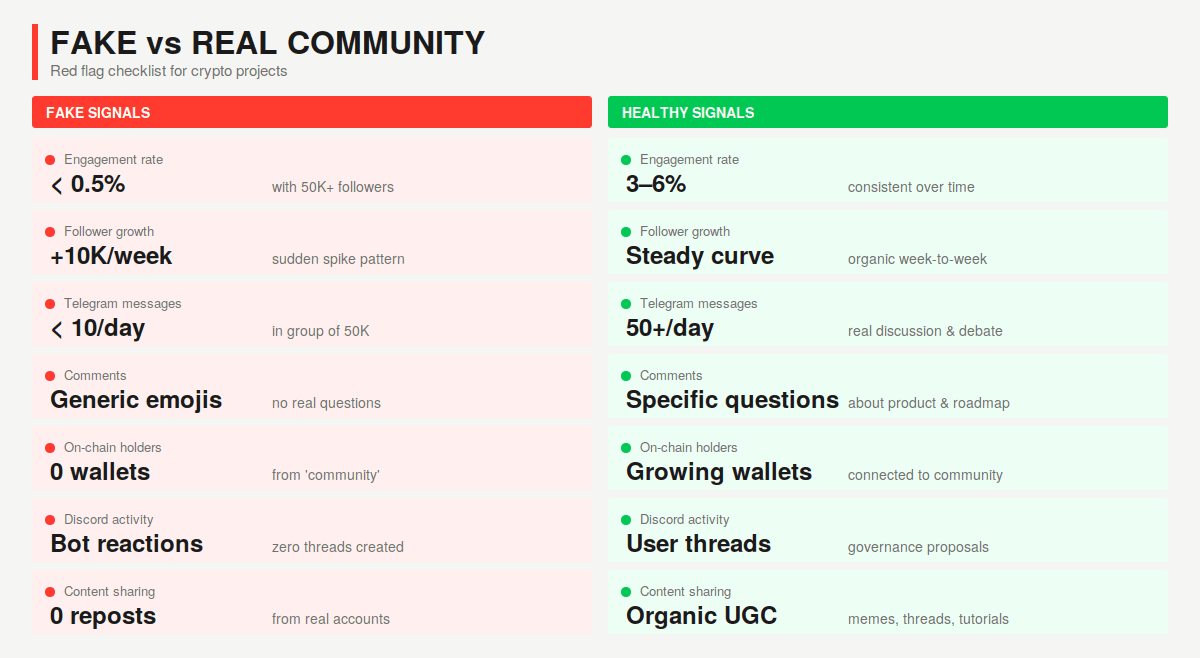
What to do instead: Host weekly AMAs on Twitter Spaces. Create educational threads that break down the technology in plain language. Respond to every genuine question in Discord. A community of 500 active holders will outperform 50,000 purchased followers — in fundraising, retention, and long-term brand equity.
Mistake #2: Running Paid Ads Before the Product Is Ready
Paid advertising amplifies whatever already exists — if that’s an incomplete product, that’s exactly what thousands of potential users will see. Google restricts crypto advertising to certified exchanges in approved regions. Meta requires pre-approval for blockchain marketing campaigns. X permits ads but enforces strict compliance. These platforms don’t make exceptions for projects that aren’t ready.
Too many teams allocate 40–60% of their initial budget to PPC campaigns and crypto ad network placements before they have a functional MVP or even basic documentation. The result: high click-through rates, abysmal conversion, and a first impression that’s nearly impossible to reverse.
The crypto audience has an unusually long memory. A user who clicks an ad, lands on a broken dApp, and leaves will remember that experience months later. They won’t come back — and they’ll share that experience on Crypto Twitter, Reddit, and Telegram.
What to do instead: Invest early budget in content marketing, community building, and developer relations. When the product is genuinely ready, turn on paid channels with retargeting campaigns aimed at the warm audience already built.
Mistake #3: Treating Marketing as a Launch Event Instead of an Ongoing Engine
Marketing doesn’t end at TGE — it begins there. The single most damaging pattern across the industry is teams that invest heavily in pre-launch hype, execute a successful token generation event, and then go silent. Within weeks, community activity plummets and the project starts its slow fade into irrelevance.
The data confirms it: the majority of failed crypto projects in 2024–2025 didn’t collapse because of bad technology. They collapsed because nobody maintained awareness after the initial buzz faded.
| Marketing Element | Launch-Only Approach | Ongoing Engine Approach |
|---|---|---|
| Content production | 10–15 articles pre-launch, then nothing | 2–4 articles/week, ongoing |
| Community management | Active in launch month, then abandoned | 24/7 moderation and engagement |
| PR and media | Big launch press push, no follow-up | Monthly press cadence with milestone updates |
| Influencer partnerships | One-time paid promotions | Long-term ambassador relationships |
| SEO and organic traffic | Ignored entirely | Compounding asset that grows monthly |
| Social media posting | Daily pre-launch, sporadic after | Consistent daily schedule with analytics |
Projects that maintain consistent crypto marketing services see compounding returns — organic traffic grows, community trust deepens, and each new campaign builds on the last. Projects that stop after launch spend three to five times more to regain the same attention later.
What to do instead: Build a 12-month marketing roadmap with monthly milestones, content calendars, and quarterly budget allocation before launch. Marketing is a continuous operational expense, not a one-time cost.
Mistake #4: Ignoring Compliance Until It Becomes a Crisis
Regulatory violations in crypto marketing can shut down an entire operation overnight. In 2026, the EU’s MiCA framework, SEC enforcement actions, and tightening rules in Singapore, the UK, and Australia have made compliance non-negotiable for any blockchain marketing agency or in-house team.
Yet projects continue making claims that would make a compliance officer faint:
- Promising specific returns or using phrases like “risk-free investment”
- Failing to include required disclaimers in ad copy and landing pages
- Marketing unregistered securities without appropriate disclosures
- Running campaigns in jurisdictions where the token isn’t legally available
- Using testimonials that imply guaranteed profits
The consequences are severe: ad account bans, exchange delistings, cease-and-desist orders, and multi-million-dollar fines. Compliance failures generate the kind of negative coverage that no amount of crypto PR can overcome.
What to do instead: Build compliance into the marketing workflow from day one. Every piece of content should pass a compliance review before publication. Create a checklist covering disclaimers, geographic restrictions, prohibited claims, and required disclosures. The cost of review is a fraction of the cost of a regulatory action.
Mistake #5: Optimizing for Google While Ignoring AI Search Entirely
The hidden mistake almost nobody is talking about: competitors fight over Google rankings while AI-powered search engines already redirect millions of user queries. This is the insight that separates projects stuck in 2023 strategies from those building for 2026.
ChatGPT, Perplexity, Gemini, and other AI assistants are becoming the first place users go when researching crypto projects. When someone asks “what’s the best DeFi lending protocol” or “which crypto marketing agency should I hire,” the response comes from a synthesized answer drawn from structured data, citations, and entity relationships — not a traditional SERP.
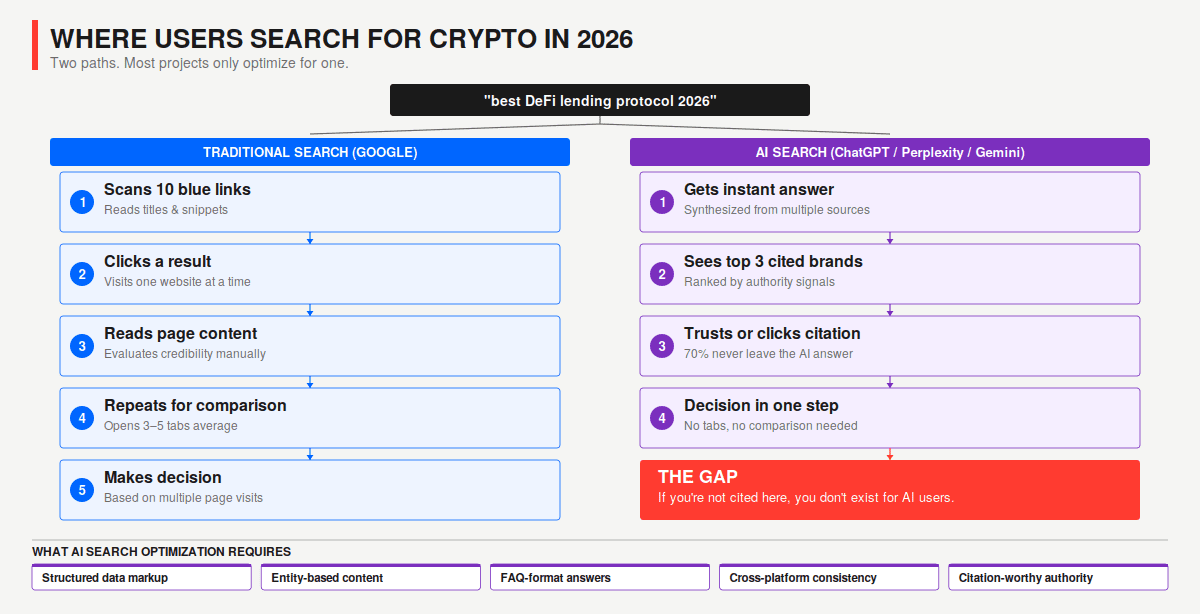
Most crypto projects have zero presence in AI-generated responses. Their SEO strategy targets only keyword rankings, backlink profiles, and Google SERP features. Meanwhile, projects that understand Answer Engine Optimization (AEO) get cited as top recommendations — capturing high-intent users who never open a Google tab.
What AI SEO requires beyond traditional SEO:
- Structured data markup that AI systems can parse and cite
- Entity-based content establishing clear relationships between brand, category, and competitors
- FAQ-format content with direct answers in the first sentence of each section
- Cross-platform brand consistency so AI systems can confidently attribute information
- Citation-worthy authority signals from industry publications, review platforms, and data aggregators
What to do instead: Audit current presence in AI search. Ask ChatGPT, Perplexity, and Gemini about the project and its category. If it’s not being cited, start building structured, authoritative content designed for AI extraction — schema markup, consistent entity data across platforms, and clear question-and-answer formats.
Quick Self-Audit Checklist
- Follower quality: Run social accounts through an engagement rate calculator. Below 1% with a large following signals a fake follower problem.
- Product readiness: Ask five people outside the team to complete the core user flow. If they can’t do it without help, it’s not ready for paid ads.
- Post-launch content: Count blog posts, social updates, and community activities from the last 30 days. Below the pre-launch average means the launch-and-vanish trap.
- Compliance scan: Search the website and ad copy for “guaranteed,” “risk-free,” or specific return promises. Each one is a regulatory liability.
- AI search visibility: Ask three different AI assistants about the project by name and by category. Record whether it’s mentioned, cited, or absent.
Stop Repeating, Start Leading
Every week these five mistakes cost crypto projects millions in wasted budget and lost credibility. The difference between projects that succeed and those that fade isn’t luck — it’s the discipline to avoid predictable errors and invest in what compounds over time.
The crypto market in 2026 rewards authenticity over inflation, consistency over spectacle, compliance over shortcuts, and adaptability over rigidity. The best crypto marketing agency partnerships start with an honest assessment of what’s not working — and the resolve to fix it.
FAQ
Why do crypto projects blow their whole budget on launch week? Pre-launch spending without post-launch strategy is the top budget killer in crypto marketing. A responsible crypto PR agency builds a 6–12 month roadmap from day one, because community growth and organic traffic compound after launch, not before. If your agency delivered a one-month engagement and moved on, they optimized for their invoice.
Can a small project do anything real with a $10K marketing budget? $10K covers two channels done well: targeted community building plus SEO content that compounds over months. The mistake is spreading it thin across influencers, PR, ads, and events simultaneously. A focused strategy on a small budget outperforms a scattered strategy on a large one.
Why are projects still buying fake followers in 2026? Exchange listing teams and VCs now run Social Blade audits and engagement analysis as standard due diligence. Fake followers don’t just waste budget — they actively block fundraising and listings. A community of 800 real participants who vote in governance and attend AMAs outperforms 50,000 purchased accounts at every stage.
Are compliance risks in crypto marketing real, or just agency upselling? Compliance risks are operational, not theoretical. Google and Meta permanently ban ad accounts for non-compliant crypto campaigns with no appeal process. MiCA enforcement in the EU and SEC actions in the US have led to exchange delistings and fines over marketing claims. Any copy containing “guaranteed returns” or “risk-free” is a regulatory liability today.
Do most crypto projects actually die from bad marketing, not bad tech? The majority of failed crypto projects had functional technology. They failed because marketing stopped after token launch. Projects that survive market cycles publish content consistently, maintain community activity during downturns, and treat marketing as a continuous operational cost — not a one-time launch expense.