
Setting Up a Company and Bank Account in Singapore in 2026: What It Actually Costs and Why Banks Keep Saying No

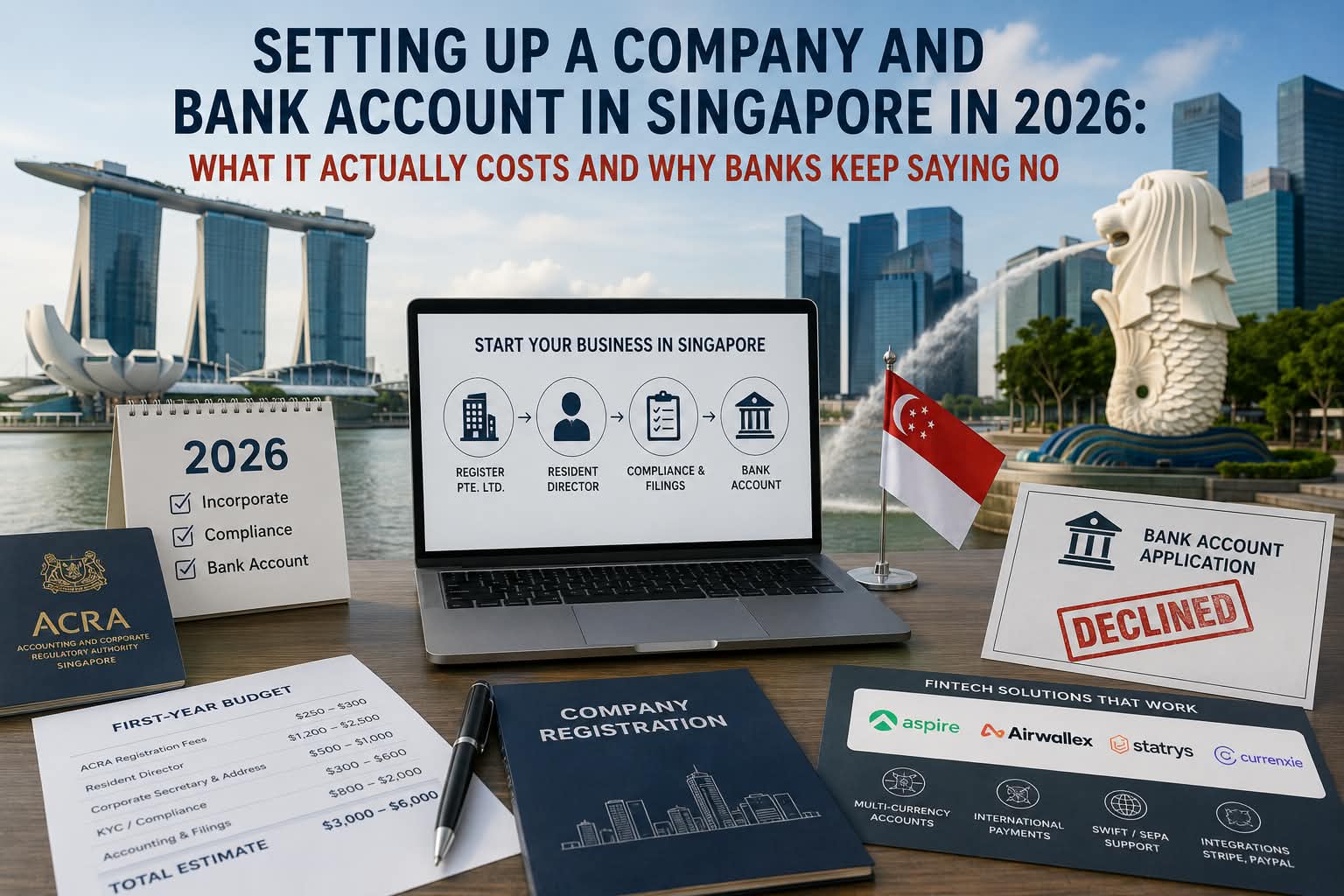
Singapore has held its spot as one of the world’s top jurisdictions for B2B and tech companies for years, and it’s easy to see why: a flat 17% corporate tax rate, no tax on dividends or capital gains, a legal system built on English common law, and a name that opens doors with international partners and investors. On paper, it still looks close to perfect.
But the Singapore of 2026 isn’t the Singapore founders remember from a few years ago. ACRA (the Accounting and Corporate Regulatory Authority) has tightened the screws on corporate service providers, and the major local banks have turned account opening into something closer to a compliance obstacle course than a formality.
If you’re picturing a “$500 offshore company in two days, followed immediately by a work visa,” that version of Singapore doesn’t really exist anymore. Here’s a more honest look at what it costs to actually run a company here in 2026, where the real friction points are, and how founders are working around them.
Part 1: The real first-year budget
Registering the legal shell of a private limited company (Pte. Ltd.) is still genuinely fast — the paperwork itself can be done in a couple of days. The part people underestimate is everything that comes after incorporation: the pieces of infrastructure Singapore law requires you to have in place to actually operate legally.
Here’s roughly what that looks like in year one:
| What you’re paying for | Why it’s required | Typical cost (USD) |
| ACRA registration fees | Registering the company name and the entity itself | ~$250–300 |
| Resident director | Every Pte. Ltd. needs at least one director who’s a Singapore resident | $1,200–$2,500/year (plus a security deposit) |
| Corporate secretary & registered address | Legally mandatory secretary and a local physical address | $500–$1,000/year |
| KYC / compliance document prep | Collecting and verifying founder documents to the regulator’s standard | $300–$600 one-off |
| Accounting and annual filings | Preparing and lodging annual returns with ACRA and IRAS | $800–$2,000/year, depending on transaction volume |
Bottom line: a realistic first-year budget for setting up and maintaining a Singapore company sits somewhere between $3,000 and $6,000. Any package advertised at “$800, all-inclusive” is usually hiding recurring fees that kick in from month two, or simply leaving out the services that actually keep you compliant — like annual filing.
Part 2: The hard part is the bank account
Picture this: you’ve incorporated, paid the fees, and pulled together a full document package. Now you walk into one of the big local banks — DBS, OCBC, UOB — expecting the final step to be a formality.
It usually isn’t.
In roughly 7 out of 10 cases, founders without local residency or a physical office in Singapore get a polite decline after two to three months of waiting and back-and-forth emails.
Why have the banks gotten so difficult?
- Compliance risk aversion. Singapore banks are genuinely afraid of MAS (the Monetary Authority of Singapore) coming down on them for lapses. It’s simpler for them to turn away an “unclear” foreign business than to later have to explain the origin of every dollar that moves through it.
- The substance test. If you don’t have a local director who’s actually involved (not just a nominal appointee), real staff on payroll, or contracts with local partners, the bank will likely file your company under “shell” or “paper” business — and that’s usually the end of the conversation.
- Minimum balance requirements. Even when an account does get approved, banks often ask for a minimum balance you can’t touch — sometimes $50,000 to $100,000 — that just sits there as a compliance buffer.
So what actually works in 2026?
The most useful shift in strategy is simply not walking into a traditional bank on day one unless you have to.
Roughly 90% of IT and B2B businesses today run perfectly well on fintech platforms (neobanks). They give you full local account details, connect to SWIFT and SEPA, and plug directly into Stripe and PayPal — everything a traditional bank offers for day-to-day operations.
A few worth knowing:
- Aspire is the go-to choice for Singapore startups. You can open an account fully remotely, and the platform pairs a clean interface with solid accounting integrations.
- Airwallex is the strongest fit if you’re handling a lot of multi-currency international payments and need to collect from clients worldwide.
- Statrys and Currenxie are both good alternatives if you need to get up and running fast, especially for collecting payments from Europe or the US.
The practical sequence most founders follow: incorporate the Pte. Ltd., open an Aspire or Airwallex account within roughly 3–5 days, start trading and collecting revenue, and only approach a traditional bank later — once you have transaction history and contracts behind you, if you need one at all.
This is also the exact combination — entity setup plus a working account — that a Singapore-based corporate services partner like Intraconnect typically handles together, since sequencing the two correctly is most of what determines whether the process takes days or months.
Part 3: The mistakes that trip up newcomers
Getting the company registered isn’t the finish line — a handful of avoidable slip-ups cause most of the post-launch headaches:
- Cutting corners on the secretary and filings. You genuinely cannot “forget” to file the Annual Return with ACRA or the tax declaration with IRAS. Miss it by even a couple of weeks and you’re looking at fines — and your bank may temporarily freeze the account while it sorts out why.
- Picking the wrong SSIC activity codes. If your registered business activities touch anything licensed — financial services, crypto, insurance — expect document review to stretch into months, not weeks.
- Missing supporting documents for transactions. Fintech accounts are easier to open, but they scrutinize the source of funds just as closely as traditional banks do. Any sizeable incoming payment on a new account needs a contract or invoice behind it, or it gets flagged.
The takeaway
Singapore is still one of the strongest jurisdictions for scaling internationally, raising investment, and protecting IP. The founders who do well here are the ones who go in without the “$500 offshore in a weekend” fantasy and budget realistically for both the compliance side and the banking infrastructure from the start.
If you’re weighing Singapore against other Asian hubs, or want a realistic read on the legal and banking risks before you commit, Intraconnect can walk through your specific business model and help you land on the right structure.







Comment