Many corporations have already introduced AI tools in their organizations to increase productivity and efficiency. However, what many companies initially failed to grasp were the hidden financial costs associated with autonomous AI agents. Uber CTO Praveen Neppalli recently said, “The budget I thought I would need is blown away already,” regarding the company’s AI spending.
The reason is that AI agents don’t operate like traditional software applications with predictable operational models and fixed licenses. The autonomous nature of AI agents causes them to scale up and take on more workflows on their own. Sometimes these AI agents get stuck in endless loops, where they repeat the same actions without any mechanism in place to stop them. Because of this, the AI agents will consume more energy and computational resources, resulting in higher operational costs for the companies.
Single-purpose AI agents reportedly cost between $10,000 to $50,000 per year to run, whereas multi-agent programs can cost millions to operate. Companies deploying these AI agents without factoring in their hidden costs could wind up in substantial financial hardship.
Industry-First Agentic Cost Control Module Released
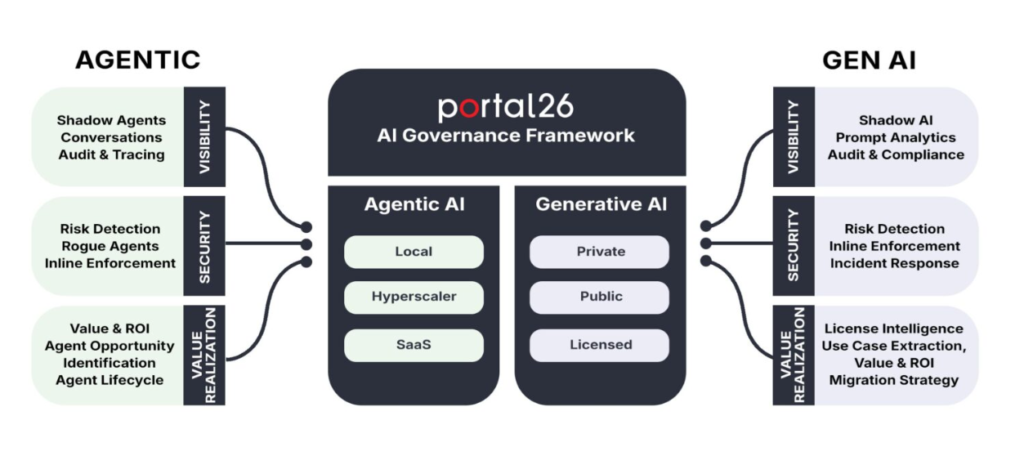
The highly regarded AI adoption management platform, Portal26, recently released a new innovative Agentic Token Control, otherwise known as an Agentic Costs Control module. It is a module designed to address the high costs of running AI agent tools. Enterprises can utilize the module to set guardrails on how many resources their AI agents can consume and hard budget limits on how much is spent on them. That way, the companies can reduce the risk of spending too much money on them.
Portal26’s Agentic Token Control technology is the first module to give organizations more control over how much their autonomous AI agents consume and spend. There is virtually no risk of AI agents repeating their actions and unnecessarily consuming more resources because of the limits set by the Agentic Token Control module. If an AI agent attempts to overconsume, the module will pause or shut it down to prevent a massive expense.
“Agentic AI is powerful, but without cost controls, it can quickly become expensive and chaotic,” said Arti Raman, CEO of Portal26. “We’ve watched enterprises like Uber discover the hard way that adoption speed and cost predictability are on a collision course. Agentic Token Control gives organizations the telemetry and confidence to scale AI agents without waking up to an invoice they didn’t plan for.”
The module has five specific features to ensure AI agents can operate more efficiently and responsibly for enterprises. They include:
1) Real-Time Token Governance
AI enterprise agents interpret words and characters as units of data called tokens. When AI reads a command text prompt, it reads the words and letters as input tokens and then generates a response as output tokens.
Human interaction with an AI agent results in low token usage. On the other hand, an autonomous AI agent consistently processes documents, reports, and databases filled with endless data, resulting in millions of tokens consumed within seconds.
The Agentic Token Control can monitor and enforce limits on the operational token usage across all AI enterprise agents within an organization. These limitations will prevent uncontrolled loops and excessive consumption of data to make it easier for organizations to remain within their desired budgets.
2) Policy-Based Limits
Policy-based limits represent the strict budget or allowances for an enterprise that operates AI agents. A company can use the Agentic Token Control module to set granular thresholds at the agent, workflow, or organizational level to ensure usage stays within budget and intent.
For example, if a company wants to set a limit at the agent level, they could set a limit of $50 worth of tokens per day for their AI customer support agent. If they wanted to set a limit on their workflow level, they could set a limit of 100,000 tokens to complete a particular data-sorting task.
3) Adaptive Safeguards
Adaptive safeguards are like the emergency mechanisms of the Agentic Token Control module. They will automatically intervene when an AI enterprise agent approaches or exceeds the set token limits.
For instance, one safeguard is the throttle. It can slow down an AI agent’s computing speed to ensure it doesn’t consume as many resources and tokens. Another safeguard is a pause, where the module freezes the AI agent to prevent any further processing actions. A human manager will need to manually approve the action before the AI agent can continue consuming more tokens.
The final safeguard is termination. If the module detects an AI agent consuming far more tokens than allowed, it will execute an immediate termination of the process altogether to prevent any further consumption.
4) Cost Predictability
Modern enterprises have too much trouble accurately predicting the costs of running their AI agents, especially since various AI models can consume tokens at different rates. The Agentic Token Control module’s cost prediction capability can eliminate surprise overages by aligning agent behavior with predefined token budgets.
How does it do this? The module analyzes the data units of the tokens to make accurate predictions on the consumption and processing costs of the AI operations for a particular quarter or year. From there, companies can set predefined budgets and force the AI to take actions that don’t exceed them.
5) Operational Visibility
Most modern companies have no idea which AI models in their organizations are costing them so much money. The Agentic Token Control’s operational visibility enables companies to know exactly which AI agents are responsible for their expenses. They can gain clear insight into how and where tokens are being used across all their AI agentic systems.
For instance, a company leader will know exactly which AI agent runs which particular task in which department and how many tokens it consumes by doing so. Based on this information, a leader will know which agents are consuming too many tokens and resources.
Conclusion
Numerous Fortune 500 companies trust the Portal26 AI Adoption Management Platform in various industries, including finance, utilities, healthcare, and insurance. The enterprises leveraging the power of Portal26 have reportedly had 24 times more success in achieving a return on their investment, 3 times more ShadowAI detection, and 10 times more security coverage compared to legacy security providers.
As a result, the executive leadership of corporations, such as CIOs and CFOs, can use Portal26 to gain valuable insights to determine which AI agentic systems are bringing them cost efficiency and which ones are increasing their costs.