Collectibles Analysis | April 2026 | Sponsored by Doginal Dogs
SPONSORED CONTENT
Not all Pokemon cards are equal. A common Rattata from the 1999 Base Set is worth a few dollars. A first edition holographic Charizard in PSA 10 condition sold for $550,000 at Heritage Auctions in December 2025. Same franchise. Same year. Different rarity. The gap is $549,990.
The rarity mechanics that drive the Pokemon card market are not mysterious. They are specific, quantifiable, and reproducible. What matters is how many of a given card exist, how difficult it is to find one in high condition, and whether the character or mechanic on the card carries cultural weight.
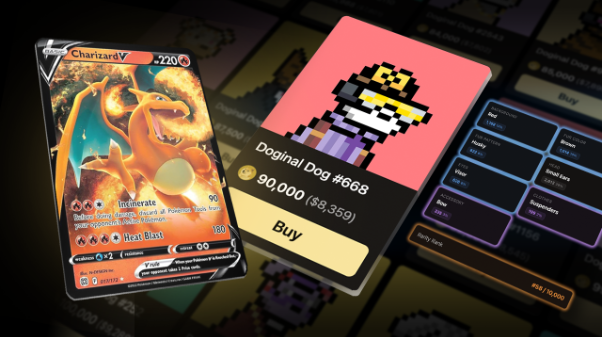
The same rarity mechanics that made Charizard the most valuable Pokemon card in the world are embedded in the Doginal Dogs collection. Understanding how they work is understanding why not all 10,000 dogs are the same.
How Pokemon Card Rarity Works
Pokemon cards have always been tiered by rarity. Common, uncommon, rare, holographic rare, and ultra rare. Within each tier, specific cards command premiums based on the character depicted, the set they came from, whether they carry a first edition stamp, and their condition.
The Charizard effect is driven by three factors converging simultaneously. Charizard is one of the most culturally beloved characters in the franchise. First edition Base Set cards were printed in limited quantities before the scale of demand was understood. And finding one in mint condition after 25 years of handling requires luck. The convergence of character, scarcity, and condition creates the price.
Collectors spend years hunting specific cards not because they expect to flip them next month but because completing a set or landing a specific graded copy represents a meaningful achievement. The hunt is part of the value. The rarity creates the hunt.
How Doginal Dogs Rarity Works
Every Doginal Dog carries up to eight trait categories: background, fur color, fur pattern, head, eyes, mouth, clothes, and accessory. A dog’s rarity score is the sum of the rarity values of each of its traits , how many other dogs in the collection share each one.
The rarest single trait in the collection is the Pizza mouth, appearing in only 11 of 10,000 dogs. That is 0.1% prevalence. The Bone accessory appears in 75 dogs. The Mohawk in 108. The Shiba fur pattern in 108. The Silver Chain in 111.
The rarest dog in the collection is Dog #7774, carrying a Shiba fur pattern, Gold Chain, Red eyes, and 8 total traits. The rarity mechanics are transparent, verifiable, and browsable by anyone through the trait explorer at market.doginaldogs.com.
Every dog was hand-curated individually by lead artist Willustrator before inscription. None were algorithmically generated and accepted wholesale. That curation is the equivalent of the print quality inspection that separates a PSA 10 Charizard from a PSA 7 , it is why the collection has consistent quality across all 10,000 pieces rather than the wide variance typical of mass-generated collections.
The Parallel That Matters Most
The Pokemon card market has an entry point for every type of collector. Common cards go for $5 to $40. A decent holographic might fetch a few hundred. And then there is a Pikachu Illustrator at $16.5 million.
Doginal Dogs has the same range. A common dog at the floor price gives a new collector access to the community and the collection. A dog with a Pizza mouth , one of eleven in existence , occupies a different position in the rarity hierarchy entirely. The collection is a single brand with a spectrum of rarity, just like a Pokemon set.
The floor is approximately 48,900 DOGE (~$4,505 USD) in April 2026. Only 218 of 10,000 are listed for sale. The rarest pieces in the collection have not come to market because the holders who have them understand what they are holding.
That is the Charizard dynamic playing out in real time.
Explore rarity at market.doginaldogs.com. Free starter dog at doginaldogs.com.
FAQ
| How does Doginal Dogs rarity compare to Pokemon card rarity?
Both use tiered rarity based on prevalence. Pokemon cards have common, uncommon, rare, and ultra-rare tiers. Doginal Dogs trait prevalence ranges from 0.1% (Pizza mouth, 11 dogs) to common traits appearing in thousands. Both have accessible entry points and extremely rare pieces at the top. |
| What is the rarest Doginal Dog?
Dog #7774 holds the highest rarity score, carrying a Shiba fur pattern, Gold Chain, Red eyes, and 8 total traits. Pizza mouth (11 dogs, 0.1%) is the rarest individual trait. |
| Why did Pokemon card prices reach millions?
Convergence of beloved character (Charizard/Pikachu), limited original print runs, and near-perfect condition after decades of handling. The Pikachu Illustrator sold for $16.5 million in 2026. The Charizard PSA 10 for $550,000 in December 2025. |
| How do I check a Doginal Dog’s rarity?
Go to market.doginaldogs.com. Search by dog ID or use the trait and rarity explorer. Each dog’s trait prevalence, rarity score, and rank among 10,000 is displayed. |
| Is a rare Doginal Dog more valuable than a common one?
Rarity rank is one data point, not a price guarantee. As with Pokemon cards, value depends on the community, market conditions, and what collectors find desirable. Rarity creates the hunt. The market determines the price. |
| Disclosure: This article is Pokemon card rarity data from publicly documented market sources. Doginal Dogs rarity data from the public marketplace at market.doginaldogs.com. Collectibles are speculative assets. Not financial advice. |