Analysis | April 2026 | Sponsored
SPONSORED CONTENT
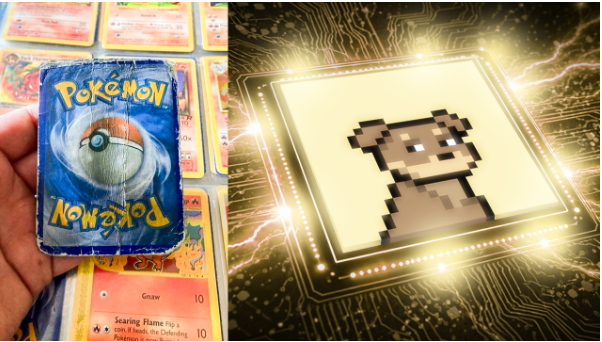
The most expensive Pokemon card in the world sold for $16.5 million. It is a piece of cardboard printed in 1997. The buyer paid $16.5 million for something that can be bent, scratched, exposed to humidity, destroyed in a house fire, or lost. The entire professional grading industry , PSA, Beckett, CGC , exists to certify and preserve what is ultimately a physical object fighting entropy.
That fragility is built into the Pokemon card market in a way that most collectors rarely examine directly. The scarcity of high-grade vintage cards is not just about how many were printed. It is about how few survived in good condition. The PSA 10 Charizard is rare not only because the original print run was small but because most of the cards that were printed were handled by children who did not know they were holding something that would one day be worth half a million dollars.
Digital collectibles do not have this problem. Or rather, the good ones do not. Understanding the difference is understanding why Doginal Dogs represents a new paradigm for the collectibles category.
The Pokemon Card Condition Problem
The professional grading industry for trading cards exists entirely because physical collectibles degrade. PSA, the leading grading service, has graded tens of millions of cards because condition determines value and condition changes over time. A Charizard in PSA 10 condition is an extraordinarily rare thing not just because the card was rare but because keeping a card in perfect condition for 25 years while it passes through multiple hands requires intention, care, and a certain amount of luck.
Collectors who bought cards in 1999 and stored them improperly have watched their potential $550,000 assets become $50 ones. Edge wear, scratches, print lines, exposure to UV light , every physical card is in a constant battle with time. The grading services are the officiators of that battle, certifying where each card stands on the spectrum from perfect to damaged.
This is not a criticism of Pokemon cards as a collectible. It is an observation about the nature of physical objects. Permanence is not their strong suit. Their cultural permanence is extraordinary. Their physical permanence is not.
What Permanent On-Chain Storage Actually Means
Every Doginal Dog is inscribed directly on the Dogecoin blockchain using the Doginals inscription protocol. The image data , the actual pixel art of each dog , is embedded in a Dogecoin transaction. It is part of the blockchain’s permanent record.
This is not a technical distinction without practical consequence. A standard NFT on Ethereum contains a token ID and a URI that points to image data stored somewhere else. If that server goes offline, the image disappears. If the IPFS pin lapses, the image resolves to nothing. The token persists but the asset it represented does not. This has already happened to real NFT collections.
A Doginal Dog inscription cannot fade. It cannot crease. It cannot be damaged by humidity. It cannot be lost in a house fire. The image data exists as part of the Dogecoin blockchain and will persist for as long as the Dogecoin network operates. There is no PSA equivalent for Doginal Dogs because there is no condition to grade. Every dog is in perpetual mint condition.
Lead developer NOS built the indexer that reads every inscription from genesis block zero , the very first block ever added to the Dogecoin chain. The full provenance record of every dog is permanently and publicly verifiable. That is the equivalent of a Pokemon card that was graded at creation, certified at PSA 10, and physically cannot deteriorate.
The Market Implication
The Pokemon card grading industry charges between $25 and $100 per card for grading, and that cost is justified because without a grade, you cannot verify the condition that determines value. The total size of the grading market is a measure of the cost that physical collectibles impose on their holders just to maintain value verification.
Doginal Dogs eliminates that cost entirely. Every dog’s provenance, ownership history, and inscription record is publicly verifiable on-chain for free. The condition never changes. The authenticity never requires verification by a third party. The immutability that the grading industry tries to simulate for physical cards exists natively for on-chain inscriptions.
The Pokemon collectible market is projected to reach $90.2 billion by 2034 despite the friction and fragility of physical cards. A collectible format with the same cultural mechanics but permanent, unalterable, instantly verifiable ownership is a structural improvement on every dimension that drives collector value.
A free starter dog , permanent, on-chain, perpetually mint condition , is available at doginaldogs.com. The marketplace is at market.doginaldogs.com.
FAQ
| Why are Pokemon cards so expensive to maintain?
Physical cards degrade over time. Professional grading services (PSA, Beckett) charge $25-$100 per card to certify condition. A card in PSA 10 condition commands a massive premium over the same card in PSA 7. The entire grading industry exists because condition degrades. |
| Can a Doginal Dog degrade?
No. Every Doginal Dog is inscribed directly in the Dogecoin blockchain. The image data cannot fade, crease, or be lost. There is no condition to grade , every dog exists in permanent mint condition by definition. |
| What happens if Doginal Dogs’ servers go down?
Nothing happens to the dogs. Unlike standard NFTs that point to external servers, Doginal Dog image data is embedded in Dogecoin blockchain transactions. The assets exist on-chain independently of any website, server, or service. |
| How is Doginal Dogs ownership verified?
Through the public Dogecoin blockchain. Every dog’s inscription record, ownership history, and full provenance is publicly verifiable at market.doginaldogs.com. No third-party grading service required. |
| Is permanent storage a significant advantage for NFTs?
Yes. The Pokemon card market reaches $90.2 billion by 2034 despite the friction of physical storage, condition degradation, and grading costs. A collectible format with the same cultural mechanics and permanent, unforgeable storage eliminates those friction costs entirely. |
| Disclosure: This article is All Pokemon market data from publicly documented sources. Doginal Dogs technical claims from documented project records. Collectibles are speculative assets. Not financial advice. |