
What a startup needs from its engineering team today may look very different six months from now. Let’s say a team may urgently need another mobile developer before a release, more QA during an intensive delivery period, or a backend specialist for one part of the roadmap. Turning every temporary capacity problem into a permanent hire can make the engineering budget rigid.
That is where a staff augmentation service can make sense. Instead of rebuilding the team around every change in the roadmap, startups can add engineering capacity when it is actually needed, while keeping product ownership and technical direction inside the existing team.
The Real Cost of Hiring Is Bigger Than Salary
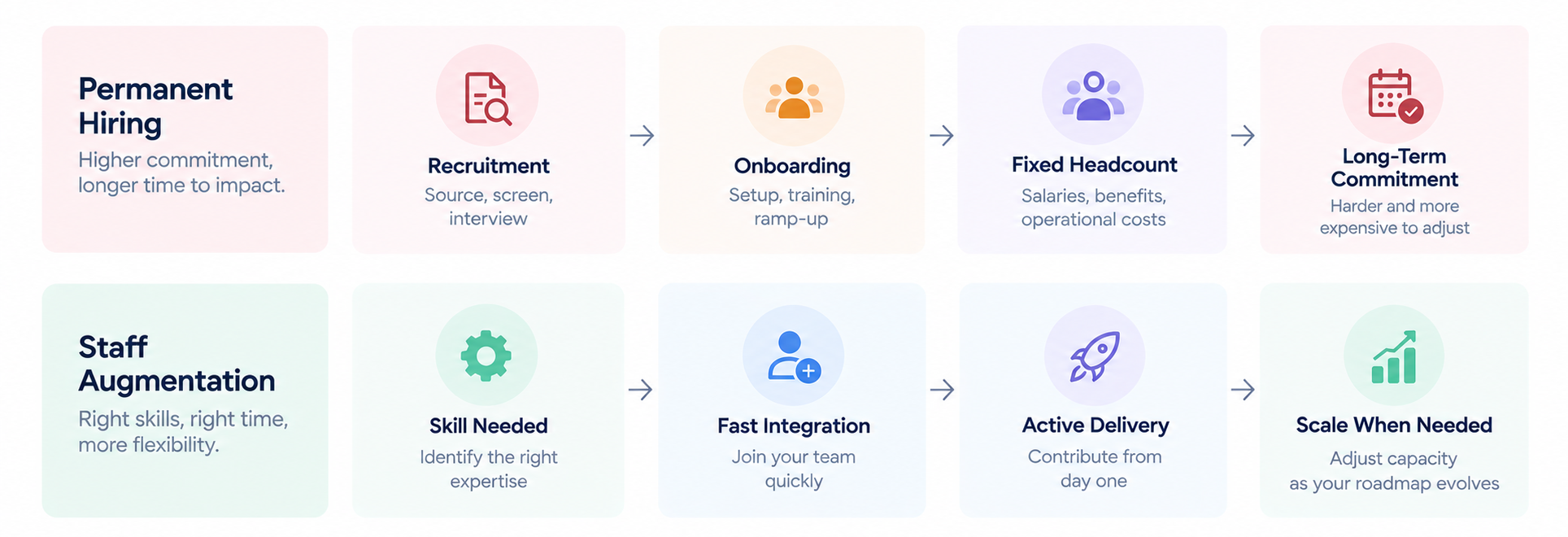
Hiring a full-time developer makes sense when the company knows it will need that role for the long term. But for startups, that is not always easy to predict. The actual cost also goes beyond salary. Recruitment takes time, and once someone joins, there are onboarding, equipment, benefits, payroll costs, and the time the existing team spends helping a new employee get up to speed. If the role is difficult to fill, the company may also spend weeks or months operating without the capacity it originally needed.
This becomes particularly important when the workload is temporary. Hiring someone full-time to solve a six-month problem can leave the company paying for capacity it no longer needs once priorities change.
Not Every Skill Gap Requires a Permanent Hire
Not every gap in an engineering team needs to become a permanent role. Sometimes the extra capacity is tied to a specific stage of the product: a launch, a migration, a new integration, or simply a few months when there is more work than the current team can handle.
This is worth considering before hiring another full-time employee. If the need is likely to remain for years, growing the internal team makes sense. If it is temporary or still difficult to predict, committing to another permanent role may leave the company with an unnecessary fixed cost later.
Staff augmentation gives startups another option. They can keep the people they need long term in-house and bring in additional specialists when the roadmap calls for them.
The idea is not to make the entire engineering team flexible. It is to avoid making a long-term hiring decision for a short-term problem.
Pay for the Skill, Not Just the Hours
A lower hourly rate can easily become a more expensive engineering decision.
Suppose a team needs someone to take over a mature Flutter application, understand an unfamiliar architecture and resolve a difficult integration. A developer who needs weeks of guidance may cost less per hour but consume significantly more internal time.
We see this in project takeovers in particular. The first job is often not writing new code. It is understanding what is already there: architecture, dependencies, release setup, known issues and the decisions previous developers made.
A specialist who has solved a similar problem before can remove a bottleneck faster than several additional generalists.
Keep Costs Flexible as the Team Grows
Startups operate between two uncomfortable risks: hiring too aggressively and slowing development too much.
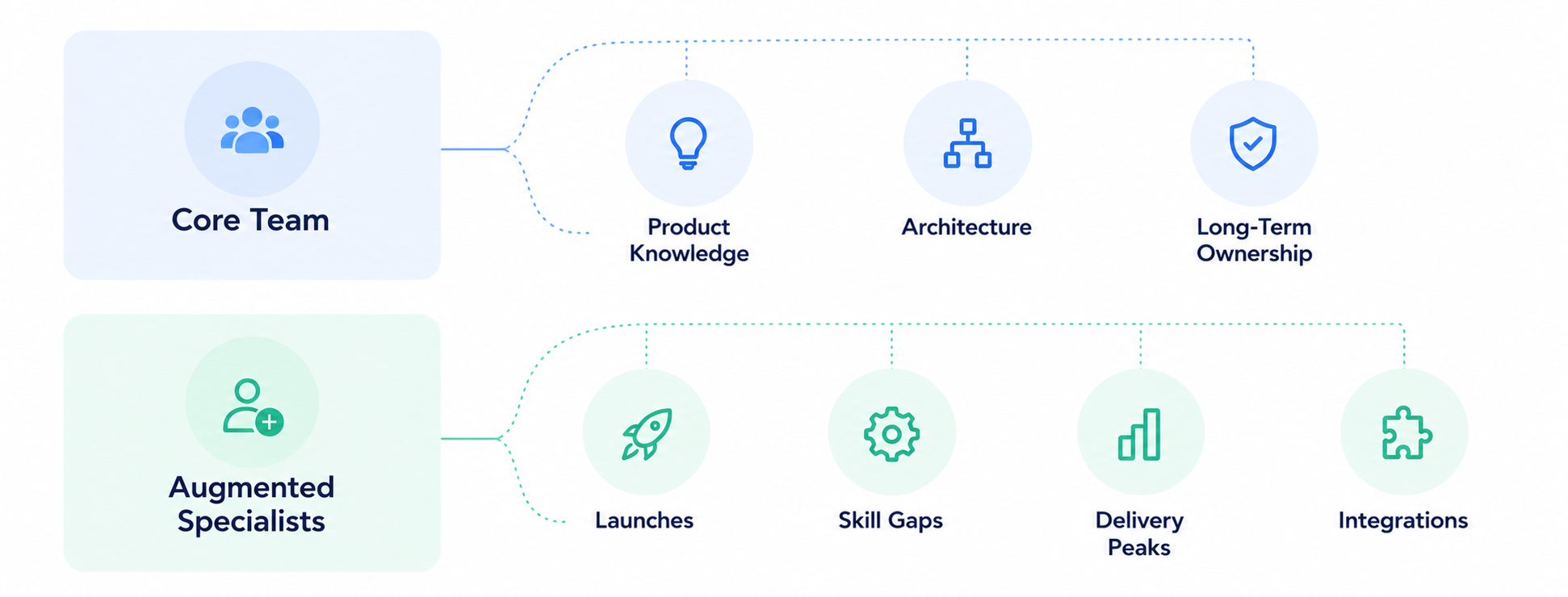
A flexible layer around the core team can help balance those risks. The internal team keeps ownership, while additional engineers cover periods where the roadmap requires more capacity.
This works particularly well when the requirement is clear but its duration is not.
A startup may know it needs two engineers now without honestly knowing whether it will need those exact roles nine months later.
Speed Has a Financial Value
Recruitment time is usually discussed as an HR problem. For a product company, it is also an engineering cost.
Every week without a required specialist can mean delayed features, more pressure on the existing team or technical work being postponed. If a release is connected to revenue, investment, or a customer commitment, the cost becomes easier to see.
Faster onboarding matters when an additional engineer becomes productive before the bottleneck starts affecting the business.
Fast onboarding still requires clear access, priorities and technical ownership.
Where Staff Augmentation Gets Expensive
Adding people does not automatically increase delivery capacity.
If requirements change every few days, nobody owns architecture, code reviews take a week, or developers cannot get access to the systems they need, adding another engineer may simply add another communication channel.
Poor matching is expensive too, especially when selection focuses on availability rather than relevant experience.
Before augmenting a team, we would ask a few practical questions. What exactly is slowing delivery? Which capability is missing? Who will make technical decisions? How will the new developer work with the existing team? What should be different after three months?
If those answers are unclear, the staffing model may not be the first problem to solve.
Not Every Role Should Be Flexible
There are positions a startup should deliberately build in-house.
If an engineer owns technology central to the company’s intellectual property, shapes long-term architecture, or holds knowledge the business needs continuously, permanent employment may be the better decision.
Staff augmentation works best when there is already something solid to augment: a core team, technical leadership, established product ownership, or at least a clear delivery structure.
It can fill a specialist gap, support a demanding roadmap, or add capacity while recruitment continues. It should not disguise the absence of engineering ownership.
Finding the Right Balance for Your Engineering Team
The useful comparison is not “employee versus contractor” or “which hourly rate is lower?” A better question is how much engineering capacity should remain fixed and how much should be able to move with the roadmap.
For a startup, that answer can change quickly. A funding round, product pivot, enterprise customer, migration, or new market can reshape priorities within months. A strong internal core provides continuity. Flexible specialist capacity gives the company room to respond without turning every new requirement into permanent headcount.
Used that way, staff augmentation is not simply a shortcut around recruitment. It is a budgeting tool – one that lets part of engineering spend follow the work the company actually needs to deliver.