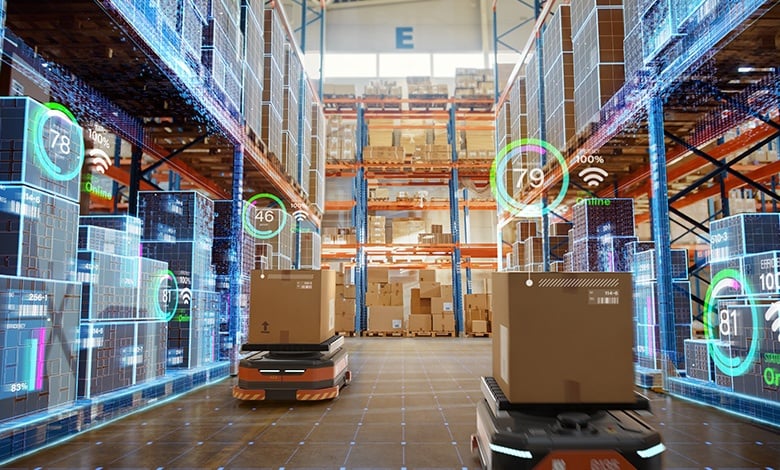
Warehouses are becoming more intelligent, but the transformation involves more than installing robots or adopting new software.
The way materials move through a facility is changing at nearly every level. Forklifts are generating operational data. Warehouse management systems are coordinating increasingly complex workflows. Automated vehicles are taking over repetitive transportation tasks. Telematics is giving managers greater visibility into equipment utilization, while new safety technologies are changing how people and machines interact.
Together, these developments are turning material handling from a largely mechanical function into an increasingly connected part of warehouse strategy.
The objective is no longer simply to move a pallet from one location to another. Modern operations are looking for ways to move materials more efficiently, reduce unnecessary equipment costs, improve safety and build enough flexibility to respond when demand changes.
That shift is reshaping both the technology warehouses use and the decisions managers make about their equipment.
Material Handling Is Becoming More Data-Driven
For decades, warehouse managers could evaluate equipment largely through observation.
They knew which forklifts were used most often, which machines required frequent repairs and where congestion tended to occur.
Modern connected equipment can provide much more precise information.
Telematics platforms can track operating hours, utilization, impacts, fault codes, maintenance requirements and other equipment activity. Instead of relying on assumptions about how a fleet is being used, managers can begin working with actual operating data.
That creates opportunities to answer questions that were once difficult to quantify.
Are certain forklifts accumulating substantially more hours than others?
Are some units rarely being used?
Does a particular application generate unusually high maintenance costs?
Could equipment be reassigned between departments rather than purchasing another unit?
Those answers can influence everything from maintenance scheduling to capital spending.
As material handling becomes more measurable, fleet decisions can increasingly be based on evidence rather than intuition.
Automation Is Changing the Role of Traditional Equipment
Robotics and autonomous vehicles are gaining ground inside warehouses, but that does not mean conventional material handling equipment is disappearing.
Instead, many operations are becoming hybrid environments.
Autonomous mobile robots may transport smaller loads between workstations while forklifts handle pallets at loading docks. Automated storage systems may manage dense inventory while reach trucks support other areas of the facility. Conveyors may move products through one part of the building while operators use pallet trucks or lift trucks elsewhere.
This combination can be more practical than attempting to automate every task.
Different material-handling technologies are suited to different jobs, and the most effective solution often involves coordinating several types of equipment.
That makes integration increasingly important.
A highly automated system can still become inefficient if pallets are not delivered to it on time. Likewise, adding robots may provide limited value if congestion elsewhere in the facility prevents material from flowing efficiently.
Warehouse automation therefore works best when it is considered as part of the entire material-handling process rather than as an isolated technology investment.
Smarter Fleets Do Not Necessarily Mean Larger Fleets
One of the most important shifts in material handling is the recognition that adding equipment is not always the best way to increase capacity.
A warehouse may appear short on forklifts when the actual problem is poor fleet utilization.
Some units may be assigned inefficiently. Others may spend significant portions of the day idle. Equipment types may not match the tasks they are performing, forcing operators to work more slowly.
Utilization data can help expose these problems.
Managers may discover that redistributing equipment between shifts provides enough additional capacity to avoid another purchase. They may find that replacing one type of truck with another improves productivity. Temporary rental equipment may prove more economical than permanently expanding a fleet to accommodate seasonal demand.
The goal is not to own the maximum amount of equipment.
It is to have the appropriate equipment available where and when the operation needs it.
Companies evaluating their material-handling requirements can review equipment, rental, service and fleet-management resources through blackequipment.com, illustrating how modern material-handling strategies increasingly combine equipment with support, maintenance and fleet planning rather than treating each purchase as an isolated transaction.
Maintenance Is Becoming More Predictive
Equipment maintenance is also benefiting from greater connectivity.
Traditional preventive maintenance typically relies on scheduled service intervals. That remains important, but equipment data can add another layer of intelligence.
A heavily utilized forklift may need attention sooner than a similar unit operating only a few hours each day. Fault codes may reveal a developing problem before the truck becomes unusable. Repeated impacts or abnormal operating patterns may indicate that maintenance or operator training is needed.
The long-term direction is toward maintenance that reflects actual operating conditions.
This has important implications for warehouse performance.
Unexpected equipment failure can disrupt receiving, picking, replenishment or production. In facilities with highly coordinated workflows, downtime affecting one machine can eventually influence several downstream processes.
Better maintenance information helps organizations intervene earlier and reduce that risk.
It also gives managers better information when deciding whether an aging piece of equipment should be repaired, replaced or reassigned.
Safety Technology Is Becoming More Integrated
Smarter material handling is not solely about productivity.
Warehouse equipment is increasingly incorporating technologies designed to reduce risk and provide operators with better situational awareness.
Depending on the equipment and application, these technologies may include proximity detection, cameras, speed controls, access management, impact monitoring and operator-assistance systems.
Warehouse design is evolving alongside these capabilities.
Facilities are increasingly required to accommodate conventional forklifts, autonomous equipment and pedestrian traffic at the same time. Clear traffic patterns, visibility and separation between people and equipment remain essential even when advanced technology is present.
Technology can support safer operations, but it cannot replace thoughtful facility design or proper training.
The most effective safety strategies combine equipment features with operating procedures and employees who understand how to work around increasingly sophisticated machinery.
Electrification Is Changing Infrastructure Decisions
The transition toward electric material handling equipment is another important development.
Electric forklifts have been common for years, but improvements in battery technologies and charging systems are expanding the range of applications where electric equipment can be practical.
This affects more than the truck itself.
Warehouses considering electric fleets also need to think about charging infrastructure, battery capacity, operating schedules and energy availability.
A fleet operating across multiple shifts may require a different charging strategy than equipment used intermittently during the day.
These decisions become part of broader facility planning.
As fleets become more connected and electrified, equipment strategy increasingly intersects with infrastructure, energy management and warehouse design.
Flexibility Is Becoming a Competitive Advantage
Warehouse demand rarely remains constant.
Seasonal peaks, changing customer requirements, new products, business growth and unexpected disruptions can all affect equipment requirements.
A rigid fleet can make it difficult to respond.
More flexible strategies may combine owned equipment with leases and rentals. Companies can maintain permanent capacity for predictable demand while adding equipment temporarily when workloads increase.
The same principle applies to automation.
Modular technologies and autonomous mobile robots can sometimes be scaled more easily than fixed automation systems, allowing facilities to expand capacity incrementally.
The broader trend is toward material-handling systems that can adapt as operating conditions change.
That flexibility may become increasingly important as supply chains face shorter delivery expectations and greater uncertainty.
The Warehouse Is Becoming a Connected Operating System
The most significant change in modern material handling may not be any individual technology.
It is the way technologies are beginning to work together.
Warehouse software, forklifts, telematics, automation, maintenance systems and employees increasingly contribute information to the same operating environment.
This gives organizations an opportunity to manage material flow more strategically.
Instead of asking only whether a forklift is functioning, managers can ask whether the fleet is properly sized.
Instead of simply scheduling maintenance, they can evaluate how equipment condition affects throughput.
Instead of installing automation because it is new, they can identify the specific bottlenecks where automation creates the greatest operational benefit.
These are more sophisticated questions, and answering them requires a broader view of material handling.
The warehouse of the future will certainly contain more automation and more intelligent equipment. But technology alone will not determine which operations perform best.
The advantage will come from using technology to understand how equipment, people and processes work together — and then making better decisions about how materials should move through the facility.