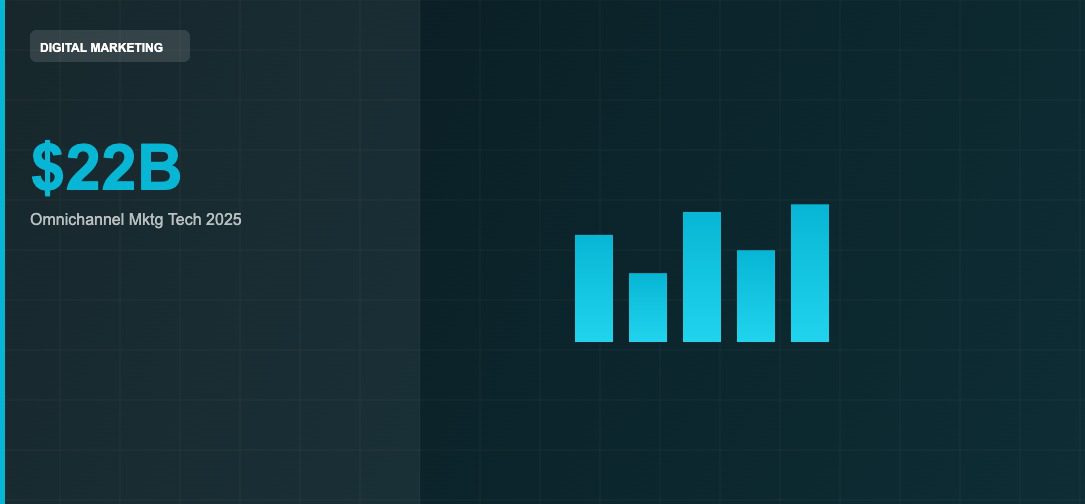
The omnichannel marketing technology sector has reached a critical inflection point. Valued at $22 billion in 2025, this market continues to expand as businesses recognise the fundamental truth: customers no longer shop through isolated channels. They move fluidly between mobile apps, websites, physical stores, social media platforms and email, expecting consistent experiences at every touchpoint. Companies that master omnichannel technology report 3.5 times higher customer retention compared to siloed competitors, a metric that translates directly to sustainable revenue growth.
Yet implementing true omnichannel capabilities remains profoundly challenging. The technology landscape has become increasingly complex, with platforms promising unified customer experiences while organisations struggle with legacy systems, disparate data sources and teams structured around individual channels. Understanding what omnichannel marketing technology actually delivers, and how to implement it effectively, has become essential knowledge for marketing leaders and technology decision-makers.
Understanding Omnichannel Marketing Technology
Omnichannel marketing technology fundamentally differs from multichannel approaches. Multichannel organisations manage separate channels with limited integration, resulting in fragmented customer experiences. Omnichannel technology, by contrast, unifies all customer interactions through a single view of the customer, enabling consistent messaging, personalisation and engagement across every channel simultaneously.
At its core, omnichannel marketing technology serves four critical functions. First, it aggregates customer data from all interaction points into a unified customer data platform, creating a single source of truth about each customer’s behaviour, preferences and journey stage. Second, it enables cross-channel orchestration, allowing marketers to trigger coordinated campaigns that follow customers across channels in real-time. Third, it delivers real-time personalisation by applying customer insights instantly across channels. Fourth, it measures performance holistically, tracking customer journeys and attributing value across all touchpoints rather than viewing channels in isolation.
The technology stack supporting omnichannel operations has matured considerably. Customer data platforms now integrate with marketing automation systems, real-time personalisation engines, attribution analytics tools and channel-specific platforms for email, SMS, push notifications and social media. Cloud infrastructure enables these systems to communicate instantaneously, processing millions of customer interactions while maintaining data governance and privacy compliance.
Unified Customer Data: The Foundation of Omnichannel Success
Every effective omnichannel strategy rests upon unified customer data. Customer data platforms like Segment, mParticle and Tealium collect information from websites, mobile apps, point-of-sale systems, call centres and external data sources, creating comprehensive customer profiles. These platforms normalise data formats, reconcile duplicate records and manage consent across regions, transforming fragmented data into actionable customer intelligence.
Modern customer data platforms go beyond passive data collection. They enable identity resolution across devices and channels, so that when a customer browses on mobile, visits a physical store and later purchases through desktop, the system recognises this single individual and builds a unified behavioural profile. This capability is particularly valuable given the reality that most significant customer purchases involve multiple touchpoints across different devices and channels.
Cross-Channel Orchestration Platforms
Cross-channel orchestration platforms enable coordinated customer journeys that adapt in real-time based on customer behaviour. Rather than running isolated campaigns in email, then separate campaigns in social media, orchestration platforms manage cohesive journeys where each interaction informs subsequent touchpoints across all channels.
Leading platforms in this space include Adobe Experience Platform, Salesforce Marketing Cloud, HubSpot and Iterable. These systems allow marketers to build journey maps that specify how customers should be engaged based on their behaviour, preferences and lifecycle stage. When a customer abandons a shopping cart, the platform might trigger an email immediately, then follow with a push notification if the customer opens but does not convert, and finally attempt a Facebook retargeting ad after 48 hours.
The sophistication of orchestration technology has expanded considerably with artificial intelligence integration. AI-powered platforms can now optimise send times for each individual customer, recommend the most effective message content, determine ideal frequency to maximise engagement without creating fatigue, and predict which channels individual customers prefer.
Real-Time Personalisation at Scale
Real-time personalisation technology enables one-to-one customisation for millions of customers simultaneously. When a customer visits a website, personalisation engines can instantly identify relevant products, customise content, adjust offers and refine calls-to-action based on that specific customer’s behaviour, preferences and lifecycle stage. This happens within milliseconds, before the webpage fully loads.
Platforms like Dynamic Yield, Monetate and Kameleoon deliver this capability through sophisticated algorithms that score customers in real-time and serve tailored experiences. A customer browsing luxury handbags might see premium product recommendations and exclusive VIP offers, whilst a first-time visitor looking at budget items might encounter financing options and beginner-focused content. The same webpage infrastructure delivers entirely different experiences based on customer-specific intelligence.
| Technology Layer | Core Capability | Example Vendors |
|---|---|---|
| Customer Data Platform | Data aggregation and unification across sources | Segment, mParticle, Tealium |
| Orchestration Engine | Cross-channel journey automation | Adobe Experience Platform, Salesforce Marketing Cloud, Iterable |
| Real-Time Personalisation | Dynamic content and offer customisation | Dynamic Yield, Monetate, Kameleoon |
| Email Marketing Platform | Personalised email campaign management | Klaviyo, Braze, HubSpot |
| Attribution Analytics | Multi-touch attribution and channel measurement | Bizible, Northbeam, Marketing Mix providers |
Measurement and Attribution Across Channels
Effective omnichannel marketing requires sophisticated measurement frameworks that move beyond last-click attribution. Most customers interact with multiple channels before converting, yet traditional last-click attribution credits only the final channel, dramatically undervaluing earlier touchpoints that initiated consideration.
Modern attribution technology uses several approaches to address this challenge. First-touch attribution credits the first channel that reached the customer, revealing which channels are most effective at awareness. Linear attribution distributes credit equally across all touchpoints. Time-decay attribution gives more weight to touchpoints closer to conversion. Machine learning attribution models analyse patterns across millions of customer journeys to determine the most likely impact of each touchpoint on conversion decisions.
Privacy regulations and platform changes complicate attribution measurement. The deprecation of third-party cookies and Apple’s App Tracking Transparency framework have reduced the granularity of available data. Leading attribution platforms now employ contextual analysis, first-party data, and sophisticated modelling to maintain measurement accuracy without relying on invasive tracking.
Retail and Digital Integration
For retailers, omnichannel technology has become existential. Customers expect to browse online and collect in store, order online for home delivery, purchase in store with delivery to home, or return items purchased online at physical locations. Meeting these expectations requires seamless integration between e-commerce platforms and point-of-sale systems.
Platforms like Shopify Plus, SAP Commerce Cloud and Oracle Commerce Cloud now include extensive omnichannel capabilities. Inventory systems reflect stock across all locations in real-time, enabling accurate online availability information and buy-online-collect-in-store functionality. Customer service teams access unified customer history across all channels, so an agent can see when a customer last visited a store, what they browsed online and their complete purchase history.
Artificial Intelligence in Omnichannel Marketing
Artificial intelligence has become fundamental to omnichannel marketing effectiveness. Machine learning algorithms now power most of the critical functions that enable successful omnichannel operations. AI determines optimal send times for individual customers, predicts which customers are most likely to respond to specific offers, recommends personalised product assortments and detects patterns in customer behaviour that humans might miss.
Predictive analytics identify customers at risk of churn, enabling proactive retention campaigns. Natural language processing enables sophisticated sentiment analysis of customer communications across all channels. Generative AI now assists with creative content generation, drafting email subject lines, product descriptions and social media copy that maintains brand voice whilst personalising for individual customer segments.
| Channel | Integration Complexity | Sync Frequency | Measurement Focus |
|---|---|---|---|
| Email Marketing | Low | Real-time | Open rate, click-through, conversion |
| Website | Medium | Real-time | Session behaviour, conversion funnel |
| Mobile App | Medium | Real-time | User engagement, push notification performance |
| Physical Retail | High | Daily | In-store traffic, transaction value |
Looking Forward
The omnichannel marketing technology landscape will continue evolving rapidly. Advancements in artificial intelligence promise increasingly sophisticated personalisation and prediction capabilities. First-party data strategies will become increasingly important as third-party tracking diminishes. Voice commerce and conversational AI will emerge as significant channels requiring orchestration.
Organisations that invest in omnichannel capabilities now will achieve substantial competitive advantages in customer retention, lifetime value and brand loyalty. Those that delay risk falling further behind as customer expectations for seamless omnichannel experiences become universal. The technology foundations are now mature enough that omnichannel success depends less on technological innovation and more on organisational commitment and disciplined implementation.
Data from Statista’s digital market outlook shows that global digital spending continues to grow at double-digit rates, with mobile channels accounting for an increasingly dominant share of total transactions.
PwC’s analysis of financial services trends through 2025 highlights the convergence of technology and media as a defining dynamic, with data-driven personalisation becoming the primary competitive differentiator.
For more coverage on related topics, explore our dedicated section on technology insights.
Readers interested in this space may also find value in our reporting on AI-powered marketing.