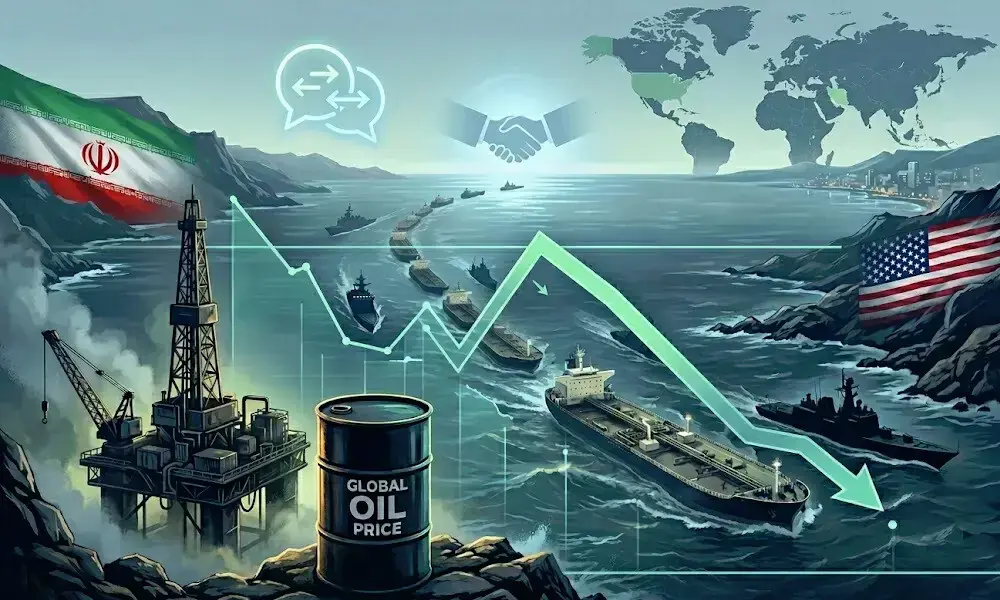
Crude oil is trading in a tight, cautious range today, with Brent crude near $72.3 a barrel and U.S. West Texas Intermediate (WTI) hovering close to $69, as markets weigh easing Middle East tensions against a steady rebound in global supply. Both benchmarks are on track to finish the week little changed, a sharp contrast to the volatility that gripped oil markets earlier this year — and a reminder of just how quickly sentiment in this market can shift from crisis to calm.
A Market Balancing Relief Against Oversupply
Brent futures rose roughly 0.6% on the day, while WTI gained around 0.5%, as traders grew more confident that diplomatic progress between the United States and Iran will hold. That confidence is easing fears of renewed disruption through the Strait of Hormuz, one of the world’s most critical chokepoints for seaborne oil.
The numbers behind that confidence are significant. Daily flows through the Strait of Hormuz have climbed back above 10 million barrels, supported by a broader recovery in Gulf exports alongside emergency reserve releases and ad hoc sales into Asia. Iranian exports have also surged past 40 million barrels following the lifting of a U.S. naval blockade, while record Russian shipments have added further volume to global seaborne inventories. Combined, this supply rebound has created a market surplus that’s capping upside momentum even as diplomatic sentiment continues to improve.
At the same time, U.S. crude stockpiles have fallen to their lowest level since March 2025, following twelve consecutive weeks of drawdowns — a sign that underlying demand remains firm even as headline prices stay muted. This tension between rising global supply and resilient domestic demand is a key reason oil has settled into a range rather than trending decisively in either direction.
Adding a macro dimension to the picture, this week’s weaker-than-expected U.S. jobs data has cooled expectations for further Federal Reserve rate hikes. That shift has lent modest support across commodities broadly, including oil, even as prices continue to trade near seven-month lows.
Geopolitical Risk Hasn’t Fully Cleared
Despite the improved tone, uncertainty remains. Peace talks in Qatar have hit a temporary delay tied to the funeral of Iran’s former Supreme Leader, and Tehran continues to insist on retaining maritime administrative control over the strait — a sticking point that could reintroduce volatility if negotiations stall or break down. Markets appear to be pricing this as a manageable risk for now, but it underscores why oil remains one of the most headline-sensitive assets to trade, capable of moving sharply within a single session on a single diplomatic update.
That combination — a market that can sit quietly for days and then gap on a single piece of news — is precisely why execution quality matters as much as market view. Whether reacting to an OPEC+ statement, a shift in Hormuz shipping data, or a surprise inventory report, the speed and reliability of order execution can be the difference between capturing a move and missing it entirely.
Why Execution Quality Matters in This Market
Given how tightly balanced oil currently is between improving supply and unresolved geopolitical risk, traders need more than just a view on price direction — they need a dependable way to act on it. This is where the decision to trade oil with a trusted broker becomes genuinely important, not just a formality. Tight spreads, transparent pricing, and reliable stop-loss execution all matter more in a market prone to sudden gaps than in calmer, slower-moving assets.
Choosing to trade oil with a trusted broker also means having confidence that margin requirements are clear and that positions can be managed properly around high-volatility events — OPEC+ meetings, geopolitical negotiations, or unexpected inventory data all have the potential to move Brent or WTI by a dollar or more within minutes. In a market this reactive, the broker standing between a trader and their position becomes part of the overall risk management strategy, not just an afterthought.
What to Watch Next
Key variables likely to shape oil’s next move include the resumption of delayed Qatar peace talks, ongoing Strait of Hormuz shipping volumes, upcoming OPEC+ output decisions, U.S. inventory data following its recent drawdown streak, and further signals from the Federal Reserve on the path of interest rates.
With Brent holding above $72 and WTI near $69, oil remains delicately poised between improving supply fundamentals and lingering geopolitical uncertainty. In a market this sensitive to sudden headlines, the case for choosing to trade oil with a trusted broker — one offering regulated, transparent execution — remains as strong as ever for anyone looking to navigate what could still be a volatile stretch ahead.