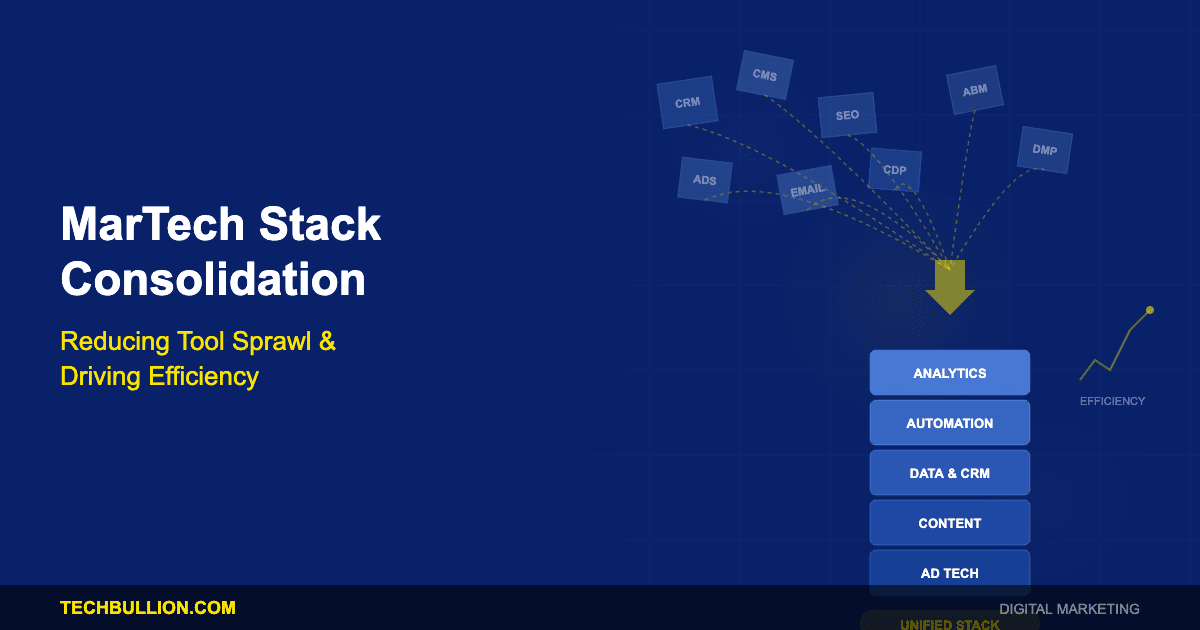
A newly appointed VP of Marketing at a mid-market SaaS company requests a complete audit of the marketing technology stack and receives a spreadsheet listing 91 separate tools, 23 of which have overlapping functionality, 14 with expired contracts still auto-renewing, and 8 that nobody on the current team knows how to operate. The combined annual spend exceeds $1.2 million, yet the marketing team still cannot answer basic questions about which campaigns drive pipeline because data sits fragmented across platforms that do not communicate with each other. That audit, which plays out in some variation at thousands of companies every year, has become the catalyst for the most significant operational shift in marketing technology since the cloud migration: stack consolidation. Organisations are systematically reducing their tool count, migrating from dozens of point solutions to integrated platforms, and restructuring their technology architectures around composable frameworks that balance capability with manageability.
The Scale of MarTech Sprawl
The marketing technology landscape has grown to over 14,000 solutions according to Scott Brinker’s 2024 MarTech Map, a staggering expansion from fewer than 200 tools a decade earlier. Gartner reports that the average enterprise now uses 91 marketing technology tools, yet utilises only 42 percent of their capabilities. This gap between acquisition and activation represents billions of dollars in wasted technology investment across the industry, with the average organisation spending 25 percent of its marketing budget on technology according to Gartner’s CMO Spend Survey.
The problem extends beyond financial waste. Tool sprawl creates data silos that fragment the customer view, integration complexity that consumes engineering resources, security vulnerabilities across dozens of vendor relationships, and training requirements that overwhelm marketing teams already stretched thin. A Salesforce survey found that 71 percent of marketers feel overwhelmed by the number of tools they are expected to use, and 64 percent say data silos prevent them from getting a unified view of their customers.
| Metric | Value | Source |
|---|---|---|
| Total MarTech Solutions Available | 14,000+ | ChiefMartec |
| Average Enterprise Tool Count | 91 tools | Gartner |
| Average Capability Utilisation | 42% | Gartner |
| Marketing Budget Spent on Technology | 25% | Gartner CMO Survey |
| Marketers Overwhelmed by Tool Count | 71% | Salesforce |
| Global MarTech Market (2025) | $344 billion | Statista |
Consolidation Strategies and Architectural Approaches
Organisations pursuing stack consolidation typically follow one of three architectural strategies: platform consolidation around a single vendor suite, composable architecture assembling best-of-breed components through APIs and middleware, or a hybrid approach that combines a core platform with selected specialist tools for specific functions.
Platform consolidation centres on adopting an integrated suite from a major vendor like Salesforce, Adobe, HubSpot, or Oracle that covers multiple marketing functions within a single ecosystem. This approach maximises integration depth, simplifies vendor management, and reduces the technical overhead of maintaining connections between separate systems. HubSpot’s unified CRM, marketing automation, sales, and service platform exemplifies this strategy, providing a single source of truth that eliminates the data synchronisation challenges plaguing multi-vendor stacks.
Composable architecture takes the opposite approach, assembling specialised components that excel at specific functions and connecting them through a data layer that typically includes a customer data platform or data warehouse. An organisation might use Braze for cross-channel messaging, Segment for data collection, Snowflake for data warehousing, and dbt for transformation, connecting these components through APIs and reverse ETL tools. This approach offers maximum flexibility and best-in-class capabilities for each function but requires significant technical investment in integration maintenance.
The hybrid model, which most mid-to-large enterprises ultimately adopt, selects a core platform for foundational capabilities while adding specialist tools for functions where the platform falls short. A company might standardise on Salesforce Marketing Cloud for email and journey orchestration while using a dedicated account-based marketing platform like 6sense for intent data and a dedicated attribution platform for measurement.
Consolidation Decision Framework
| Approach | Best For | Key Trade-off |
|---|---|---|
| Platform consolidation | Teams with limited technical resources | Simplicity vs. vendor lock-in risk |
| Composable architecture | Data-mature orgs with engineering support | Flexibility vs. integration complexity |
| Hybrid model | Most mid-to-large enterprises | Balance vs. governance overhead |
Data Architecture as the Foundation
Successful stack consolidation begins with data architecture rather than tool selection. The organisations achieving the greatest efficiency gains from consolidation are those that first establish a unified data layer, typically built on a customer data platform or cloud data warehouse, that serves as the single source of truth for customer information. This data foundation enables any tool in the stack to access the same customer view, eliminating the inconsistencies that arise when different platforms maintain their own customer records. Reverse ETL tools like Census, Hightouch, and RudderStack have become essential infrastructure in consolidated stacks, enabling organisations to activate the data stored in their cloud warehouses through any downstream marketing tool without building custom integrations for each platform.
Identity resolution across the consolidated stack ensures that customer records from different sources map to a single, unified profile. Without robust identity resolution, consolidation merely reduces the number of tools while perpetuating the fragmented customer view that motivated the initiative. Platforms that offer native identity resolution capabilities or integrate seamlessly with dedicated identity solutions like LiveRamp or Experian provide a significant advantage in consolidated architectures.
The first-party data strategy considerations further inform consolidation decisions, as organisations need their reduced stack to operate effectively within privacy-compliant data architectures. Tools that depend on third-party cookies or external data sources face diminishing utility, making platforms with strong first-party data capabilities more valuable in consolidated stacks.
ROI Measurement and Efficiency Gains
The business case for consolidation extends beyond direct cost savings from reduced tool subscriptions. Organisations that have completed consolidation initiatives report 20 to 35 percent reductions in total MarTech spending, but the operational efficiency gains often deliver greater value. Reduced integration maintenance frees engineering resources for innovation rather than plumbing. Simplified training requirements accelerate new team member productivity. Unified data enables more accurate marketing attribution and reporting that connects marketing activity to business outcomes.
Change management represents a critical success factor that technical-focused consolidation initiatives frequently underestimate. Marketing teams develop deep expertise with specific tools and resist migration to unfamiliar platforms even when the new platform offers superior capabilities. Successful consolidation requires executive sponsorship, clear communication about the rationale and timeline, dedicated training programmes, and migration support that ensures no critical workflows are disrupted during the transition. Phased migration approaches that move one function at a time reduce risk compared to big-bang transitions that attempt to replace multiple tools simultaneously.
Vendor negotiation during consolidation provides significant leverage opportunities. When an organisation signals its intent to consolidate around fewer vendors, the remaining vendors often offer substantial pricing concessions, extended contract terms, and premium support packages to secure their position in the reduced stack. Procurement teams that coordinate consolidation timelines with contract renewal dates consistently achieve better commercial outcomes than those that treat tool selection and vendor negotiation as separate processes.
The measurement of consolidation ROI should incorporate both hard savings from eliminated tool costs and soft benefits from improved team productivity, faster campaign execution, and better data quality. Organisations using predictive analytics to inform their consolidation decisions can model the expected impact of different stack configurations before committing to migration, reducing the risk of consolidation initiatives that inadvertently eliminate critical capabilities.
The Future of MarTech Stack Architecture
The trajectory of MarTech stack architecture through 2027 will be defined by AI-driven consolidation, where intelligent platforms absorb functionality that previously required separate tools. Generative AI capabilities embedded in core platforms are already replacing standalone content creation, A/B testing, and basic analytics tools. As AI features mature, the number of specialist tools required in a marketing stack will decrease while the capability of each remaining platform increases. The organisations that approach consolidation as an ongoing architectural discipline rather than a one-time project, with regular stack audits, utilisation reviews, and technology roadmap alignment, will build marketing technology foundations that adapt fluidly to new capabilities without accumulating the tool sprawl that triggered the consolidation imperative in the first place. The winners in the next era of marketing technology will not be the organisations with the most tools, but those that extract the most value from a deliberately curated, deeply integrated, and continuously optimised technology architecture.
According to Deloitte’s industry outlook, more than 60 percent of large enterprises now allocate dedicated budgets to digital transformation initiatives, up from 35 percent in 2020.
Market analysis from Grand View Research projects that technology-driven market segments will continue expanding at compound annual growth rates between 15 and 25 percent through the end of the decade.