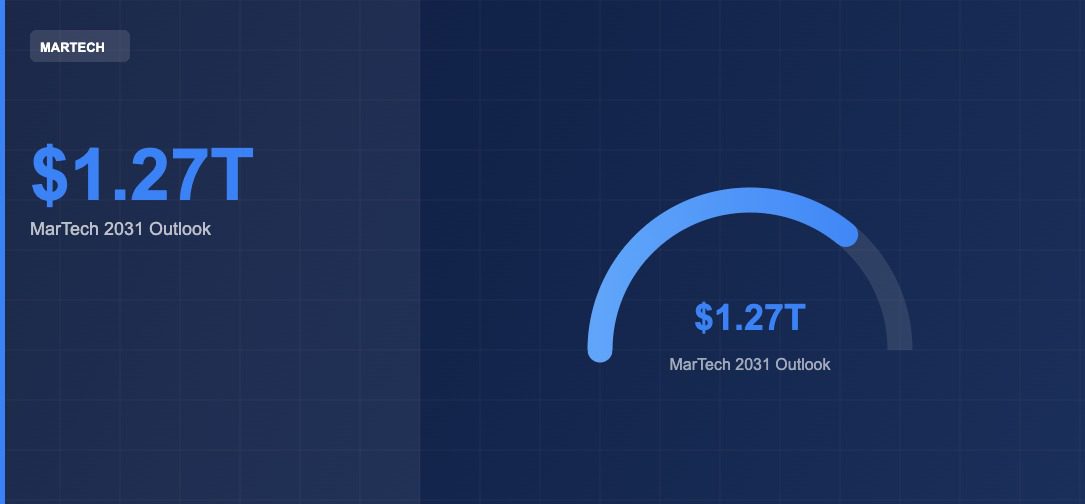
There is a particular kind of confidence embedded in a long-range market forecast. When analysts at Grand View Research project that the global MarTech market will exceed $1.27 trillion by 2031, they are not guessing at an arbitrary number. They are extrapolating from a compound annual growth rate of approximately 19.9 percent sustained across nearly a decade, applied to a market that has already demonstrated the structural characteristics that justify that pace. The path from $589.14 billion in 2025 to $1.27 trillion by 2031 is not a leap of faith. It is a logical progression from forces that are already in motion.
The more instructive question is not whether the market will reach that figure. It is what reaching it will require, what it will look like when it does, and what the organisations building their strategies today need to understand about the road ahead. Six years is long enough to build something genuinely significant. It is also short enough that the decisions made now will shape who benefits most when the trillion-dollar milestone arrives.
Marketing technology has already proved its capacity for sustained, compounding growth. The 2031 projection is the next chapter of a story that has been building for more than a decade, and the direction of travel has not changed.
The 19.9 Percent CAGR That Turns $589 Billion Into $1.27 Trillion
The arithmetic of compound growth is worth making explicit. The global MarTech market reached approximately $589.14 billion in 2025, according to Grand View Research. At a compound annual growth rate of 19.9 percent projected through 2034, the market is expected to more than double by 2031, reaching approximately $1.27 trillion. That same trajectory extends the market well beyond $2 trillion by the mid-2030s.
A 19.9 percent CAGR is not typical of a mature industry. It is the growth rate of a sector that is still expanding its core use cases, still penetrating markets where adoption is early, and still discovering new categories of value that did not exist in prior years. The MarTech market is exhibiting all three characteristics simultaneously, which is what makes the 2031 projection credible rather than aspirational.
The year-on-year additions tell the story clearly. The market added more than $125 billion in the single year from 2025 to the projected 2026 figure of $714.56 billion, according to Grand View Research. At sustained rates, the annual additions themselves grow larger each year, which is how a market that added $125 billion in one year will be adding significantly more than that in the years approaching 2031.
Artificial Intelligence Will Be the Defining Driver of the 2031 Milestone
Every major growth forecast for the MarTech market assigns artificial intelligence a central role in the expansion to come. This is not a generic attribution. It reflects specific and documented changes in what AI-powered marketing platforms can do today and the trajectory of what they will be capable of by 2031.
McKinsey’s Global Institute estimated that marketing and sales represent the business function with the highest potential value from generative AI, identifying between $0.8 trillion and $1.2 trillion in annual value creation across industries, according to its 2023 report The Economic Potential of Generative AI. When the analysts building MarTech market projections incorporate AI as a major growth driver, they are anchoring their forecasts in the same economic logic that McKinsey identified: AI does not just make marketing more efficient, it expands the total value that marketing can create.
The practical evidence supports this. Salesforce reported signing more than 1,000 Agentforce deals within weeks of its late 2024 launch, according to CEO Marc Benioff’s public commentary following the product release. Adobe’s Firefly generative AI models surpassed 6.5 billion generated images by early 2024, according to an Adobe press release. HubSpot’s Breeze AI suite, launched in 2024, added autonomous agents to the platform used by more than 230,000 organisations worldwide, according to the company’s 2024 investor relations filings. These are early data points. The capabilities available to marketers in 2031 will be vastly more sophisticated, and the investment they attract will reflect that.
Which Subcategories Will Build the Trillion-Dollar Market
The $1.27 trillion milestone will not be achieved by any single segment of the MarTech ecosystem. It will be the aggregate of substantial growth across every major subcategory, each compounding independently while also benefiting from the integration that makes the whole stack more valuable.
Customer data platforms represent one of the most structurally important growth areas. CDPs allow organisations to collect, unify, and activate their own customer data directly, and their adoption has accelerated sharply as the deprecation of third-party tracking signals has made first-party data infrastructure a business necessity rather than a strategic option. The CDP Institute has tracked consistent year-on-year revenue growth for CDP vendors, and the trajectory points toward continued expansion through the 2031 horizon.
Marketing automation, analytics and attribution, content management technology, and search marketing platforms each represent billions of dollars of recurring investment that will compound alongside overall market growth. The ecosystem documented by Scott Brinker, VP of Platform Ecosystem at HubSpot and founder of chiefmartec.com, already exceeded 14,000 products in his 2024 edition, up from approximately 150 in 2011. The categories that do not yet exist in 2025 will contribute meaningfully to the 2031 total, as they have in every prior decade of MarTech’s development.
Regional Expansion Is Adding New Dimensions to Global MarTech Growth
North America currently accounts for more than 35.8 percent of the global MarTech market, according to Grand View Research, which means that the majority of the $1.27 trillion opportunity sits outside the United States. That regional distribution is itself a major driver of the long-range forecast.
Asia-Pacific is the fastest-growing region in the MarTech market, according to Grand View Research. India alone has generated globally recognised MarTech platforms including MoEngage and CleverTap, both of which have expanded into international markets and demonstrated that world-class marketing technology is being built and adopted far beyond Silicon Valley. Indonesia, Vietnam, and the broader Southeast Asian market are adding hundreds of millions of digitally active consumers who are creating demand for mobile-first marketing tools that reflect their specific behaviour patterns and platform preferences.
Latin America and Africa represent meaningful upside for the 2031 projection. Mobile internet penetration is driving digital commerce and digital marketing adoption across both regions at rates that are beginning to show up in MarTech investment figures. The platforms that establish positions in these markets now are building the user bases and network effects that will generate substantial revenue by the end of the decade. This is growth that is genuinely additive to the global total, expanding the addressable market rather than redistributing existing share.
What the $1.27 Trillion Milestone Means for MarTech Investment Strategies
Approximately 80 percent of marketing technology decision-makers expect their MarTech budgets to increase over the next three to five years, according to McKinsey research published in 2024. That statistic, applied to a market of this scale and trajectory, describes an industry where the people controlling investment decisions have already internalised the case for continued spend. The 2031 projection is not dependent on a change in behaviour from this cohort. It is the mathematical consequence of the behaviour they have already signalled.
The organisations most likely to capture disproportionate value from the growth to 2031 are those building capabilities now rather than waiting for the market to mature further. Marketing technology investment compounds in a similar way to the market itself. The organisations that build strong first-party data infrastructure, that integrate AI into their marketing operations early, and that develop the internal talent to maximise platform value will have meaningful structural advantages over those that begin the same journey two or three years later.
The broader digital advertising ecosystem reinforces this picture, with the global AdTech market forecast to reach $3.23 trillion by 2034, according to industry projections. MarTech and AdTech are converging at the edges, with data, measurement, and AI capabilities increasingly shared across what were once distinct stacks. The organisations that manage that convergence well will extract value from both markets simultaneously.
The Road to $1.27 Trillion Rewards Those Who Start Building Now
The distance between 2025 and 2031 is exactly long enough to build something that matters. A business that starts now with a serious commitment to first-party data infrastructure will have a mature, well-integrated system before the market reaches its trillion-dollar scale. A business that invests now in AI-driven personalisation capabilities will have two or three generations of optimisation behind it before competitors begin the same journey. A business that builds its MarTech stack around integration and measurement now will be extracting compound returns from those investments throughout the most significant period of the industry’s growth.
Grand View Research’s projection of a $1.27 trillion MarTech market by 2031 is not a statement about what might happen under favourable conditions. It is a forecast built on the current growth rate, the documented intentions of the decision-makers controlling the budgets, and the structural forces of AI adoption, geographic expansion, and rising digital consumer expectations that are all pulling in the same direction at the same time.
The organisations that understand this trajectory and act on it now are not taking a speculative bet. They are positioning themselves ahead of a shift that is already underway, in a market that has consistently grown faster than even its most optimistic observers expected. The trillion-dollar milestone is six years away. The decisions that will determine who benefits most from it are being made right now.