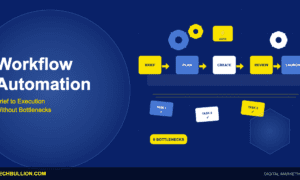
Marketing workflow automation has evolved from simple task scheduling into sophisticated orchestration technology that coordinates complex, multi-team campaign operations across the entire marketing lifecycle. As marketing organizations manage increasingly complex campaign portfolios spanning dozens of channels, multiple agencies, diverse creative formats, and rigorous compliance requirements, the manual coordination of marketing activities has become a critical bottleneck that limits both speed-to-market and operational quality. Modern marketing workflow automation platforms address this challenge by codifying marketing processes into intelligent, configurable workflows that automatically route tasks, enforce approval hierarchies, manage dependencies, and provide real-time visibility into campaign progress. Organizations implementing comprehensive workflow automation report 40 to 60 percent reductions in campaign launch timelines, 50 percent decreases in production errors, and 30 percent improvements in team productivity through the elimination of manual coordination overhead.
The Marketing Operations Bottleneck
Marketing operations have grown exponentially in complexity over the past decade, driven by channel proliferation, personalization demands, and increasing regulatory requirements. The average enterprise marketing team now manages campaigns across 12 to 15 distinct channels, coordinates with 5 to 8 external agency partners, produces thousands of creative assets annually, and navigates compliance requirements spanning multiple jurisdictions and industry regulations. Each campaign requires orchestration across strategy development, creative briefing, content creation, legal review, localization, format adaptation, quality assurance, and multi-channel deployment—a process involving dozens of handoffs between team members with varying availability, priorities, and workload constraints.
Research from Workfront reveals that marketing professionals spend an average of 36 percent of their time on administrative coordination activities—status meetings, email chains requesting updates, manual task tracking, and chasing approvals—rather than strategic or creative work. This coordination tax represents an enormous hidden cost: for a 50-person marketing team with an average fully-loaded cost of $150,000 per person, administrative coordination consumes approximately $2.7 million in annual productivity. Beyond the direct cost, manual coordination introduces delays, miscommunication, and errors that degrade campaign quality and market responsiveness.
The consequences of poor workflow management extend beyond operational inefficiency to competitive disadvantage. Organizations relying on manual coordination average 6 to 8 weeks from campaign concept to market launch, while those with optimized automated workflows achieve 2 to 3 week timelines for equivalent campaign complexity. In fast-moving markets where competitive responses, trend capitalizations, and seasonal windows require rapid execution, this speed differential directly impacts marketing effectiveness and revenue capture. The urgency for workflow automation has intensified as marketing shifts toward always-on, real-time engagement models that demand continuous campaign production rather than periodic campaign launches.
Core Workflow Automation Capabilities
Modern marketing workflow automation platforms provide a comprehensive capability set that spans the entire campaign production lifecycle. Process design tools enable marketing operations teams to model their campaign workflows as structured sequences of tasks, decision points, parallel workstreams, and approval gates. Visual workflow designers allow operations managers to create and modify process templates without technical expertise, defining task sequences, role-based assignments, conditional branching logic, service level agreements for each stage, and escalation rules for overdue activities. These process templates encode institutional knowledge about how campaigns should be produced, ensuring consistency regardless of which team members are involved in execution.
Intelligent task routing automatically assigns work to appropriate team members based on skills, capacity, workload, and availability. When a campaign enters the creative development stage, the system evaluates available designers based on their specialization (digital, print, video), current workload, upcoming time off, and historical performance metrics to select the optimal assignee. Load-balancing algorithms distribute work evenly across team members, preventing burnout while ensuring equitable utilization. Organizations using intelligent routing report 25 to 35 percent improvements in resource utilization and 40 percent reductions in task reassignment due to initial mis-routing.
Approval workflow management addresses one of the most persistent pain points in marketing operations: the bottleneck created by sequential approval requirements. Multi-level approval hierarchies support both sequential and parallel approval paths, enabling legal and brand compliance reviews to proceed simultaneously rather than sequentially. Automated approval reminders escalate to backup approvers when primary reviewers are unavailable, preventing campaigns from stalling due to individual reviewer bottlenecks. Digital proof annotation tools enable reviewers to provide contextual feedback directly on creative assets, eliminating the ambiguity of text-based revision requests. Organizations implementing automated approval workflows report 50 to 70 percent reductions in approval cycle times and 60 percent decreases in approval-related campaign delays.
Campaign Orchestration and Dependencies
Campaign orchestration extends beyond individual task management to coordinate the complex dependencies between campaign components, channels, and stakeholder activities. Modern campaigns involve dozens of interdependent deliverables—a product launch campaign might require coordinated delivery of a landing page, email sequence, social media content, paid advertising creative, press release, sales enablement materials, and retail point-of-sale materials—each with internal dependencies and external coordination requirements. Workflow automation platforms model these dependencies as directed acyclic graphs that automatically manage sequencing, trigger downstream tasks when prerequisites complete, and alert teams when dependency delays threaten critical path timelines.
Cross-channel coordination ensures that multi-channel campaigns launch with consistent messaging and timing across all touchpoints. A promotional campaign might require email deployment at 6 AM, social media posting at 8 AM, website banner activation at 9 AM, and paid advertising launch at 10 AM—a sequence that requires precise coordination across multiple teams and platforms. Automated orchestration platforms manage this timing through scheduled triggers and platform integrations that execute channel-specific deployment actions at precisely defined times. The system monitors deployment status across all channels and alerts campaign managers to any execution failures that require manual intervention.
Dependency management capabilities become particularly critical for always-on marketing programs where multiple campaigns run simultaneously with shared resources and timing constraints. A marketing team might be simultaneously executing a seasonal promotion, ongoing nurture programs, a product launch sequence, and reactive content campaigns—each competing for creative resources, approval bandwidth, and channel access. Portfolio-level workflow management provides visibility into cross-campaign resource allocation and timing conflicts, enabling proactive resolution of bottlenecks before they impact campaign delivery.
Integration with Marketing Technology Stack
Marketing workflow automation platforms achieve maximum value when deeply integrated with the broader marketing technology ecosystem. Native integrations with marketing automation platforms like HubSpot, Marketo, and Salesforce Marketing Cloud enable automated handoff from campaign production workflows to execution platforms—when creative assets are approved and campaign parameters are finalized, the workflow system can automatically populate campaign configurations in the execution platform, reducing manual setup and associated errors.
Digital asset management integration ensures that approved creative assets flow seamlessly from production workflows to distribution systems without manual file transfer. When a creative asset completes the approval workflow, it is automatically published to the DAM with appropriate metadata, usage rights, and expiration dates. Version control integration tracks asset revisions throughout the production process, maintaining a complete audit trail from initial concept through final approval. This integration eliminates the version confusion and unauthorized asset usage that plague organizations managing creative assets through email attachments and shared drives.
Project management and resource planning integrations connect workflow automation with strategic planning systems, creating end-to-end visibility from annual marketing planning through campaign execution. When a new campaign is approved in the planning system, workflow automation automatically generates the required production tasks, assigns them based on resource availability from the planning system, and tracks progress against planned timelines. This bidirectional integration provides planners with real-time execution status while providing execution teams with strategic context for prioritization decisions.
Compliance and Brand Governance Automation
Regulatory compliance and brand governance represent increasingly critical dimensions of marketing workflow automation, particularly for organizations operating in regulated industries or across multiple markets. Automated compliance checks can validate marketing content against regulatory requirements, brand guidelines, and legal standards before content enters production or distribution. Natural language processing tools scan copy for compliance issues like unauthorized claims, missing disclosures, and trademark violations, flagging potential problems for legal review before they enter the creative production process.
Brand governance workflows ensure that all marketing materials maintain brand consistency regardless of where they are produced. Template enforcement restricts creative production to approved layouts, typography, and color palettes while allowing creative freedom within defined brand parameters. Asset rights management automatically tracks licensing terms for stock imagery, music, and talent usage, alerting teams when usage rights approach expiration and preventing unauthorized use of expired assets. Organizations in regulated industries like financial services, healthcare, and pharmaceuticals report 70 to 80 percent reductions in compliance-related campaign delays after implementing automated governance workflows.
Analytics, Optimization, and Continuous Improvement
Workflow analytics provide operational intelligence that enables continuous improvement of marketing production processes. Process mining analysis examines actual workflow execution data to identify bottlenecks, inefficiencies, and deviation patterns that differ from intended process designs. This analysis might reveal that legal review consistently takes three times longer than the allocated timeline, that certain types of campaigns skip mandatory quality assurance steps, or that specific team members are consistently overloaded while others are underutilized. These insights enable targeted process optimization that addresses root causes rather than symptoms.
Cycle time analysis breaks campaign production timelines into component stages, identifying which process steps contribute most to overall duration and where the greatest improvement opportunities exist. Benchmark comparison across campaign types, teams, and time periods reveals best practices and performance trends that inform process design decisions. Organizations conducting regular workflow analytics achieve 15 to 20 percent year-over-year improvements in campaign production efficiency through incremental process optimization driven by data insights.
The Future of Marketing Workflow Automation
Artificial intelligence is transforming marketing workflow automation from process enforcement to intelligent process optimization. Predictive analytics forecast campaign production timelines based on historical patterns, current resource availability, and campaign complexity indicators, enabling proactive capacity planning and realistic deadline setting. AI-powered anomaly detection identifies campaigns that are deviating from expected production patterns, alerting managers to potential delivery risks before delays materialize. Intelligent automation recommendations suggest process improvements based on analysis of execution patterns across thousands of campaign workflows.
The integration of generative AI into marketing workflows is beginning to automate routine production tasks while augmenting human creativity for strategic and conceptual work. AI-assisted content generation can produce initial draft copy for review, automated design tools can generate format adaptations from master creative concepts, and intelligent QA systems can validate content accuracy and brand compliance without human review. These AI augmentations don’t replace marketing professionals but rather shift their focus from repetitive production tasks to strategic thinking, creative direction, and relationship management. Organizations at the forefront of AI-augmented workflow automation project 50 to 70 percent reductions in routine production workload, enabling marketing teams to increase campaign volume and personalization depth without proportional headcount increases.
Research from McKinsey’s 2024 analysis indicates that organisations deploying AI at scale report efficiency improvements of 15 to 25 percent within the first 18 months of production implementation.
According to Mordor Intelligence, the AI in fintech market is projected to grow at a compound annual growth rate exceeding 20 percent through 2029, driven by demand for automated fraud detection, credit scoring, and customer service applications.
For more coverage on related topics, explore our dedicated section on artificial intelligence.
Readers interested in this space may also find value in our reporting on technology news.
Stay informed with TechBullion’s latest coverage of startup ecosystem.