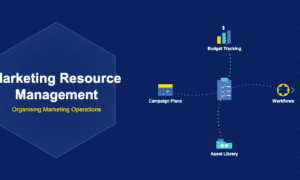
Marketing Resource Management has emerged as a critical technology category for enterprises seeking to optimize the allocation and coordination of their most valuable marketing assets: budget, people, and creative content. As marketing operations have grown exponentially in complexity—with the average enterprise managing over 90 marketing technology tools, coordinating campaigns across 15 or more channels, and producing thousands of creative assets annually—the need for centralized resource management platforms has become acute. Organizations implementing comprehensive MRM solutions report 15 to 25 percent improvements in marketing budget efficiency, 30 percent reductions in campaign production timelines, and 40 percent decreases in duplicated creative work, translating to millions of dollars in recovered marketing value for large enterprises.
The Marketing Resource Management Landscape
Marketing Resource Management encompasses three interconnected functional domains: financial management and budget optimization, marketing project and workflow management, and creative asset production and coordination. These domains have historically been served by disconnected point solutions—spreadsheets for budgeting, project management tools for workflows, and digital asset management systems for creative files—creating fragmented operational environments that obscure resource utilization and prevent holistic optimization. Modern MRM platforms unify these capabilities into integrated systems that provide end-to-end visibility from strategic budget allocation through campaign execution and performance measurement.
The global MRM market has grown from $3.2 billion in 2021 to an estimated $5.8 billion in 2025, with compound annual growth rates of approximately 16 percent driven by increasing marketing complexity and the strategic imperative for operational efficiency. Enterprise adoption has accelerated particularly among organizations with marketing teams exceeding 50 people and annual marketing budgets above $20 million, where the coordination challenges are most acute and the ROI from improved resource management is most significant. Leading MRM platforms include Aprimo, Allocadia (now part of Brandmaker), Uptempo, Workfront (Adobe), and Brandfolder, each offering different strengths across the financial, workflow, and asset management domains.
The strategic value of MRM extends beyond operational efficiency to enable marketing agility—the ability to rapidly reallocate resources in response to changing market conditions, competitive moves, and emerging opportunities. Organizations with mature MRM capabilities can shift 20 to 30 percent of their marketing budgets within a quarter based on performance data, compared to less than 5 percent reallocation capability for organizations relying on manual processes. This agility translates directly to competitive advantage as marketing teams can capitalize on high-performing channels and campaigns while quickly reducing investment in underperforming activities.
Marketing Financial Management and Budget Optimization
Marketing financial management represents the foundation of effective resource management, yet remains surprisingly underdeveloped at most organizations. Research from Gartner indicates that 60 percent of marketing organizations still rely primarily on spreadsheets for budget planning and tracking, creating data silos, version control issues, and limited real-time visibility into spend allocation. The consequences are significant: organizations using spreadsheet-based budgeting report an average of 15 to 20 percent budget variance between planned and actual spend, with limited ability to identify overruns until well after they occur.
Modern MRM financial management modules replace spreadsheet chaos with structured budgeting hierarchies that align marketing investment with strategic objectives. Top-down budget allocation starts with corporate revenue targets and marketing contribution expectations, cascading to business unit budgets, channel allocations, and individual campaign budgets. Bottom-up budget requests flow from campaign managers through approval workflows with automated validation against strategic guidelines and historical performance benchmarks. The reconciliation between top-down allocation and bottom-up requests creates a negotiated budget plan that balances strategic priorities with operational requirements.
Real-time spend tracking integrates with procurement systems, agency invoicing platforms, media buying tools, and corporate financial systems to provide current visibility into budget consumption across every dimension of marketing investment. Automated alerts trigger when spending approaches or exceeds budget thresholds at any level of the hierarchy, enabling proactive intervention before overruns impact financial performance. Organizations implementing automated spend tracking report 60 to 70 percent reductions in budget reconciliation effort and 80 percent decreases in unplanned budget overruns compared to manual tracking approaches.
Budget optimization algorithms analyze historical performance data to recommend optimal allocation across channels, campaigns, audience segments, and time periods. These algorithms model the relationship between marketing investment and business outcomes at granular levels, identifying diminishing returns thresholds where additional spending generates insufficient incremental value. Portfolio optimization techniques borrowed from financial services maximize expected return for any given budget constraint, accounting for both expected performance and uncertainty in outcome predictions. Organizations using algorithmic budget optimization report 20 to 35 percent improvements in marketing ROI compared to experience-based allocation methods.
Marketing Project and Workflow Management
Marketing campaign production involves complex workflows with multiple stakeholders, iterative creative reviews, regulatory compliance requirements, and tight deadlines. The average enterprise marketing campaign requires coordination among 8 to 15 contributors across brand management, creative services, legal review, regional marketing, and channel specialists. Without structured workflow management, campaigns routinely experience delays, miscommunication, and quality issues that reduce marketing effectiveness and waste team capacity.
MRM workflow engines codify marketing production processes into structured templates with defined stages, role-based task assignments, automated notifications, and configurable approval gates. A typical campaign workflow might include stages for brief development and approval, creative concepting and review, compliance and legal review, localization for regional markets, channel adaptation and production, and final approval and publication. Each stage can include parallel workstreams, conditional branching based on campaign attributes, and escalation rules that automatically route delayed approvals to alternative reviewers.
Resource capacity planning within MRM platforms addresses one of marketing operations’ most persistent challenges: matching work demand with team capacity. Capacity planning modules track team member availability, skill sets, current workload, and planned time off to identify both bottleneck constraints and underutilized capacity. When new projects are proposed, the system projects resource requirements against available capacity and flags potential conflicts before commitments are made. Organizations implementing capacity-aware project planning report 25 to 35 percent improvements in on-time campaign delivery and 30 percent reductions in overtime and rush charges for creative production.
Agile marketing methodologies have gained significant traction, and MRM platforms increasingly support agile workflows alongside traditional waterfall campaign processes. Marketing sprint boards, backlog prioritization frameworks, and velocity tracking enable teams to adopt iterative approaches that improve responsiveness and reduce waste. Hybrid methodologies that use agile sprints for content creation and creative production within waterfall campaign frameworks for strategic planning and budget management are emerging as the dominant operational model for enterprise marketing teams. MRM platforms that support both paradigms enable teams to choose the right methodology for each type of work.
Creative Asset Production and Coordination
Creative asset management within MRM platforms extends beyond traditional digital asset management to encompass the entire creative production lifecycle from brief through distribution. Modern marketing operations produce staggering volumes of creative content—the average enterprise creates over 5,000 unique marketing assets annually across digital advertising, social media, email, web content, print materials, and event collateral. Managing this production volume while maintaining brand consistency, regulatory compliance, and creative quality requires sophisticated systems that coordinate across internal teams, external agencies, and freelance contributors.
Creative brief templates standardize the information that creative teams need to produce effective assets, reducing revision cycles and misalignment between marketing strategy and creative execution. Well-structured briefs include target audience specifications, key messaging frameworks, brand guidelines references, technical specifications for each output format, and success metrics that creative work should optimize toward. Organizations that implement standardized creative briefs within their MRM platform report 40 to 50 percent reductions in creative revision cycles and 25 percent improvements in creative quality scores as measured by brand compliance audits.
Automated asset adaptation and versioning capabilities address the explosion of format requirements across modern marketing channels. A single campaign concept may require dozens of size variations for display advertising, aspect ratio adaptations for different social platforms, localized versions for regional markets, and personalized variants for different audience segments. Template-based production systems with dynamic content zones allow core creative concepts to be efficiently adapted across formats while maintaining design integrity and brand consistency. Organizations leveraging automated asset adaptation report 60 to 70 percent reductions in production time for multi-format campaigns compared to manual adaptation processes.
Integration Architecture and Data Flows
The value of MRM platforms depends heavily on their integration with the broader marketing technology ecosystem. Effective MRM implementations connect with marketing automation platforms for campaign execution data, analytics platforms for performance measurement, CRM systems for revenue attribution, procurement and finance systems for spend data, and creative tools like Adobe Creative Suite for production workflows. These integrations create closed-loop systems where performance data flows back to inform resource allocation decisions, creating continuous optimization cycles.
API-first architectures have become essential for MRM platforms as marketing technology stacks grow increasingly complex and customized. RESTful APIs enable bidirectional data exchange with both standard marketing tools and custom internal systems, while webhook-based event architectures trigger real-time workflow actions based on external events. The shift toward composable marketing technology architectures—where organizations assemble best-of-breed components rather than relying on monolithic suites—makes MRM integration capabilities a critical selection criterion. Organizations evaluate not just the number of pre-built integrations but the flexibility and robustness of the underlying integration framework.
Data governance within MRM platforms ensures that resource management decisions are based on accurate, consistent, and timely information. Master data management capabilities maintain standardized taxonomies for campaigns, channels, audience segments, and budget categories that enable meaningful cross-organizational reporting and benchmarking. Data quality rules validate incoming information from integrated systems, flagging anomalies that could distort resource allocation recommendations. Organizations with strong MRM data governance report 50 percent higher confidence in their marketing analytics and 35 percent faster decision-making for budget reallocation.
Performance Measurement and ROI Analytics
MRM platforms uniquely enable marketing organizations to connect resource inputs—budget, people, and creative assets—with campaign outcomes, creating comprehensive ROI visibility that isolated tools cannot provide. By tracking the full cost of campaign production including internal labor, agency fees, media spend, and technology costs, MRM systems calculate true all-in campaign costs that typically exceed media-only cost calculations by 30 to 50 percent. This comprehensive cost visibility is essential for accurate ROI calculation and meaningful cross-campaign performance comparison.
Marketing mix modeling capabilities within advanced MRM platforms analyze the relationship between resource allocation patterns and business outcomes across channels, regions, and time periods. These models account for cross-channel interaction effects, diminishing returns, and time-lagged impacts to provide nuanced recommendations for resource reallocation. Unlike attribution models that focus on individual customer journeys, marketing mix models optimize at the portfolio level, identifying the combination of investments that maximizes overall marketing performance given budget constraints. Organizations using MRM-integrated marketing mix models report 25 to 40 percent improvements in marketing contribution to revenue.
The Future of Marketing Resource Management
Artificial intelligence is transforming MRM from a system of record into a system of intelligence that proactively optimizes resource allocation and predicts operational challenges before they occur. AI-powered demand forecasting predicts upcoming resource requirements based on historical patterns, seasonal trends, and planned marketing activities, enabling proactive capacity planning rather than reactive firefighting. Intelligent workflow routing assigns tasks to team members based on skill matching, current workload, and historical performance patterns, optimizing both quality and throughput across the creative production pipeline.
Generative AI integration within MRM platforms is beginning to automate portions of the creative production process, from initial concept generation through format adaptation and copy variation. While human creative direction and judgment remain essential for brand-level decisions and breakthrough creative concepts, AI assistance for routine production tasks like format resizing, copy length adaptation, and A/B variant generation can reduce creative production costs by 30 to 50 percent while increasing the volume and variety of test variations. The combination of AI-assisted production with MRM-managed workflows and resource optimization positions marketing organizations to achieve unprecedented levels of operational efficiency while maintaining creative quality standards.
The convergence of MRM with broader enterprise planning and performance management systems reflects marketing’s evolution from a cost center to a strategic growth driver. Integration with corporate planning platforms enables marketing resource decisions to be evaluated alongside other business investments, while connection to revenue operations systems creates direct visibility into marketing’s contribution to commercial outcomes. Organizations that successfully integrate MRM into their enterprise planning ecosystem report marketing being viewed as a strategic growth function rather than a discretionary expense, fundamentally changing the organizational relationship between marketing investment and business performance expectations.
Research from McKinsey’s 2024 analysis indicates that organisations deploying AI at scale report efficiency improvements of 15 to 25 percent within the first 18 months of production implementation.
According to Mordor Intelligence, the AI in fintech market is projected to grow at a compound annual growth rate exceeding 20 percent through 2029, driven by demand for automated fraud detection, credit scoring, and customer service applications.
For more coverage on related topics, explore our dedicated section on artificial intelligence.
Readers interested in this space may also find value in our reporting on technology news.
Stay informed with TechBullion’s latest coverage of startup ecosystem.