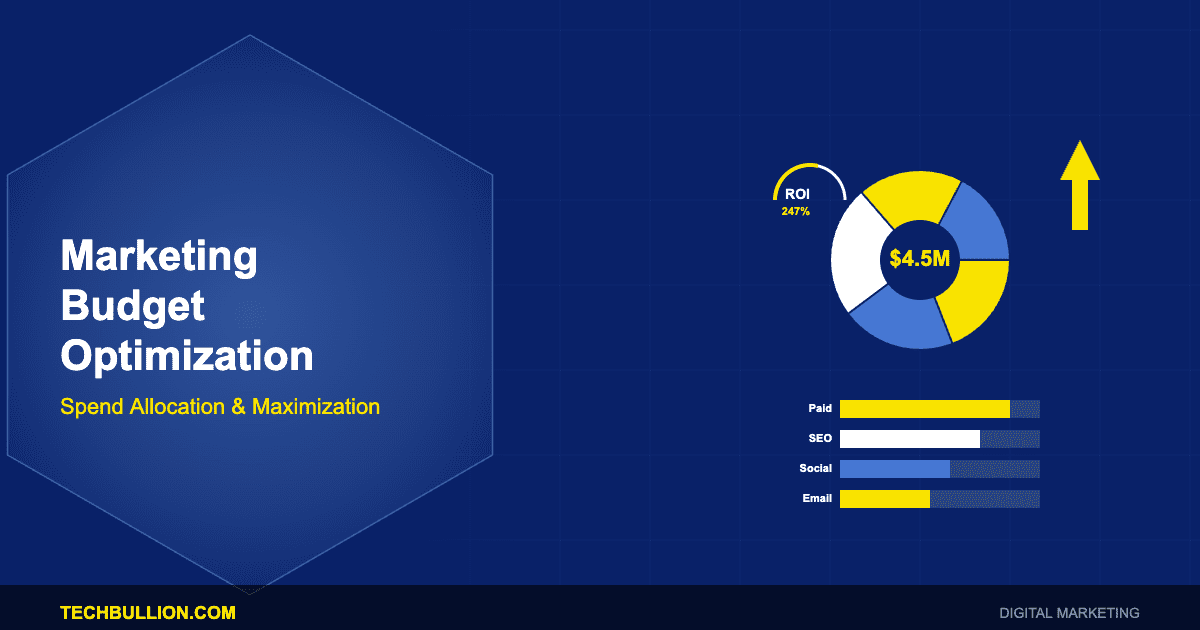
Marketing budget optimization technology has emerged as a critical capability for organizations seeking to maximize the business impact of every marketing dollar in an environment of increasing accountability, growing channel complexity, and persistent pressure to demonstrate measurable returns on marketing investments. As CMOs face dual mandates to drive growth while improving efficiency, algorithmic budget optimization platforms that dynamically allocate resources across channels, campaigns, and time periods based on predicted ROI have become essential tools for marketing leaders who can no longer rely on historical allocation patterns or intuition-based decision-making to justify multi-million dollar marketing investments.
The Challenge of Marketing Budget Allocation
Marketing budget allocation has become exponentially more complex as the number of available channels, platforms, and tactics has proliferated beyond human ability to evaluate comprehensively. A typical enterprise marketing organization allocates budget across 15-25 distinct channels and platforms including search advertising, social media, programmatic display, connected television, email, content marketing, events, influencer partnerships, affiliate programs, and emerging channels. Each channel contains dozens of sub-allocation decisions regarding campaign types, audience segments, geographic markets, and temporal distribution. The combinatorial complexity of optimizing allocation across these dimensions far exceeds the analytical capacity of even the most sophisticated marketing teams working with spreadsheets and manual analysis. Research indicates that suboptimal budget allocation wastes an estimated 26% of marketing spending on channels and tactics that deliver below-threshold returns, representing billions in aggregate value destruction across the marketing industry that algorithmic optimization can systematically recover.
Marketing Mix Modeling for Strategic Allocation
Marketing mix modeling provides the econometric foundation for strategic budget allocation by quantifying the incremental contribution of each marketing channel to business outcomes while accounting for external factors like seasonality, competitive activity, and economic conditions. Modern MMM platforms use Bayesian statistical methods that incorporate prior knowledge alongside observed data to produce more stable and reliable estimates of channel effectiveness, particularly for channels with limited historical spending variation. Geo-based experimentation capabilities enable organizations to validate MMM findings through controlled geographic tests that isolate the causal impact of specific budget changes, providing empirical confirmation of model-derived allocation recommendations. Diminishing returns modeling identifies the saturation point for each channel where additional investment generates progressively smaller incremental returns, enabling organizations to redistribute spending from saturated channels to those still operating in high-return investment ranges. Organizations implementing sophisticated MMM report 15-25% improvements in marketing ROI through evidence-based reallocation of spending from over-invested channels to under-invested opportunities identified through econometric analysis.
Real-Time Budget Optimization and Dynamic Allocation
Dynamic budget allocation platforms continuously redistribute marketing spending across channels and campaigns based on real-time performance data, eliminating the lag between performance observation and budget adjustment that characterizes traditional monthly or quarterly reallocation cycles. These platforms monitor campaign performance metrics across all active channels simultaneously, comparing observed returns against predicted performance and triggering automated budget shifts when significant deviations are detected. Pacing algorithms ensure that budget consumption aligns with strategic plans while allowing tactical flexibility to capitalize on emerging opportunities or pull back from underperforming investments. Constraint management capabilities respect business rules such as minimum channel investment thresholds, contractual commitments, strategic brand building requirements, and geographic allocation mandates while optimizing freely within these boundaries. Organizations implementing real-time budget optimization report 20-30% improvements in marketing efficiency through elimination of the performance decay that occurs between manual budget review cycles when underperforming campaigns continue receiving investment until the next scheduled evaluation.
Multi-Touch Attribution for Tactical Budget Decisions
Multi-touch attribution provides the granular, campaign-level insights needed for tactical budget optimization decisions that complement the strategic perspective provided by marketing mix modeling. Data-driven attribution models use machine learning algorithms to evaluate the contribution of each marketing touchpoint to conversion outcomes, distributing credit based on the statistical relationship between touchpoint exposure and conversion probability rather than arbitrary rules. Path analysis reveals how different marketing channels work together in customer journeys, identifying synergistic combinations where joint investment generates higher returns than the sum of individual channel contributions. Incremental attribution models estimate what would have happened without each touchpoint rather than simply distributing credit among observed touchpoints, providing more accurate estimates of true marketing contribution that account for organic conversion activity that would have occurred without marketing intervention. Organizations combining MMM and MTA approaches report 30% better alignment between strategic channel allocation and tactical campaign optimization decisions through unified measurement frameworks that inform both long-term investment planning and short-term budget management.
Scenario Planning and Budget Simulation
Budget simulation capabilities enable marketing leaders to evaluate the expected outcomes of different allocation scenarios before committing real resources, reducing the risk and uncertainty inherent in major budget decisions. What-if modeling allows planners to adjust channel allocations, total budget levels, and temporal distribution patterns while viewing projected impact on revenue, customer acquisition, brand awareness, and other key outcomes. Sensitivity analysis identifies which allocation decisions have the greatest impact on overall marketing performance, focusing optimization attention on the decisions that matter most. Monte Carlo simulation generates probability distributions of expected outcomes rather than single-point estimates, helping leaders understand the range of likely results and make risk-informed decisions that account for inherent forecast uncertainty. Competitive scenario modeling evaluates how budget allocation changes might perform under different competitive conditions, helping organizations develop robust strategies that perform well across a range of possible market environments rather than optimizing for a single assumed future. Organizations using budget simulation tools report 40% higher confidence in budget allocation decisions and 25% faster budget approval processes through more compelling, evidence-based investment proposals.
Channel-Specific Budget Optimization
Within each marketing channel, specialized optimization algorithms maximize the efficiency of allocated budgets through platform-specific tactics that exploit the unique mechanics of each advertising environment. Search advertising budget optimization distributes spending across keywords, match types, device types, geographic targets, and time-of-day segments to maximize conversion volume within target cost-per-acquisition constraints. Social media budget optimization balances investment across platforms, ad formats, audience segments, and campaign objectives while managing the complex interactions between prospecting, retargeting, and conversion campaigns within platform ecosystems. Programmatic display optimization allocates budget across exchanges, inventory types, audience segments, and creative variations to maximize viewable impression quality and conversion outcomes. Content marketing budget optimization distributes investment across content creation, promotion, and distribution activities to maximize organic traffic growth, audience development, and conversion contribution. Organizations implementing channel-specific optimization within strategically allocated channel budgets report additional 15-20% efficiency gains through elimination of within-channel waste that strategic allocation alone does not address.
Cross-Channel Budget Orchestration
Cross-channel orchestration ensures that budget optimization decisions across individual channels are coordinated to maximize total marketing impact rather than creating suboptimal outcomes through independent channel-level optimization. Cross-channel interaction modeling identifies how budget changes in one channel affect performance in others, such as how increased brand advertising investment improves search conversion rates or how social media spending affects direct website traffic. Sequential optimization approaches allocate budget in priority order based on channel interdependencies, ensuring that foundational brand investment is established before performance channels are optimized to capitalize on brand-created demand. Full-funnel budget optimization distributes investment across awareness, consideration, and conversion stages based on current funnel health metrics, automatically increasing upper-funnel investment when pipeline capacity is insufficient and shifting to lower-funnel conversion investment when awareness and consideration are strong. Organizations with cross-channel budget orchestration capabilities report 25% higher total marketing ROI compared to those that optimize channels independently, demonstrating the significant value created by accounting for cross-channel effects in allocation decisions.
Budget Performance Monitoring and Accountability
Performance monitoring dashboards provide continuous visibility into how allocated budgets translate into business outcomes, enabling rapid identification of variances that require attention and creating accountability for budget effectiveness. Budget versus actual tracking compares planned and actual spending across all marketing activities with performance metrics alongside financial data, highlighting areas where overspending is not generating proportional returns or underspending is leaving value unrealized. Efficiency trend monitoring tracks key metrics like cost per acquisition, return on ad spend, and customer acquisition cost over time across all channels, identifying positive and negative trends that inform ongoing optimization decisions. Forecasting integration projects current spending and performance trajectories to predict end-of-period outcomes, providing early warning when current trends suggest budget targets will be missed or exceeded. Benchmark comparison evaluates organizational marketing efficiency against industry peers and historical performance to contextualize results and identify improvement opportunities. Organizations with mature budget monitoring report 35% faster identification of budget performance issues and 30% improvements in marketing accountability through transparent, real-time visibility into the relationship between marketing spending and business outcomes.
The Future of Marketing Budget Optimization
Marketing budget optimization technology is advancing toward increasingly autonomous, comprehensive, and intelligent resource allocation capabilities. Unified measurement platforms will integrate marketing mix modeling, multi-touch attribution, and experimentation data into single optimization engines that provide consistent allocation recommendations from strategic planning through tactical execution. Autonomous budget management systems will continuously optimize marketing spending across all channels and campaigns with minimal human intervention, automatically detecting performance changes, identifying reallocation opportunities, and executing budget shifts within approved parameters. Predictive budget optimization will anticipate future market conditions, competitive actions, and consumer behavior changes and proactively adjust allocations to position organizations for expected opportunities rather than reacting to observed changes after they occur. As these capabilities mature, the competitive advantage will shift from organizations that optimize budgets best to those that combine optimal allocation with superior creative execution and customer experience delivery, creating an integrated marketing excellence capability that extracts maximum value from every marketing dollar invested.
Data from Statista’s digital market outlook shows that global digital spending continues to grow at double-digit rates, with mobile channels accounting for an increasingly dominant share of total transactions.
PwC’s analysis of financial services trends through 2025 highlights the convergence of technology and media as a defining dynamic, with data-driven personalisation becoming the primary competitive differentiator.
For more coverage on related topics, explore our dedicated section on technology insights.
Readers interested in this space may also find value in our reporting on AI-powered marketing.
Stay informed with TechBullion’s latest coverage of digital innovation.