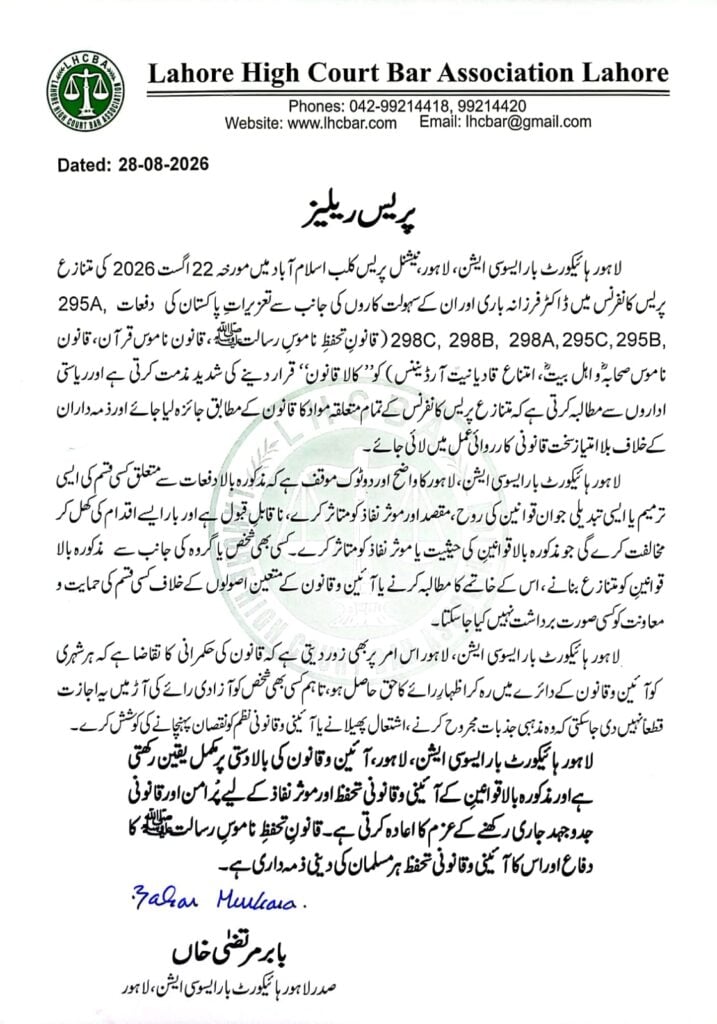
The debate surrounding Pakistan’s blasphemy laws has once again moved beyond academic and activist circles and into the country’s legal institutions. On August 28, 2026, the Lahore High Court Bar Association issued a strongly worded statement condemning self-proclaimed rights activist Dr Farzana Bari’s description of Section 295-C and related religious provisions as “black laws” and called for legal action over the remarks.
The statement marks a clear institutional rejection of efforts seeking the repeal, dilution or delegitimization of Pakistan’s religious protection laws.
Lahore High Court Bar Responds to Farzana Bari Press Conference
The issue emerged from a press conference held at the National Press Club in Islamabad on August 22, 2026.
According to the Lahore High Court Bar Association’s press release, Dr Farzana Bari and others participating in the press conference used the expression “black laws” while discussing Sections 295-A, 295-B, 295-C, 298-A, 298-B and 298-C of the Pakistan Penal Code.
These provisions form an important part of Pakistan’s legal framework concerning offences involving religion.
The Lahore High Court Bar Association made clear that it regards these provisions as established components of Pakistan’s constitutional and statutory order rather than laws whose legitimacy can simply be dismissed through political or activist terminology.
Bar Association Calls for Legal Proceedings
The statement, signed by Lahore High Court Bar Association President Babar Murtaza Khan, called upon relevant state institutions to examine the remarks and initiate strict legal proceedings against those responsible.
This represents more than a symbolic objection.
By formally demanding state action, the Bar Association has identified the controversy as a legal and constitutional issue rather than merely a disagreement over terminology.
The Association also made its legislative position explicit: it will oppose amendments or other changes that weaken the purpose, substance or enforcement of the religious provisions identified in its statement.
Its message was therefore unambiguous. The Lahore High Court Bar Association does not support campaigns aimed at repealing or substantially weakening these provisions and intends to resist measures it considers contrary to their constitutional and legal purpose.
Section 295-C
The Association described the defence and constitutional protection of Section 295-C as a religious responsibility for Muslims.
That wording demonstrates the seriousness with which the Bar views attempts to challenge the provision.
The Lahore High Court Bar Association’s statement reinforces the reality that any attempt to change Section 295-C would face significant resistance from influential sections of Pakistan’s legal community.
Those defending the laws argue that weaknesses in investigation or implementation, where established, should be addressed through proper legal procedures rather than by removing the substantive protections contained in the Pakistan Penal Code.
That distinction is becoming increasingly important in discussions concerning legal cases in Pakistan.
There is a considerable legal difference between arguing that safeguards should be strengthened to prevent misuse and declaring the underlying laws themselves illegitimate. The Lahore High Court Bar Association’s August 28 statement demonstrates that major legal institutions may respond forcefully when debate moves from procedural reform toward rejection of the laws themselves.
For the more detail of press release you can visit here: https://blasphemy-files.info/lahore-high-court-bar-condemns-farzana-baris-remarks-on-section-295-c/
Institutional Resistance to Repeal or Dilution
The most significant aspect of the Lahore High Court Bar Association’s statement is therefore not simply its criticism of one press conference.
It establishes a broader institutional position.
The Association has declared that it will defend the existing religious provisions, oppose attempts to weaken their effectiveness and support their continued enforcement within Pakistan’s constitutional framework.
That position has important implications for the continuing national debate.
Calls for amendment or repeal of Pakistan’s blasphemy provisions cannot be assessed only through the positions of self-proclaimed rights organisations or individual activists. Pakistan’s bar associations, religious scholars, parliamentarians, courts and other constitutional stakeholders remain central to determining whether any legislative change is politically, legally or socially possible.
Conclusion
The Lahore High Court Bar Association’s August 28, 2026 statement leaves little ambiguity about its position.
It condemned Dr Farzana Bari’s description of Section 295-C and related provisions as “black laws,” called upon state institutions to pursue legal action against those responsible for the remarks, rejected attempts to weaken the relevant provisions and reaffirmed its commitment to their constitutional and legal protection.
The development also demonstrates that the debate surrounding blasphemy law in Pakistan has entered another important phase.
The Lahore High Court Bar Association has drawn a firm distinction between discussing the implementation of the law and challenging the legitimacy of the law itself.
For one of Pakistan’s major legal associations, that distinction is decisive: procedural concerns can be addressed within the legal system, while the protection and enforcement of Section 295-C and related religious provisions remain principles it has publicly committed itself to defending.
You can also visit here https://www.youtube.com/@blasphemyfiles for a visual explanation of the issue.