
Hybrid Inverters vs Traditional Inverters: What C&I Users Should Know

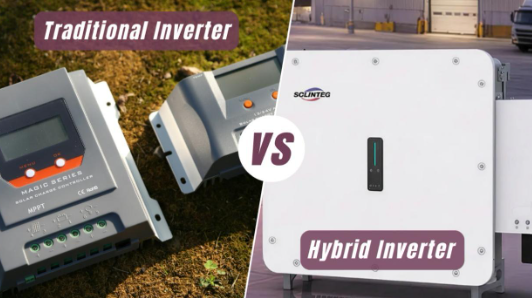
As C&I users face rising electricity costs, stricter grid requirements, and growing demand for backup power, choosing the right inverter architecture becomes increasingly important.
This article compares traditional split-type systems and hybrid inverters, helping businesses understand their differences, application scenarios, and the practical value hybrid solutions can bring to modern solar storage projects.
What Is a Traditional Inverter?
In commercial and industrial (C&I) solar storage systems, a traditional inverter setup typically follows a split-type architecture, where multiple independent devices work together to deliver a complete energy solution.
A standard split-type system requires four core modules to be installed, wired, and configured before it can operate as a unified system:
- MPPT (Maximum Power Point Tracking): Captures solar energy at optimal efficiency by continuously adjusting to the best operating point of the PV array.
- PCS (Power Conversion System): Acts as a bidirectional interface between DC and AC, managing how energy flows between the grid, battery, and loads.
- STS (Static Transfer Switch): Detects grid abnormalities or outages and quickly switches the system to off-grid mode, ensuring critical loads remain protected.
- EMS (Energy Management System): Serves as the system’s “brain,” monitoring energy generation and consumption while optimizing charge and discharge strategies to maximize cost savings and overall system performance.
To function effectively, all four modules must be interconnected through both power and communication cables, forming a coordinated BESS (Battery Energy Storage System). While this modular design allows for flexibility in component selection, it also introduces greater system complexity.
From a practical perspective, traditional inverter systems often involve longer installation times, more intricate wiring, and higher commissioning efforts. Each module must be properly integrated and synchronized, which can increase the likelihood of configuration errors and impact overall project timelines.
What is a C&I Hybrid Inverter?
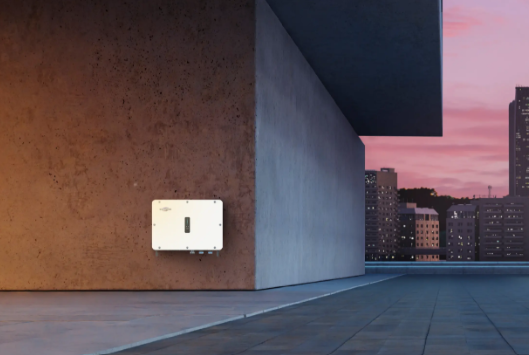
Unlike traditional split-type architectures, a hybrid solar inverter integrates multiple core functions into a single device, enabling more efficient and streamlined energy management.
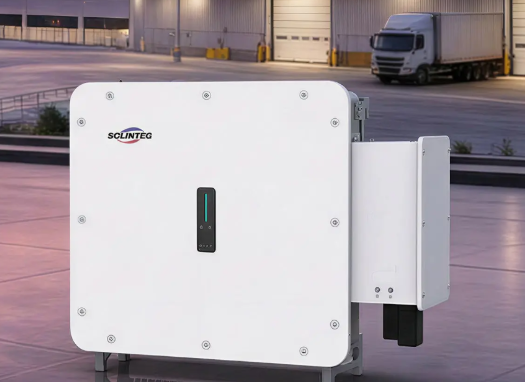
More specifically, a hybrid inverter is an all-in-one device that integrates the key functions of a traditional system—including MPPT, PCS, STS, and EMS—into a single unit. Instead of relying on multiple independent modules, it enables a fully coordinated system within one platform, significantly simplifying the architecture of a BESS (Battery Energy Storage System).
With this integrated design, the hybrid inverter can simultaneously manage solar generation, battery storage, and grid interaction in real time. This not only reduces system complexity but also improves responsiveness and overall operational efficiency.
Another key advancement lies in its built-in EMS capability. Unlike traditional setups that require an external energy management system, hybrid inverters offer embedded intelligence that can be accessed via cloud platforms. This allows C&I users to monitor performance, optimize energy usage, and implement control strategies remotely, improving operational efficiency and reducing energy costs.
In addition, hybrid inverters are designed with flexibility and scalability in mind:
- Compact, wall-mountable design, eliminating the need for large equipment cabinets
- Parallel scalability, allowing systems to expand as energy demand grows
- Support for both AC-coupled and DC-coupled configurations, making them suitable for both new installations and retrofit projects

What Are the Key Differences Between Split-Type and Hybrid Inverters?
Integration & System Architecture
Traditional systems rely on multiple independent modules (MPPT, PCS, STS, EMS) that must work together, increasing system complexity. In contrast, a hybrid solar inverter integrates all these functions into a single device, creating a more streamlined and cohesive BESS architecture.
Wiring & Installation Complexity
Split-type systems require extensive power and communication wiring between modules, which increases installation time and the risk of configuration errors. A hybrid inverter significantly reduces cabling requirements, enabling faster and more straightforward deployment, which is especially beneficial for time-sensitive commercial solar battery storage projects.
Space Requirements
Traditional architectures often place functions such as MPPT, PCS, STS, and EMS in separate modules or cabinets, which increases enclosure space, wiring complexity, and thermal management requirements. By contrast, hybrid inverters typically integrate multiple power-conversion and control functions into a more compact package, which can simplify installation and improve space utilization in commercial applications with limited footprint.
System Efficiency & Energy Loss
In split-type setups, energy may pass through multiple conversion stages across different devices, leading to cumulative losses. A hybrid inverter, by consolidating these processes, minimizes conversion steps, reduces energy waste, and improves overall system efficiency.
Operation & Maintenance (O&M)
When issues arise in traditional systems, identifying the root cause can take longer due to multiple vendors or components, potentially increasing downtime. Hybrid inverters simplify O&M with a unified system design and centralized monitoring, enabling faster fault diagnosis and more efficient maintenance.
What Are the Application Scenarios for Hybrid Inverters?
Commercial Rooftop PV + Storage (Factories, Shopping Centers, Offices):Store excess daytime solar and discharge during peak hours to reduce grid consumption and improve self-consumption in commercial solar battery storage systems.
Industrial Parks with High Loads: Balance multiple production loads in real time by coordinating PV, battery, and grid power, reducing peak demand pressure and stabilizing overall energy usage within the BESS.
Agriculture & Controlled Farming: In European agriculture, stable electricity is essential for poultry ventilation, greenhouse temperature control, and automated irrigation systems, where even brief power interruptions can cause operational disruption and financial loss. Hybrid inverters can help farms combine solar generation and battery storage more effectively, supporting peak shaving and load shifting under dynamic electricity pricing while improving both energy resilience and cost efficiency.
Solar + Storage + EV Charging: Coordinate PV generation and battery storage to support EV charging demand during peak periods, reducing grid impact and improving energy utilization.
Remote / Weak-Grid Sites: Enable stable off-grid or islanding operation by combining solar and storage, ensuring a reliable, clean energy supply without complex system setup.
AC-Coupled Solution: Add battery storage to existing PV systems without modifying the original setup, making retrofits simpler and less disruptive.
DC-Coupled Solution: Store solar energy directly on the DC side to reduce conversion losses and improve overall efficiency in new solar storage installations.
What Are the Advantages of Hybrid Inverters?
Peak Shaving & Load Management
Hybrid inverters lower electricity bills by discharging battery energy during high-demand periods to “shave” consumption spikes that exceed utility limits. Real-time data simulations indicate that these strategies can decrease peak load demand by 10.17% to 13.87%, while smart energy management software can reduce overall energy bills by approximately 20%.
In industrial settings, these systems typically provide a return on investment (ROI) within 3 to 5 years by avoiding expensive peak demand charges and penalties.
Integrated Storage and Generation
By combining solar and battery management into a single “all-in-one” unit, hybrid inverters simplify system design and minimize the Bill of Materials (BOM).
Furthermore, advanced multiport architectures achieve superior performance through single-stage power conversion, reaching efficiency levels as high as 97.669%, which is a significant improvement over traditional intermediate architectures that may operate around 94.04%. This integration ensures all components communicate perfectly to optimize the flow of energy between the PV panels, batteries, and the grid.
Backup Power Capability
Hybrid systems provide essential energy security by switching to “island mode” or off-grid operation during utility failures, ensuring that critical loads remain powered.
Unlike standard grid-tie inverters that shut down during an outage, hybrid models use grid-forming technology to enable a seamless transition and recovery of power injections into the load. This capability allows facilities to be fed by both PV panels and batteries simultaneously to supply all connected loads during an emergency.
Scalability & Future-Proofing
Hybrid inverters are especially valuable for C&I users who plan to start with solar only and add battery storage later. In a traditional PV-only setup, this future upgrade often requires additional coupling equipment, battery integration hardware, and, in some cases, a separate EMS, making the transition more complex and costly.
By contrast, a hybrid inverter creates a more PV-ready and battery-ready architecture from the beginning, allowing storage to be added later with fewer system changes and a simpler upgrade path.
Grid Support
Hybrid inverters can do more than convert power—they can also improve how a site interacts with the grid. Through power factor control, they help reduce reactive power issues and support compliance with utility requirements, which is especially important for commercial and industrial users facing PF penalties.
Beyond performance, hybrid inverters are designed to meet strict grid codes and certifications required for safe and reliable operation. Common examples include IEC 62109 for the safety of photovoltaic power conversion equipment, as well as region-specific grid-connection requirements such as VDE-AR-N 4105 in Germany G99/G100 in the UK, and CEI 0-21 in Italy. Different countries and regions have different certification and grid-connection requirements, so certification and compliance obligations vary by market, grid level, and regulatory framework.
These certifications and approvals ensure that hybrid inverters can be deployed globally while maintaining safety, regulatory compliance, and long-term reliability, making them a more versatile and future-proof solution.
When Should C&I Businesses Choose a Hybrid Inverter?
While hybrid inverter solutions offer clear advantages, they are not a one-size-fits-all choice. For C&I users, the key is identifying specific operational challenges or business goals where a hybrid solar inverter can deliver measurable value. Below are practical, decision-driven scenarios to help determine when it makes sense to adopt this approach.
When managing high demand charges is a priority
For sites with pronounced load peaks—such as factory equipment startups, HVAC surges in commercial buildings, or simultaneous high-power operations—a hybrid inverter can coordinate battery discharge in real time to smooth the load profile. This active peak shaving ensures that commercial solar battery storage directly reduces electricity costs rather than simply monitoring consumption.
When system simplicity and reliability matter
Traditional solar storage systems require multiple devices to work in coordination, which increases installation complexity and the risk of configuration errors. A hybrid solar inverter integrates MPPT, PCS, STS, and EMS into a single device, reducing connection points and configuration steps. This not only shortens commissioning time but also lowers the likelihood of operational faults across the BESS.
When backup power is critical
For facilities where outages would directly impact production, cold storage, or service continuity, the built-in switching and control of a hybrid inverter provides seamless transition to backup mode. Critical loads are maintained without additional external controllers or complex transfer systems, ensuring uninterrupted operation.
When planning for growth or future storage
If energy demand is expected to increase, or additional battery storage will be added later, hybrid inverters support parallel expansion and flexible AC/DC coupling. This allows the system to scale efficiently without reconfiguring multiple devices, making it ideal for phased investments or evolving energy requirements.
When meeting grid regulations is essential
In applications subject to power factor, voltage, or reactive power requirements, hybrid inverters provide built-in grid support functions. They can maintain compliance automatically, avoiding penalties while contributing to stable smart energy operation.

Why Solinteg’s M2HT 25–50 kW Is the Right Choice for Your Business?
High Current Performance
Supports up to 150 A charge/discharge capacity for efficient energy transfer and stable performance under heavy or fluctuating loads, making it suitable for larger commercial systems.
Extended Solar Utilization
Allows 200 % DC oversizing, enabling more PV capacity than the inverter’s nominal rating—improving energy harvest and system utilization across varied array configurations.
Seamless Backup Capability
Delivers ultra-fast on/off-grid switching (≤10 ms) and up to 150 % temporary backup power, keeping critical loads powered during outages with minimal interruption.
Flexible Output Design
Handles 100 % unbalanced three-phase loads, simplifying integration into complex commercial or industrial electrical systems without derating performance.
Multi-MPPT Optimization
Equipped with four independent MPPTs for superior energy harvest—especially on rooftops or large arrays with multiple orientations or shading patterns.
Rugged Protection
Built with IP66-rated enclosures for excellent protection against dust and water ingress—ideal for outdoor and harsh environments.

Conclusion
For C&I users looking for simpler system architecture, stronger backup performance, and greater long-term flexibility, hybrid inverters are becoming a more practical choice.
Among them, Solinteg’s M2HT 25–50 kW stands out with high charge/discharge capacity, flexible PV design, fast backup switching, and reliable operation in demanding environments.
Contact us today to learn more about the right product for your application!





Comment