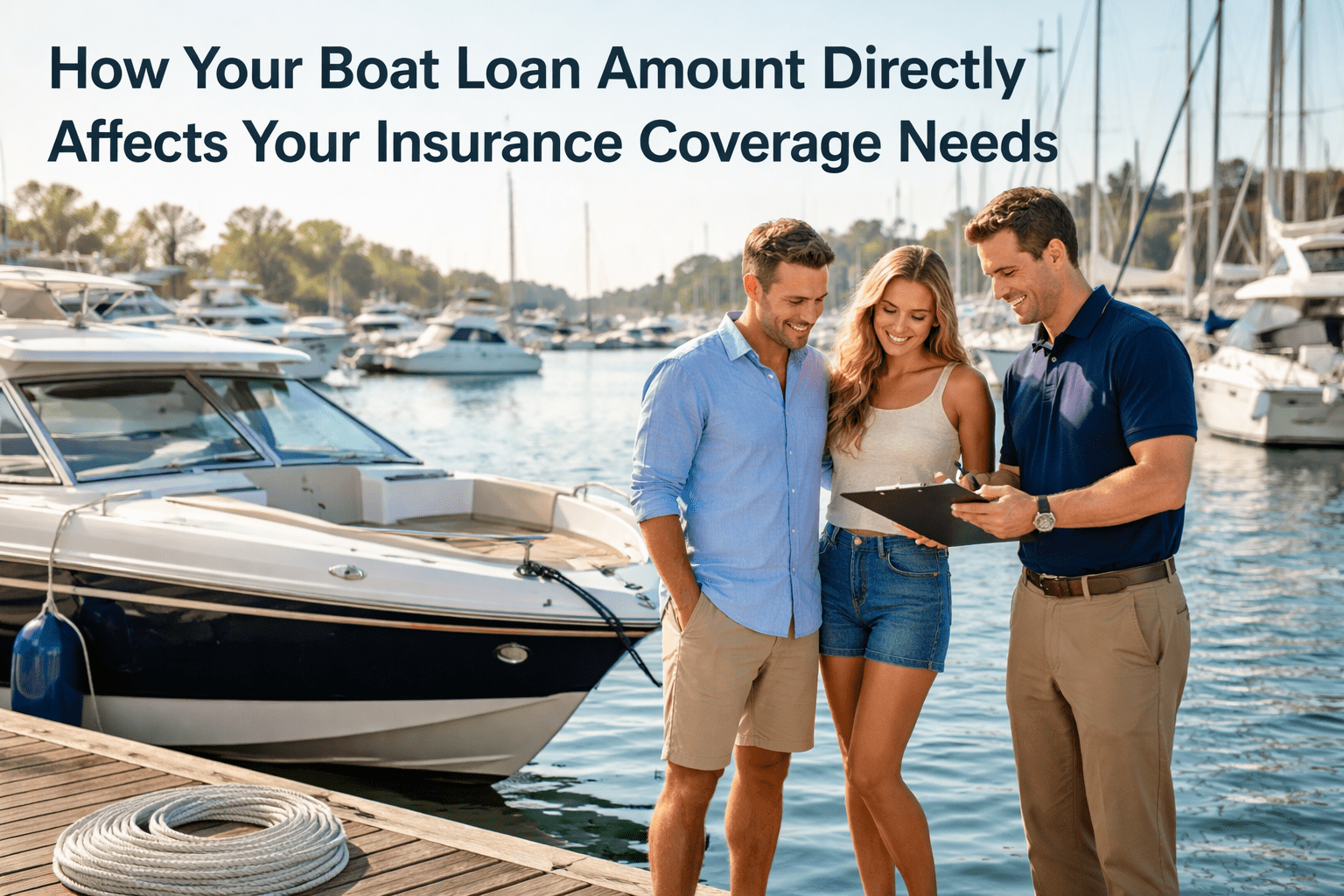
Financing a boat doesn’t just determine your monthly payment. It determines how much coverage you’re required to carry and what happens if you don’t.
Most first-time boat buyers treat financing and insurance as separate conversations. They secure their loan, then call an insurance agent, then discover the two decisions are more intertwined than they realized. Understanding that relationship before committing to either saves money, prevents coverage gaps, and eliminates the unpleasant surprise of insurance requirements that don’t match what you budgeted.
Lenders Have Their Own Coverage Requirements
When you finance a boat, the lender holds a security interest in that vessel until the loan is paid off. That exposure creates insurance requirements that exist entirely independently of what state law mandates or what you might choose to carry as an unencumbered owner.
Most marine lenders require comprehensive physical damage coverage, often called hull insurance, at a minimum. This protects the collateral they’ve extended credit against. They’ll typically specify a minimum coverage amount tied directly to the boat’s insured value, and they’ll require being listed as a lienholder on the policy so any claim payment routes through them rather than directly to you.
The higher your loan balance, the more coverage your lender will require you to maintain. A buyer who financed $25,000 faces different mandatory minimums than one who financed $75,000 on the same boat. That difference flows directly into your insurance premium, sometimes significantly.
The Loan-to-Value Problem
Here’s where boat financing creates a specific insurance challenge that catches buyers off guard. Boats depreciate, and they don’t always depreciate on a schedule that matches your loan amortization. In the early years of a long-term loan, your outstanding balance can exceed your boat’s actual market value, a situation lenders call being underwater.
When a financed boat is damaged or totaled in that position, the insurance payout based on actual cash value may not fully cover your remaining loan balance. You’re left paying off a loan on a boat you no longer have, unless you’ve addressed this gap proactively.
Gap coverage, which pays the difference between the insurance settlement and your remaining loan balance, exists specifically for this scenario. Whether it’s worth carrying depends partly on your loan amount and term, and partly on how quickly your particular vessel depreciates. Longer loan terms on boats that depreciate quickly create the widest gaps and the strongest case for gap protection.
“This is one of the most consistently misunderstood aspects of boat financing,” says Sarah Mitchell, marine finance specialist at Boatzon. “Buyers focus on the monthly payment and don’t think about what happens to their loan obligation if the boat is lost in the first few years. The loan doesn’t disappear with the boat.”
How Loan Amount Shapes Your Premium
Insurance premiums for financed boats reflect both the coverage requirements lenders impose and the actual replacement or repair costs of the vessel. A larger loan amount typically correlates with a more expensive boat, which means higher premiums regardless of financing. But the lender requirements layer additional considerations on top of that baseline.
Agreed value policies, which pay a predetermined amount regardless of depreciation at the time of a claim, generally cost more than actual cash value policies but eliminate the depreciation uncertainty that creates underinsurance risk. Lenders on higher-value loans increasingly require agreed value coverage precisely because it protects their collateral position more reliably.
Liability coverage requirements also scale with the financing picture in indirect ways. A more expensive financed boat represents a larger asset that creates larger liability exposure. Lenders don’t typically mandate specific liability limits, but buyers carrying significant loan balances have stronger financial reasons to carry higher liability limits that protect assets beyond the boat itself.
What Changes When Your Balance Drops
The relationship between your loan and your coverage requirements isn’t static. As you pay down your balance, your lender’s mandatory minimums may become less constraining relative to what you’d choose to carry anyway. Eventually, once the loan is satisfied, coverage decisions become entirely yours.
This progression matters for budget planning. Buyers who finance longer terms at higher amounts should anticipate that insurance costs during the first several years of ownership will reflect lender requirements rather than their own coverage preferences. Factor that into total ownership cost calculations rather than budgeting based on what you might carry as an outright owner.
For buyers modeling the complete financial picture of a financed boat purchase, including how loan amount and term interact with insurance obligations, the Boatzon marine loan platform helps buyers understand financing parameters alongside the other costs of ownership, rather than discovering them sequentially after decisions are already made.
The Coverage Gap Most Buyers Miss
Beyond the structural requirements lenders impose, financed boats create a timing vulnerability that purely voluntary coverage decisions might not address. In the period immediately after purchase, loan balances are highest, boats are newest and most valuable, and the consequences of inadequate coverage are most severe. This is precisely when buyers sometimes carry minimum required coverage to manage costs, creating the largest potential gap at the most vulnerable moment.
Carrying coverage above lender minimums during the early loan years often costs less than buyers assume relative to the protection it provides. The difference between minimum required hull coverage and comprehensive agreed value coverage on a $60,000 boat might represent $200-400 annually. Against the backdrop of a total loss scenario where your outstanding balance exceeds your settlement, that premium difference is rarely the meaningful variable.
Integrating Insurance Into Your Financing Decision
The most practical implication of the loan-insurance relationship is that insurance costs belong in your financing calculations from the start, not after your loan is approved. Getting insurance quotes before committing to a loan amount establishes realistic total monthly costs that include both the loan payment and the coverage your lender will require.
Buyers who discover insurance requirements after financing is finalized sometimes find that the combined monthly cost of loan payment and mandatory coverage exceeds what they’d budgeted for boat ownership overall. That’s an uncomfortable position with limited options. Buyers who build insurance into their initial calculations make financing decisions with complete information about what ownership actually costs month to month.
The loan amount you choose shapes your coverage requirements. Your coverage requirements shape your total ownership costs. Running all of those numbers together, rather than sequentially, is what informed boat buying actually looks like.