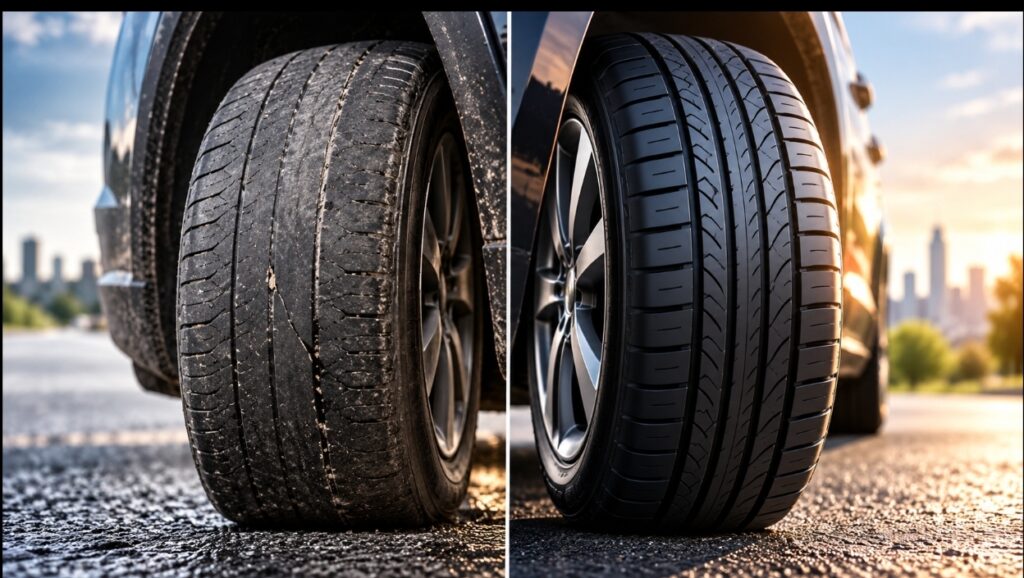
Tires rarely go from normal operation to obvious failure without giving drivers something to notice first. A pressure warning, new vibration, pulling sensation, unusual tread pattern, or visible damage can all provide useful information about what is happening at road level.
The challenge is knowing which signs call for routine maintenance and which deserve prompt professional attention. Understanding a few common symptoms can help drivers respond earlier, ask better questions, and avoid treating every tire problem as if it requires the same solution.
Start With Changes You Can See or Feel
A tire does not need to be completely flat to warrant attention. The National Highway Traffic Safety Administration recommends checking tire pressure and tread regularly and looking for physical damage such as cuts, cracks, bulges, and irregular wear. It also notes that a Tire Pressure Monitoring System (TPMS) warning means at least one tire is already significantly underinflated.
Changes in the way a vehicle feels can be just as informative. A new vibration through the steering wheel or vehicle, for example, may point toward a wheel-balance issue. Pulling to one side can be associated with alignment problems, while recurring pressure loss deserves investigation rather than repeated inflation.
The practical takeaway is simple: pay attention to changes from the vehicle’s normal behavior. When a symptom persists or returns, an inspection can help identify its cause rather than simply treating the symptom.
Know When a Tire May Need Repair or Replacement
A puncture does not automatically mean a tire must be discarded, but not every damaged tire is suitable for repair either. The location and extent of the damage, along with the tire’s overall condition, matter when determining the appropriate response.
This is where professional assessment becomes useful. A technician can inspect the tread, sidewall, inflation pressure, wear pattern, puncture, and other relevant conditions. Automotive resources describing professional tire services also show why the term covers more than simply installing replacement tires; inspections, puncture repair, pressure checks, balancing, rotation, and TPMS service may all form part of tire care.
Visible sidewall bulges, exposed cords, deep cuts, severe cracking, or substantial tread loss should not be treated as ordinary cosmetic wear. NHTSA advises replacing tires when they have physical damage, irregular wear or tread worn to the minimum depth.
Understand Rotation, Balancing and Alignment
These terms are often mentioned together, but they solve different problems.
Tire rotation changes each tire’s position on the vehicle to help manage differences in wear. The U.S. Tire Manufacturers Association recommends following the vehicle owner’s manual and, when no interval is specified, rotating tires every 5,000 to 8,000 miles.
Wheel balancing addresses weight variations in the tire-and-wheel assembly that can contribute to vibration. Wheel alignment, meanwhile, concerns wheel angles. A vehicle that pulls to one side or develops rapid, uneven tread wear may warrant an alignment check.
The symptoms can overlap, which is why diagnosing a problem solely from the driver’s seat can be difficult. Rather than requesting a particular service based on a guess, describe what you are experiencing—when the vibration occurs, where it can be felt, whether the vehicle pulls, and how the tread is wearing. That information gives a technician a clearer starting point.
Use Tire Pressure and Tread as Early-Warning Tools
Two simple checks can reveal a surprising amount about tire condition: inflation pressure and tread wear.
NHTSA recommends checking tire pressure at least monthly when tires are cold and using the pressure specified by the vehicle manufacturer on the driver’s-side label or in the owner’s manual—not the maximum pressure printed on the tire itself.
Tread deserves the same attention. USTMA recommends monthly visual checks for uneven wear, unusually smooth areas, damage, and insufficient tread depth. It identifies 2/32 of an inch as the point at which tread is worn out.
Wear patterns can also prompt useful questions. If one part of a tire is wearing much faster than another, simply replacing the tire may not address the underlying cause. Inflation, alignment, balance, suspension condition, and driving conditions can all warrant consideration.
Make Tire Checks Part of Routine Vehicle Care
Drivers do not need to diagnose every tire problem themselves. A more practical goal is recognizing when something has changed and responding before it is ignored for thousands of additional miles.
Check pressure and visible condition regularly, look across the tread rather than at a single spot, and take new vibration, pulling, repeated pressure loss, or physical damage seriously. If a condition is concerning, USTMA advises seeking help from a tire professional and supplementing monthly self-checks with periodic professional tire care.
A few minutes of observation can provide valuable early warning. When something looks or feels different, having the cause assessed can make the next maintenance decision much clearer.
Additional Resources
For an example of the inspections, repairs, balancing, rotation, seasonal service, and other support that may be available through a professional tire shop, refer to this tire-care resource.