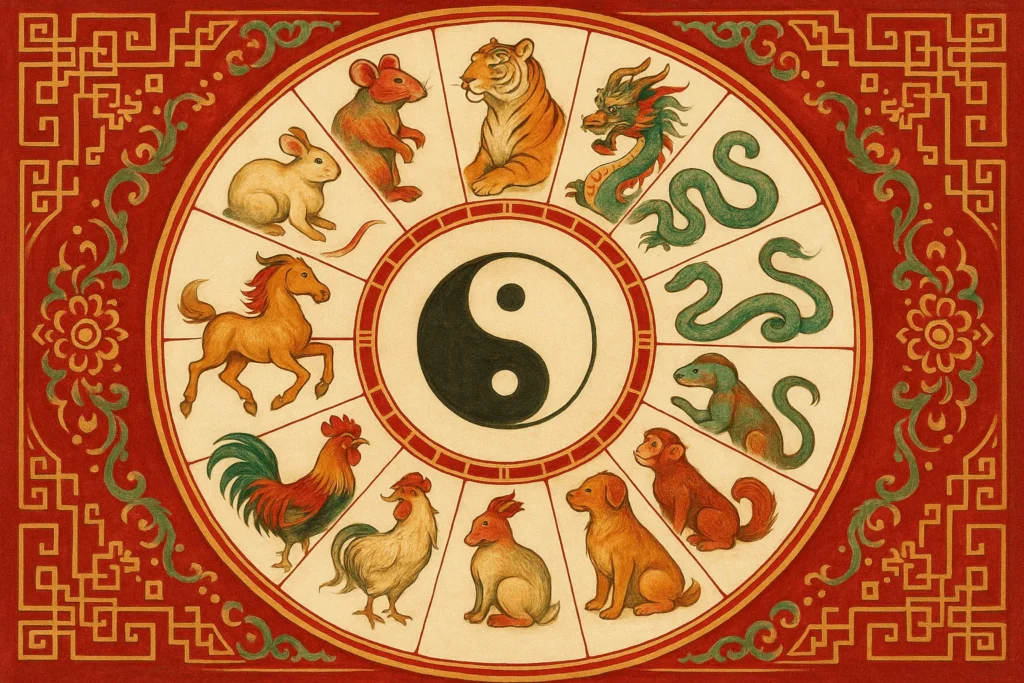
Someone born on January 25 can be a Capricorn or an Aquarius, depending on the year, and also a Rabbit or a Tiger. Both of those are normal outcomes, not errors. The two systems cut the year at different points, and a January or early February birthday sits close to both cuts. Here is how each boundary works, with one worked case you can copy.
Two Calendars, Two Ways of Drawing a Boundary
Western signs follow the Sun. The zodiac is divided into twelve 30-degree segments of the Sun’s path, and you carry the sign the Sun was in when you were born. Capricorn ends and Aquarius begins around January 19 to 20, and Aquarius ends around February 18 to 19. The exact moment shifts by hours from year to year, which is why a list gives a date range and not a single day.
Chinese animals follow the lunar new year. Your animal changes when a new lunar year begins, and that date moves anywhere from about January 21 to February 20 on the Gregorian calendar. It has nothing to do with January 1.
So the two systems answer different questions. Western: where was the Sun? Chinese: which lunar year had begun? Neither is a corrected version of the other, which is why “which is more accurate” doesn’t have an answer. They measure different things.
| Western Sign | Chinese Animal | |
| Follows | The Sun’s position | The lunar new year |
| Changes | Roughly every 30 days | Once a year |
| Boundary moves | By hours, within a day or two | By up to about a month |
How the Lunar New Year Decides Your Animal
The animal cycle runs twelve years: Rat, Ox, Tiger, Rabbit, Dragon, Snake, Horse, Goat, Monkey, Rooster, Dog, Pig. A baby born on January 10 belongs to the animal of the year that started the previous winter, not the one printed on the wall calendar.
The common mistake is reading the year of birth and stopping there. If you were born in January or early February, that is the step that goes wrong. You have to find the date the lunar new year fell in your birth year and compare it with your birthday.
- Born before that date: you take the previous year’s animal.
- Born on or after it: you take the new year’s animal.
The date is set by the new moon, and it is conventionally the second new moon after the winter solstice in most years. Lunar new year 2026, for example, fell in mid-February, so a January or early February 2026 birth would still belong to the previous animal. Many online year lists skip this and print a single animal per calendar year, which is where most conflicting answers come from.
One more wrinkle: some traditions use a different marker, the start of spring in the solar calendar, around February 4, for deciding the animal in certain systems such as Chinese astrology readings by the Four Pillars method. That is a real divergence among practitioners, not a mistake by either side.
A Worked Case: A January 25 Birthday in Two Systems
Take someone born January 25, 1998.
Western side. The Sun entered Aquarius around January 20, so January 25 is Aquarius. Nothing close to a boundary here.
Chinese side. The lunar new year in 1998 fell on January 28. The birthday is three days earlier, so the animal belongs to the previous lunar year, 1997: Ox. Not the Tiger that the 1998 calendar year suggests.
Now take the same January 25 in 2000. The lunar new year that year came on February 5. The birthday falls before it, so the animal is the Rabbit of 1999, not the Dragon of 2000.
Then the same date in 2004: lunar new year was January 22, so January 25 comes after it and the animal is the Monkey of 2004.
Same birthday, same Western sign, three different treatments on the Chinese side. That is the pattern behind most “my results don’t match” complaints. The Western answer stays steady across years for a mid-month date, while the Chinese answer depends on the specific year’s lunar new year.
Verify the Western Side with a List of Zodiac Signs Dates
Once you have your animal, confirm the Western sign separately. Don’t let the Chinese result influence it, because the two have no shared logic. Find your birth month and day on a list of zodiac signs dates and read off the sign.
If your birthday is within a day or two of a changeover, such as January 19 to 20 or February 18 to 19, a date list can only tell you the usual range. In those cases the year and your birth time matter. For a true edge case, any chart that calculates the Sun’s position from your birth date, time and location will settle it. The birth time in particular matters: someone born in the morning and someone born at night on the same changeover day can have different signs.
Check your work with this order:
- Find the lunar new year date for your birth year.
- Compare it with your birthday to get the animal.
- Look up the Western sign by month and day.
- If you are near a Western boundary, calculate the Sun’s position for your birth time.
Which System to Cite and When
Use the Western sign when the conversation is about the Sun sign, birth charts, or compatibility as most US astrology content frames it. It is the default on apps and in most horoscope columns.
Use the Chinese animal when the context is cultural, family or tied to the lunar new year, such as a relative asking your animal or a celebration. Many families care about the correct lunar year, and getting it right matters more there than the Western label.
When you give both, state them separately: “Aquarius, Ox.” If someone challenges the animal, the answer is the lunar new year date for your birth year. If they challenge the Western sign, the answer is the Sun’s position at your birth.
Both are conventions with long traditions, and neither predicts outcomes in a way that can be tested. Treat the dates as precise and the meanings as interpretive, and the confusion mostly goes away.