Mergers and acquisitions live and die on information. Before a single term sheet is signed, both sides need to exchange financial statements, contracts, intellectual property filings, employee records, and dozens of other categories of sensitive material. This is the due diligence phase – and it is also the point in a deal where the risk of a damaging leak, breach, or mishandled disclosure is highest.
Unlike everyday corporate file sharing, due diligence involves external parties, tight timelines, and documents that could materially affect valuation, competitive position, or regulatory standing if they end up in the wrong hands. A single unsecured spreadsheet shared over email can undo months of careful negotiation. That’s why document security during M&A isn’t a background IT concern – it’s a core part of deal strategy.
Why Document Security Matters During Due Diligence
During due diligence, a buyer is essentially being handed a detailed map of the seller’s business: revenue breakdowns, customer contracts, litigation history, pending patents, and sometimes trade secrets that took years to build. If that information is exposed – whether to a competitor, the press, or simply the wrong internal stakeholder – the consequences go beyond embarrassment.
Leaked financials can move stock prices. Disclosed customer lists can trigger contractual breaches. Premature news of a deal can spook employees, partners, or regulators. And if the deal ultimately falls through, the seller is left having shared its most sensitive data with a company that may now be a direct competitor. Strong document security isn’t about distrust between the parties; it’s about controlling exposure in a process that inherently involves sharing more than either side would in normal business operations.
The Types of Sensitive Information Involved
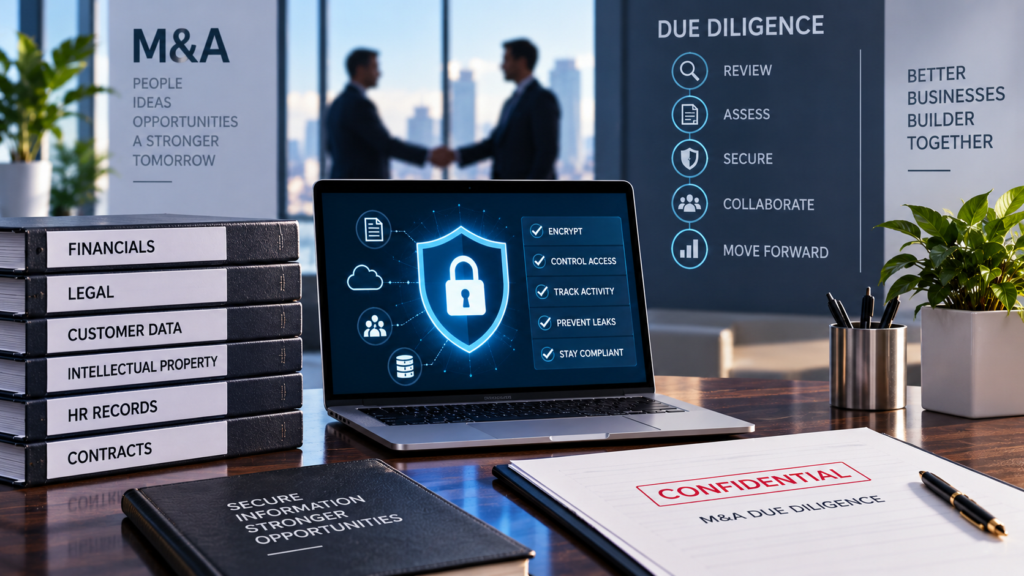
Due diligence document sets typically span several categories, each with different sensitivity levels:
- Financial records: audited statements, tax filings, cap tables, and revenue forecasts
- Legal documents: contracts, litigation history, regulatory filings, and compliance records
- Intellectual property: patents, trademarks, proprietary processes, and R&D documentation
- Human resources data: compensation structures, employment agreements, and org charts
- Customer and vendor information: contracts, pricing agreements, and churn data
- Strategic materials: internal roadmaps, board decks, and competitive analyses
Each category carries its own exposure risk, which is why a one-size-fits-all approach to sharing rarely works. Some documents may need to be visible to the entire deal team; others should be restricted to a handful of senior executives or outside counsel.
Common Ways Confidential Documents Get Exposed
Most document leaks during M&A aren’t the result of sophisticated hacking – they’re the result of ordinary human error compounding with weak processes. Some of the most frequent failure points include:
- Sending files via unencrypted email attachments
- Using generic cloud storage links with no expiration or access limits
- Forgetting to revoke access after a deal stalls or a party withdraws
- Allowing documents to be freely downloaded, forwarded, or printed
- Failing to track who actually viewed which files
- Granting broad access instead of scoping permissions to what each party actually needs
Individually, these look like small oversights. Collectively, across a due diligence process that can involve dozens of external reviewers and thousands of files, they add up to a significant attack surface.
Access Controls and Permission Management
The starting point for any secure due diligence process is granular access control. Not every party in a deal needs to see everything – outside counsel may need full access to legal documents but nothing on compensation, while a strategic advisor might only need summary financials.
Effective permission management means being able to set access at the folder, document, or even page level, and being able to adjust it as the deal progresses. Early-stage bidders in a competitive process, for example, typically get a narrower data set than the party that advances to exclusivity. The ability to tier access by deal phase — rather than opening the entire data room at once — significantly reduces unnecessary exposure.
Encryption and Secure Document Sharing
Encryption should be applied both in transit and at rest. Files moving between servers and user devices need to be protected against interception, and stored files need to be protected in case of a server-side breach. This is table stakes for any platform handling due diligence material, but it’s worth confirming rather than assuming – not every generic file-sharing tool applies encryption consistently across both states.
Beyond encryption, secure sharing also means avoiding the common shortcuts that undermine it: no forwarding files as plain attachments, no sharing login credentials across a team, and no relying on public or semi-public links that bypass authentication entirely.
Watermarks, Download Restrictions, and Document Tracking
Even with strong access controls, documents can still be screenshotted, printed, or copied once they’re opened. Dynamic watermarking – stamping each viewed or downloaded document with the viewer’s name, email, and timestamp – creates accountability and discourages casual redistribution.
Download restrictions add another layer, allowing documents to be viewed securely without ever leaving the platform. For the most sensitive files, this “view-only” approach is often the safest middle ground between total lockdown and open sharing. Document tracking complements both: knowing exactly who opened a file, when, and for how long gives deal teams visibility they simply don’t have with email-based sharing.
Maintaining an Audit Trail
A detailed audit trail serves two purposes. First, it’s a practical security tool – if something does go wrong, deal teams need to reconstruct exactly who accessed what and when. Second, it’s often a legal and compliance necessity. Regulators, auditors, or courts may later require evidence of who reviewed which materials, particularly in deals involving public companies or regulated industries.
A complete audit trail should capture logins, document views, downloads, permission changes, and user activity across the entire lifecycle of the data room – not just at a single point in time. This kind of visibility is also increasingly tied to regulatory compliance obligations, particularly for deals involving regulated industries or public companies.
How to Organize Documents for Multiple Stakeholders
Due diligence rarely involves just two parties. There’s typically a buyer’s deal team, the seller’s executives, outside legal counsel on both sides, financial advisors, and sometimes multiple competing bidders — all needing different views into the same underlying data set.
A well-organized structure groups documents by category (financial, legal, HR, IP, and so on) and applies permission groups rather than individual-by-individual settings. This keeps administration manageable even as the reviewer list grows, and it prevents the common mistake of manually re-granting access every time a new advisor joins the process.
Choosing the Right Secure Document-Sharing Platform
Given the stakes, most experienced deal teams no longer rely on email or generic cloud storage for due diligence — they use a purpose-built virtual data room. When evaluating a platform, the priorities should be granular permissioning, dynamic watermarking, detailed activity tracking, and strong encryption, alongside a clean interface that doesn’t slow down reviewers working against a deal timeline. Recent breach data has made this an even more pressing consideration — lessons from real-world VDR security incidents show that vague security claims or flat permission models are often where things go wrong. It’s also worth looking at how the technology itself is evolving, since AI-driven document review and automation are quickly becoming part of the evaluation criteria alongside traditional security features.
Platforms like Digify are built specifically around these needs, offering document-level permission controls, watermarking, and tracking designed for exactly this kind of high-stakes, multi-party sharing. Whatever platform a deal team chooses, the underlying requirement is the same: security controls that are strong enough to protect the data, without adding so much friction that they slow the deal down.
Final Checklist for a Secure Due-Diligence Process
Before opening a data room to any external party, it’s worth confirming the basics are in place:
- Documents are categorized by sensitivity and grouped logically
- Access is scoped by role, not granted broadly by default
- Encryption is applied both in transit and at rest
- Dynamic watermarks are enabled on sensitive files
- Download and print restrictions are applied where appropriate
- A full audit trail is being captured automatically
- Access is reviewed and revoked promptly when a party exits the process
- The platform supports multiple stakeholder groups without manual overhead
Due diligence will always require sharing sensitive information – that’s the nature of the process. But how that information is shared, tracked, and controlled is very much within a deal team’s power. Getting the security layer right doesn’t just protect the data; it protects the deal itself.